What Are Kepler's Three Laws
Interactive passage with audio narration, comprehension questions, and printable PDF.
By completing this purchase you agree to our Terms of Use and Privacy Policy. Your subscription renews automatically until you cancel. You can cancel anytime from your account settings. All sales are final and non-refundable. Digital content is available for download in your account immediately upon purchase.
What's included
What Are Kepler's Three Laws preview and details
About this printable What Are Kepler's Three Laws science reading passage, NGSS-aligned (Grades 5-8)
Sample passage and quiz from What Are Kepler's Three Laws
Reading passage and comprehension quiz preview
What Are Kepler's Three Laws
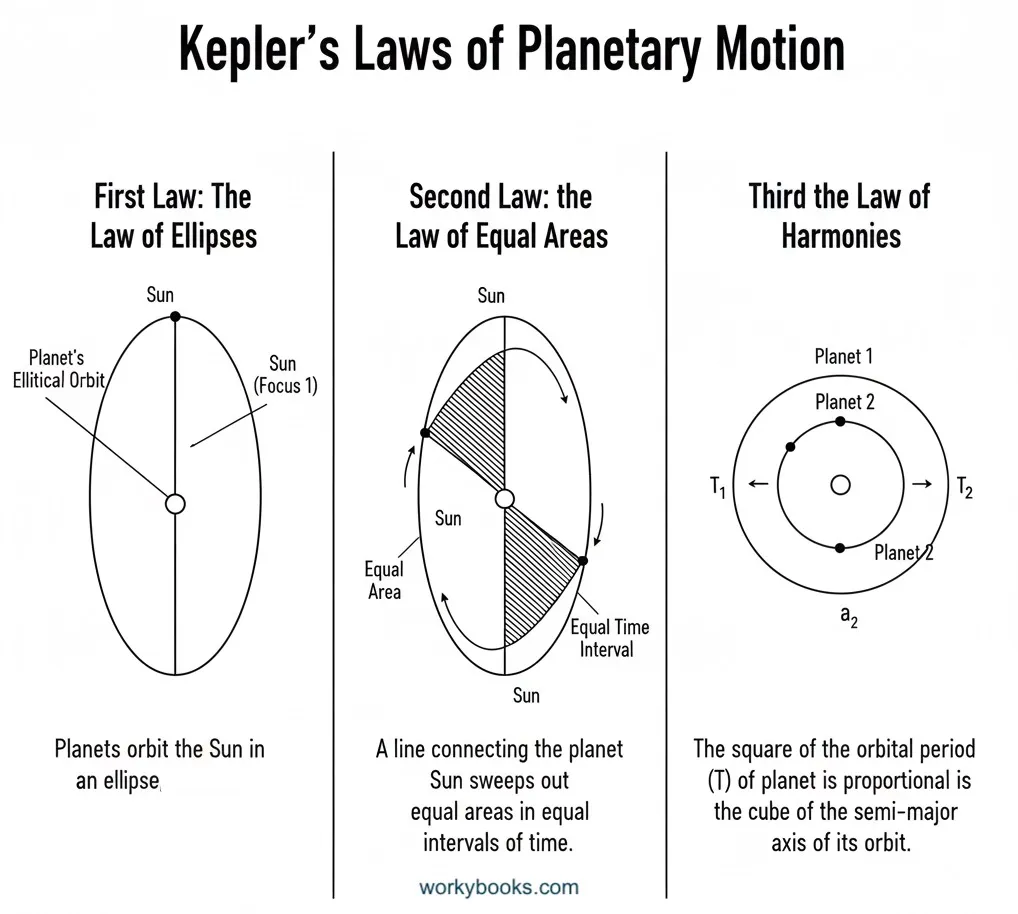
In the early 1600s, a German astronomer named Johannes Kepler discovered three important patterns about how planets move around the Sun. These patterns are called Kepler's laws, and they help scientists understand planetary motion throughout our solar system. Before Kepler, many people believed planets traveled in perfect circles. Evidence from careful observations showed this was not accurate.
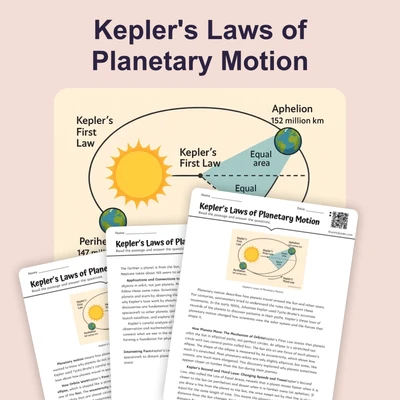
Kepler's First Law states that planets travel in ellipses, not circles. An ellipse is an oval shape, like a slightly flattened circle. The Sun sits at one focus point inside the ellipse, not at the center. This means planets are sometimes closer to the Sun and sometimes farther away during their orbit. Scientists can observe this pattern with telescopes and precise measurements.
The Second Law explains how planets move at different speeds along their orbital paths. When a planet is closer to the Sun, it travels faster. When it is farther away, it moves more slowly. Kepler described this by saying planets sweep out equal areas in equal times. Imagine drawing a triangle from the Sun to two positions of a planet. The area of that triangle stays the same whether the planet is near or far from the Sun, as long as the time period is equal.
Kepler's Third Law connects a planet's distance from the Sun to how long it takes to complete one orbit, called its orbital period. Planets closer to the Sun orbit faster and have shorter years. Planets farther away take much longer to complete their journey around the Sun. For example, Mercury orbits the Sun in just 88 Earth days because it is the closest planet. Neptune, being much farther away, takes about 165 Earth years to complete one orbit.
Mars provides a clear example of these laws in action. When Mars is closer to the Sun in its elliptical orbit, it moves faster through space. Astronomers can measure this change in speed and predict exactly where Mars will be at any future date. This predictability helps scientists plan space missions and understand the mechanics of our solar system.
These three laws matter because they revealed that the universe follows predictable patterns. Scientists use Kepler's laws to calculate spacecraft trajectories and discover planets around other stars. The laws also showed that careful observation and mathematical thinking can unlock secrets about how nature works. Understanding planetary motion helps us explore space and appreciate Earth's place in the solar system.
Interesting Fact: Kepler's laws also apply to moons orbiting planets and even artificial satellites orbiting Earth. The International Space Station follows the same patterns Kepler discovered over 400 years ago!
Comprehension quiz (10 questions)
1. What shape do planets travel in according to Kepler's First Law?
2. Where is the Sun located in a planet's elliptical orbit?
3. According to Kepler's Second Law, when does a planet move fastest?
4. What does the term 'orbital period' mean?
5. How long does it take Mercury to orbit the Sun?
6. What does Kepler's Third Law connect?
7. Why are Kepler's laws important for space exploration?
8. Which planet takes about 165 Earth years to complete one orbit?
9. Before Kepler, most people believed planets traveled in perfect circles.
10. Kepler's laws only apply to planets in our solar system and cannot be used for moons or satellites.
Perfect for the way you teach
- Build comprehension skills
- Auto-graded quiz
- Differentiated reading
- Read together at home
- Improve fluency
- Quiet reading time
- Reading curriculum support
- Independent practice
- Track Lexile growth