What Are Landslides
Interactive passage with audio narration, comprehension questions, and printable PDF.
By completing this purchase you agree to our Terms of Use and Privacy Policy. Your subscription renews automatically until you cancel. You can cancel anytime from your account settings. All sales are final and non-refundable. Digital content is available for download in your account immediately upon purchase.
What's included
What Are Landslides preview and details
About this printable What Are Landslides science reading passage, NGSS-aligned (Grades 5-8)
Sample passage and quiz from What Are Landslides
Reading passage and comprehension quiz preview
What Are Landslides
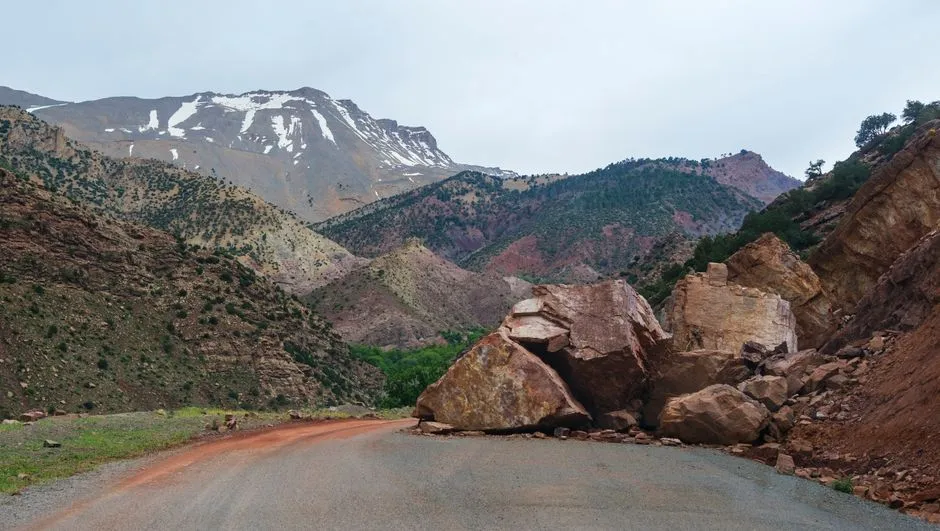
"A mountain road blocked by large rocks from a landslide with a snowy peak in the background." by pierre matile / Pexels.
A landslide is one of the most dramatic and dangerous forms of mass movement, the downhill movement of rock, soil, and debris under the force of gravity. In a landslide, a large amount of material suddenly breaks loose from a slope and rushes downward, sometimes in just seconds. Scientists explain that landslides can reshape entire hillsides in moments, making them serious natural hazards in mountainous regions around the world.
Evidence shows that several factors can trigger a landslide. Heavy rain is one of the most common causes because water soaks into the ground and adds weight to the soil. The water also reduces friction between soil particles, making the material more likely to slide. Earthquakes can shake slopes apart, breaking the bonds that hold rock and soil in place. Volcanic eruptions may melt snow and ice rapidly, creating flows of water and debris. Human activities such as construction or road building can also trigger landslides by cutting slopes too steep or removing vegetation that holds soil together.
Once the material starts moving, gravity pulls it downhill with tremendous force. The speed and size of a landslide depend on the slope angle, the type of material, and how much water is present. A large landslide can bury roads, destroy homes, and reshape entire valleys. In 2014, a massive landslide in Oso, Washington, buried a neighborhood and killed 43 people. Scientists observe that landslides are most common in areas with steep slopes, heavy rainfall, and weak or weathered rock.
Understanding landslides matters because these events pose real dangers to communities in hilly and mountainous areas. The same gravitational force that shapes Earth's surface over millions of years through erosion can also transform a hillside in a single afternoon. Scientists study past landslides and monitor slopes to predict where future landslides may occur. This research helps communities prepare and reduce risks in vulnerable areas.
Interesting Fact: The fastest landslides can travel at speeds over 200 miles per hour, faster than most cars on a highway!
Comprehension quiz (10 questions)
1. What is a landslide?
2. Which of the following is a common trigger for landslides?
3. What does the term 'mass movement' mean in the passage?
4. How does water contribute to landslides?
5. According to the passage, what happened in Oso, Washington in 2014?
6. Based on the passage, which area would most likely experience frequent landslides?
7. Why do scientists study past landslides and monitor slopes?
8. How can human activities trigger landslides?
9. True or False: Landslides always move slowly over many years.
10. True or False: The same force of gravity that causes landslides also shapes Earth's surface through erosion over millions of years.
Perfect for the way you teach
- Build comprehension skills
- Auto-graded quiz
- Differentiated reading
- Read together at home
- Improve fluency
- Quiet reading time
- Reading curriculum support
- Independent practice
- Track Lexile growth