What Are Neap Tides
Interactive passage with audio narration, comprehension questions, and printable PDF.
By completing this purchase you agree to our Terms of Use and Privacy Policy. Your subscription renews automatically until you cancel. You can cancel anytime from your account settings. All sales are final and non-refundable. Digital content is available for download in your account immediately upon purchase.
What's included
What Are Neap Tides preview and details
About this printable What Are Neap Tides science reading passage, NGSS-aligned (Grades 5-8)
Sample passage and quiz from What Are Neap Tides
Reading passage and comprehension quiz preview
What Are Neap Tides
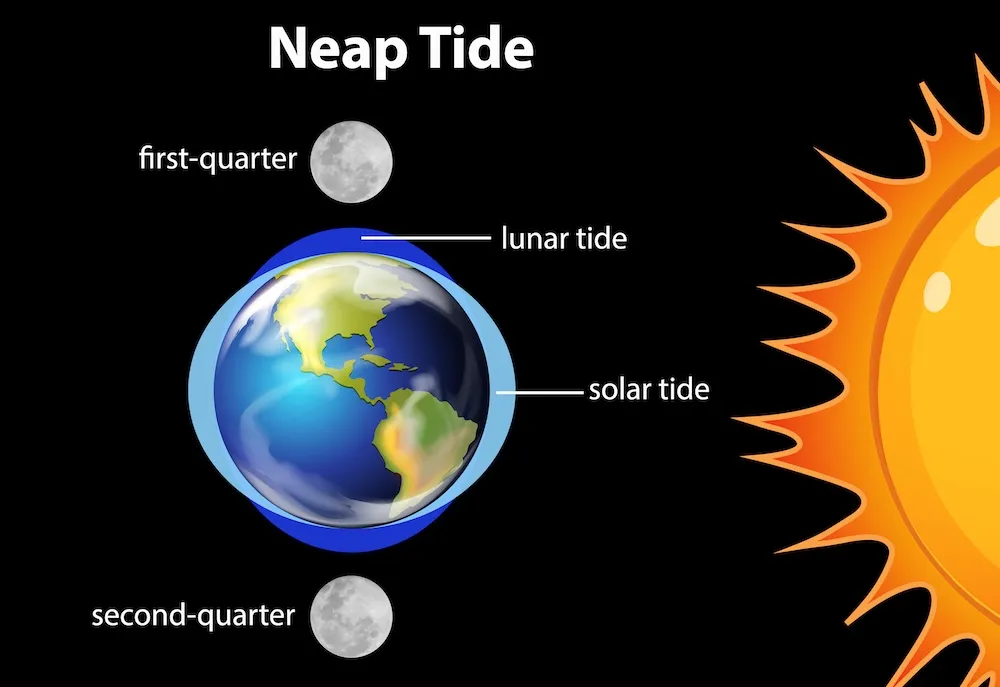
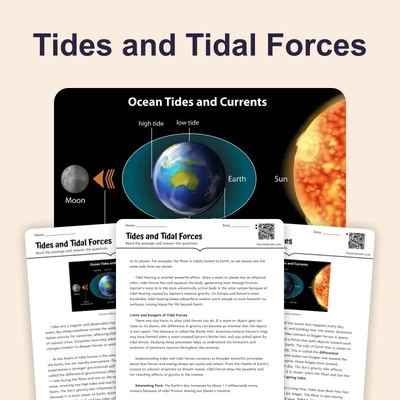
Neap tides are the weakest tides that occur each month. They happen twice during the lunar cycle when the Moon reaches its quarter phases. During these times, the Sun and Moon pull on Earth's oceans at right angles to each other. This positioning causes their gravitational forces to work against each other rather than together.
Scientists explain that gravity from both the Sun and Moon affects ocean water on Earth. When these two forces pull at right angles, they partially cancel each other out. Evidence shows this creates smaller differences between high and low tides. During neap tides, high tides are lower than usual. At the same time, low tides are higher than normal. The daily variation in water level becomes much less dramatic compared to other times of the month.
The term "neap" comes from an old English word meaning "barely enough." This name fits well because neap tides produce barely enough tidal movement. The tidal range, which measures the difference between high and low tide, can be 10 to 30 percent smaller during neap tides. This reduced range affects coastal areas in noticeable ways.
Researchers observe neap tides along coastlines around the world. In the Bay of Fundy in Canada, which experiences some of Earth's most extreme tides, neap tides still produce significant water movement. However, the difference between high and low water drops from about 16 meters during spring tides to approximately 12 meters during neap tides. Fishers and sailors must plan their activities around these tidal patterns. Boats may have difficulty entering shallow harbors during neap tide low waters.
Understanding neap tides matters because they influence coastal ecosystems and human activities. Marine organisms that live in intertidal zones experience different conditions during neap tides. These creatures face less exposure to air and temperature changes. The predictable pattern of neap tides helps scientists study the Earth-Moon-Sun system and how gravitational interactions shape our planet's oceans.
Interesting Fact: Neap tides occur about seven days after spring tides, creating a regular two-week cycle between the strongest and weakest tides. This pattern has influenced human coastal activities for thousands of years.
Comprehension quiz (10 questions)
1. What are neap tides?
2. When do neap tides occur?
3. What does the term 'tidal range' mean?
4. What does 'gravitational forces' refer to in the passage?
5. Why are neap tides weaker than spring tides?
6. How does the tidal range change during neap tides compared to other times?
7. What effect do neap tides have on organisms in intertidal zones?
8. If a sailor needs deep water to enter a harbor, when might they have the most difficulty during the tidal cycle?
9. True or False: Neap tides occur when the Sun and Moon are aligned with Earth.
10. True or False: The Bay of Fundy experiences a smaller tidal range during neap tides than during spring tides.
Perfect for the way you teach
- Build comprehension skills
- Auto-graded quiz
- Differentiated reading
- Read together at home
- Improve fluency
- Quiet reading time
- Reading curriculum support
- Independent practice
- Track Lexile growth