What Are Oceanic Trenches
Interactive passage with audio narration, comprehension questions, and printable PDF.
By completing this purchase you agree to our Terms of Use and Privacy Policy. Your subscription renews automatically until you cancel. You can cancel anytime from your account settings. All sales are final and non-refundable. Digital content is available for download in your account immediately upon purchase.
What's included
What Are Oceanic Trenches preview and details
About this printable What Are Oceanic Trenches science reading passage, NGSS-aligned (Grades 5-8)
Sample passage and quiz from What Are Oceanic Trenches
Reading passage and comprehension quiz preview
What Are Oceanic Trenches
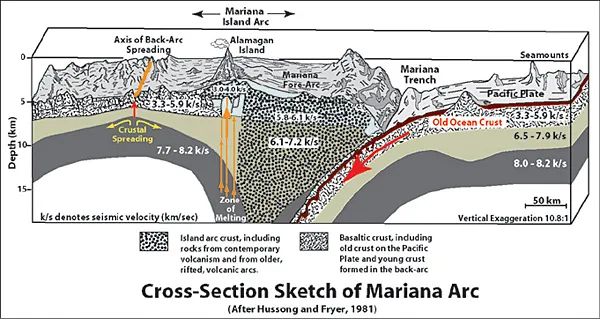
"Cross section of mariana trench" by Original uploader was Dino at English Wikipedia. / Wikimedia Commons.
Oceanic trenches are the deepest features on Earth. These long, narrow valleys form where tectonic plates collide at subduction zones. When one plate pushes against another, the denser plate bends downward. It dives beneath the other plate and drags the seafloor with it. This process creates a deep, V-shaped trench on the ocean floor.
Scientists explain that trenches mark the boundaries where convergent plate boundaries occur. At these locations, two plates move toward each other. The subducting plate can bend downward at angles between 25 and 90 degrees. As it descends into the mantle, it pulls the seafloor down. This creates trenches that can stretch thousands of kilometers long. Most trenches are only 50 to 100 kilometers wide, making them remarkably narrow compared to their length.
The Mariana Trench in the western Pacific Ocean provides a dramatic example. It plunges about 11 kilometers below sea level, making it the deepest spot on Earth. Mount Everest, the tallest mountain on land, could fit inside with room to spare. Evidence shows that the pressure at the bottom exceeds 1,000 times the pressure at sea level. The environment remains completely dark because sunlight cannot penetrate that deep. Despite these extreme conditions, scientists have discovered unique organisms that survive there.
Oceanic trenches matter because they reveal where plates interact. Finding a trench on a map points directly to a subduction zone. These features help scientists understand plate tectonics and predict where earthquakes and volcanoes may occur. Subduction zones generate some of Earth's most powerful earthquakes. They also create volcanic arcs on the overriding plate. Studying trenches helps us understand how Earth's surface changes over time.
Interesting Fact: If you dropped a steel ball into the Mariana Trench, it would take over an hour to reach the bottom, falling through nearly seven miles of water!
Comprehension quiz (10 questions)
1. What are oceanic trenches?
2. Where do oceanic trenches form?
3. What does the word 'subduction' mean in this passage?
4. Based on the passage, what is 'pressure' in the context of oceanic trenches?
5. Why is the Mariana Trench significant?
6. What can scientists learn by studying oceanic trenches?
7. If two tectonic plates collide and one is denser than the other, what will likely happen?
8. Based on the passage, what relationship exists between trenches and earthquakes?
9. Oceanic trenches are typically wider than they are long.
10. Despite extreme conditions, some organisms can survive at the bottom of oceanic trenches.
Perfect for the way you teach
- Build comprehension skills
- Auto-graded quiz
- Differentiated reading
- Read together at home
- Improve fluency
- Quiet reading time
- Reading curriculum support
- Independent practice
- Track Lexile growth