What Are Spring Tides
Interactive passage with audio narration, comprehension questions, and printable PDF.
By completing this purchase you agree to our Terms of Use and Privacy Policy. Your subscription renews automatically until you cancel. You can cancel anytime from your account settings. All sales are final and non-refundable. Digital content is available for download in your account immediately upon purchase.
What's included
What Are Spring Tides preview and details
About this printable What Are Spring Tides science reading passage, NGSS-aligned (Grades 5-8)
Sample passage and quiz from What Are Spring Tides
Reading passage and comprehension quiz preview
What Are Spring Tides
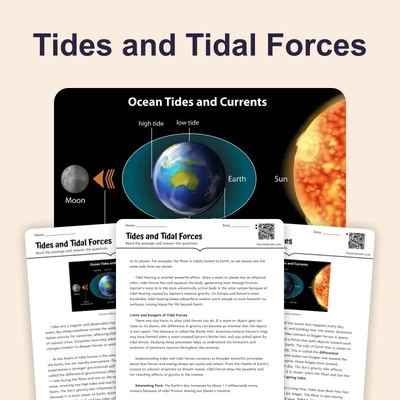
Spring tides are the strongest tides that occur each month. They happen twice during the lunar cycle when the Sun, Earth, and Moon line up in a straight row. This alignment occurs during the new moon and full moon phases. Despite the name, spring tides have nothing to do with the season of spring. The word "spring" means "to leap" or "spring forth," describing how water rises higher than usual.
Scientists explain that spring tides form because of gravitational pull from both the Sun and Moon. The Moon's gravity is the main force that causes ocean tides on Earth. When the Sun and Moon align on the same side or opposite sides of Earth, their gravitational forces work together. This combined pull creates stronger effects on Earth's oceans. Evidence shows that during spring tides, high tides rise higher than normal. Low tides also drop lower than usual. The difference between high tide and low tide is called the tidal range. Spring tides produce the greatest tidal range of the month.
The Bay of Fundy in Canada experiences some of the highest spring tides in the world. During spring tides, the water level can change by more than 50 feet between high and low tide. This dramatic change affects coastal communities and marine ecosystems. Boats must be secured carefully, and people who walk on the beach need to watch the tide schedule. Scientists observe these patterns to understand how gravitational forces shape our planet's oceans.
Spring tides matter because they influence coastal navigation, fishing, and marine life. Understanding when spring tides occur helps people plan activities safely near the ocean. These tides also move nutrients in coastal waters, which can support diverse ocean ecosystems. The predictable pattern of spring tides demonstrates how the Earth-Moon-Sun system works together through gravitational interactions.
Interesting Fact: Spring tides occur about every 14 days, roughly two times each month. The opposite of spring tides are neap tides, which are the weakest tides that happen when the Sun and Moon form a right angle with Earth.
Comprehension quiz (10 questions)
1. What are spring tides?
2. When do spring tides occur?
3. What does the word 'spring' in spring tides refer to?
4. What is tidal range?
5. Why do spring tides create higher high tides and lower low tides?
6. According to the passage, what can happen at the Bay of Fundy during spring tides?
7. How does understanding spring tides help people?
8. What are neap tides?
9. True or False: Spring tides only occur during the spring season.
10. True or False: Spring tides occur about every 14 days, roughly two times each month.
Perfect for the way you teach
- Build comprehension skills
- Auto-graded quiz
- Differentiated reading
- Read together at home
- Improve fluency
- Quiet reading time
- Reading curriculum support
- Independent practice
- Track Lexile growth