Reading PassagePremium

What Causes Tectonic Plates to Move

Interactive passage with audio narration, comprehension questions, and printable PDF.

No ratings yet
Grades 5–8ScienceElaEnglish · SpanishInteractive · Printable
Aligned toMS-ESS2-2
Just this resource
$1.50
One-time purchase
Best value
Unlock everything
$49.99$24.99/yr
50% off until Sept 15 — 10,000+ resources
Renews at $49.99/year.

By completing this purchase you agree to our Terms of Use and Privacy Policy. Your subscription renews automatically until you cancel. You can cancel anytime from your account settings. All sales are final and non-refundable. Digital content is available for download in your account immediately upon purchase.

Unlock above to use these actions

What's included

Reading passage
Audio narration
Comprehension quiz
Writing activity
Glossary & flashcards
Differentiated version
Spanish translation

What Causes Tectonic Plates to Move preview and details

About this printable What Causes Tectonic Plates to Move science reading passage, NGSS-aligned (Grades 5-8)

This comprehensive 400-500 word reading passage explains what causes tectonic plates to move across Earth's surface. Aligned to NGSS standard MS-ESS2-2 and disciplinary core idea MS-ESS2.B, the passage explores three key mechanisms: mantle convection driven by Earth's internal heat, ridge push at underwater ridges, and slab pull where dense oceanic crust sinks into the mantle. Students discover how these forces work together to move plates several inches per year. The passage includes real-world examples, connects plate motion to Earth's internal structure, and features audio integration for enhanced accessibility. Complete with a Spanish translation, simplified differentiated version, glossary of key terms, multiple-choice questions, writing activities, and graphic organizers, this resource provides comprehensive support for middle school Earth science instruction on plate tectonics and geologic processes.
Written by Workybooks TeamPublished by Workybooks
Preview

Sample passage and quiz from What Causes Tectonic Plates to Move

Reading passage and comprehension quiz preview

What Causes Tectonic Plates to Move
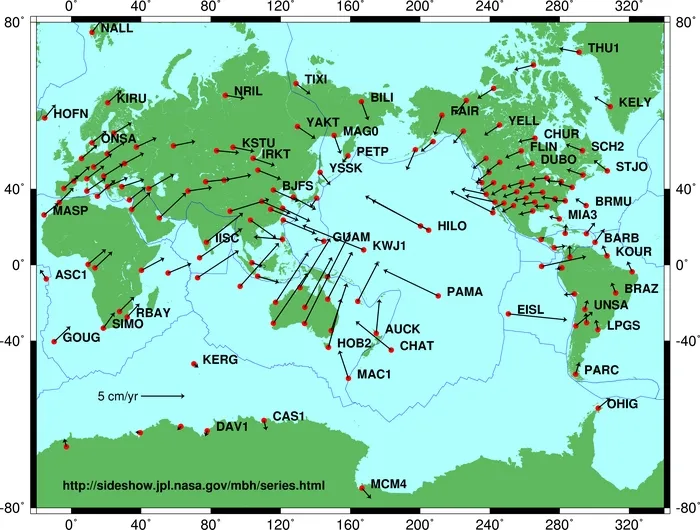
Global plate motion

"Global plate motion" / Wikimedia Commons.

Earth's tectonic plates move slowly across the planet's surface, but what pushes them? Scientists explain that three main forces work together to drive plate motion. The primary force comes from deep inside Earth itself.

Heat from Earth's interior causes the mantle to move in a process called convection. The mantle is the thick layer of hot rock between Earth's crust and core. When rock in the mantle heats up near the core, it becomes less dense and rises toward the surface. As it moves upward and away from the heat source, it cools and becomes denser. The cooler rock then sinks back down. This creates a churning motion similar to water boiling in a pot. The moving mantle drags the tectonic plates above it along for the ride.

Two additional forces help push and pull the plates. Ridge push occurs at underwater mountain ranges called mid-ocean ridges. Hot rock rises at these ridges and forms new ocean floor. The newly formed rock sits higher than the surrounding seafloor. Gravity causes this elevated rock to slide downhill away from the ridge. This sliding motion pushes the plate forward. Slab pull happens at subduction zones, where one plate slides beneath another. The edge of the sinking plate is cold and dense. It pulls the rest of the plate behind it, much like a tablecloth sliding off a table drags everything with it.

Evidence shows these forces move plates between two and six inches per year. The Pacific Plate, for example, moves about three inches annually. Scientists measure this movement using GPS technology and satellites. Over millions of years, these small movements add up. Continents shift position, ocean basins open and close, and mountain ranges form.

Understanding plate motion matters because it explains many Earth processes. Earthquakes occur when plates grind past each other. Volcanoes form where plates collide or separate. Mountain ranges rise where plates push together. All of these dramatic surface features connect back to Earth's hot interior. The planet's internal heat acts as an engine that powers the moving surface above.

Interesting Fact: The Atlantic Ocean grows wider by about one inch each year as the North American and Eurasian plates move apart. Your classroom is farther from Europe today than it was when you were born!

Comprehension quiz (10 questions)

1. What is the primary force that causes tectonic plates to move?

Heat from Earth's interior causing mantle convection
Wind and ocean currents on Earth's surface
Gravity from the moon pulling on the plates
Earthquakes shaking the plates into motion

2. What is convection in the mantle?

The process where plates slide past each other
The circular movement of hot rock rising and cool rock sinking
The formation of new ocean floor at ridges
The melting of rock to form volcanoes

3. How fast do tectonic plates typically move each year?

Between two and six inches
About one foot
Several miles
Less than one millimeter

4. In the passage, what does the term 'slab pull' describe?

The pushing force at mid-ocean ridges
The force created when a cold, dense plate edge sinks and drags the rest of the plate
The movement of hot rock rising in the mantle
The collision of two plates forming mountains

5. Based on the passage, what can you infer about the relationship between Earth's internal heat and surface features?

Earth's internal heat has no effect on surface features
Earth's internal heat only affects ocean temperatures
Earth's internal heat drives plate motion, which creates earthquakes, volcanoes, and mountains
Earth's internal heat only causes volcanic eruptions

6. Why does ridge push occur at mid-ocean ridges?

Cold rock sinks at these locations
Newly formed rock sits higher than surrounding seafloor and slides downhill due to gravity
Plates collide at these ridges
Ocean water pushes the plates apart

7. If you wanted to apply the concept of slab pull to a real-world example, which situation is most similar?

A balloon rising in the air
A ball rolling uphill
A heavy chain hanging off a table pulling the rest of the chain down
Water freezing into ice

8. According to the passage, how do scientists measure plate movement?

By counting earthquakes each year
By using GPS technology and satellites
By measuring volcanic eruptions
By studying fossils in rocks

9. True or False: The mantle is a layer of liquid rock that flows quickly beneath Earth's crust.

True
False

10. True or False: Ridge push, slab pull, and mantle convection all work together to move tectonic plates.

True
False
Who it's for

Perfect for the way you teach

Teachers
  • Build comprehension skills
  • Auto-graded quiz
  • Differentiated reading
Parents
  • Read together at home
  • Improve fluency
  • Quiet reading time
Homeschoolers
  • Reading curriculum support
  • Independent practice
  • Track Lexile growth
Topics

Reviews & Ratings

No reviews yet. Be the first to share your experience!

More reading you might love

20 more
Passage
Talus Slopes: Formation and Features - reading educational content
Grades 5–8

Talus Slopes: Formation and Features

science · MS-ESS2-1+2

Free
Passage
Stratigraphic Columns: Decoding Earth’s Geological Layers - reading educational content
Grades 5–8

Stratigraphic Columns: Decoding Earth’s Geological Layers

science · MS-ESS2-2+2

Free
Passage
Frost Wedging: How Ice Splits Rock - reading educational content
Grades 5–8

Frost Wedging: How Ice Splits Rock

earth and space science · MS-ESS2-1+2

$1.50
Passage
Chemical Weathering: The Breakdown of Rocks Through Chemical Reactions - reading educational content
Grades 5–8

Chemical Weathering: The Breakdown of Rocks Through Chemical Reactions

earth and space science · MS-ESS2-1+2

Free
Passage
What Is Space Weather and How Does It Affect the Earth? - reading educational content
Grades 3–7

What Is Space Weather and How Does It Affect the Earth?

earth and space science · MS-ESS2-2

$1.50
Passage
When Was The Last Ice Age - reading educational content
Grade 6

When Was The Last Ice Age

earth and space science · MS-ESS2-2

$1.50
Passage
Tools and Technology in Earth Science - reading educational content
Grades 5–8

Tools and Technology in Earth Science

science · MS-ESS2-2+4

$1.50
Passage
Maps and Mapping - reading educational content
Grades 5–8

Maps and Mapping

earth and space science · MS-ESS2-2

$1.50
Passage
Latitude and Longitude - reading educational content
Grades 5–8

Latitude and Longitude

earth and space science · MS-ESS2-2

$1.50
Passage
Topographic Maps - reading educational content
Grades 5–8

Topographic Maps

earth and space science · MS-ESS2-2+3

$1.50
Passage
Contour Lines and Elevation - reading educational content
Grades 5–8

Contour Lines and Elevation

earth and space science · MS-ESS2-2+3

$1.50
Passage
Maps and Their Uses - reading educational content
Grades 5–8

Maps and Their Uses

earth and space science · MS-ESS2-2+5

$1.50
Passage
Mountains and Mountain Building - reading educational content
Grades 5–8

Mountains and Mountain Building

earth and space science · MS-ESS2-1+1

$1.50
Passage
Earth's Interior - reading educational content
Grades 5–8

Earth's Interior

earth and space science · MS-ESS2-1+1

$1.50
Passage
Continental Drift Theory - reading educational content
Grades 5–8

Continental Drift Theory

earth and space science · MS-ESS2-2+1

Free
Passage
Seafloor Spreading - reading educational content
Grades 5–8

Seafloor Spreading

science · MS-ESS2-2+1

$1.50
Passage
Theory of Plate Tectonics - reading educational content
Grades 5–8

Theory of Plate Tectonics

earth and space science · MS-ESS2-2

$1.50
Passage
Divergent Plate Boundaries - reading educational content
Grades 5–8

Divergent Plate Boundaries

earth and space science · MS-ESS2-2

$1.50
Passage
Convergent Plate Boundaries - reading educational content
Grades 5–8

Convergent Plate Boundaries

earth and space science · MS-ESS2-2

$1.50
Passage
Transform Plate Boundaries - reading educational content
Grades 5–8

Transform Plate Boundaries

earth and space science · MS-ESS2-2

$1.50
Copyright © 2026 Workybooks Classroom. Made with ♥ in California.