Reading PassagePremium

What Drives the Water Cycle

Interactive passage with audio narration, comprehension questions, and printable PDF.

No ratings yet|
23
Grades 5–8ScienceElaEnglish · SpanishInteractive · Printable
Aligned toMS-ESS2-4MS-ESS2-6; RST.6-8.1RST.6-8.4
Just this resource
$1.50
One-time purchase
Best value
Unlock everything
$49.99$24.99/yr
50% off until Sept 15 — 10,000+ resources
Renews at $49.99/year.

By completing this purchase you agree to our Terms of Use and Privacy Policy. Your subscription renews automatically until you cancel. You can cancel anytime from your account settings. All sales are final and non-refundable. Digital content is available for download in your account immediately upon purchase.

Unlock above to use these actions

What's included

Reading passage
Audio narration
Comprehension quiz
Writing activity
Glossary & flashcards
Differentiated version
Spanish translation

What Drives the Water Cycle preview and details

Preview

Sample passage and quiz from What Drives the Water Cycle

Reading passage and comprehension quiz preview

What Drives the Water Cycle

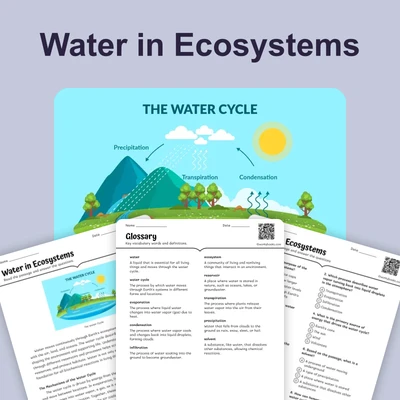
The water cycle is the continuous movement of water through Earth’s atmosphere, land, and oceans. This cycle includes key processes like evaporation, condensation, precipitation, and collection. The main factor that controls the water cycle is the Sun. Without the Sun’s energy, the water cycle would not happen. The Sun drives the movement of water by heating up Earth’s surface, especially oceans, lakes, and rivers.


When the Sun warms water, it causes evaporation—the process of liquid water turning into water vapor. This vapor rises into the atmosphere. Plants also release water vapor through a process called transpiration. Together, evaporation and transpiration add moisture to the air. As water vapor rises and cools, it undergoes condensation and forms clouds. When these clouds become heavy with water droplets, precipitation occurs as rain, snow, sleet, or hail.


The Sun not only powers evaporation but also helps shape weather patterns. It affects wind, temperature, and the movement of air masses, all of which influence how and where precipitation falls. For example, in warmer climates, more sunlight leads to higher evaporation rates, which often means more rainfall.


Real-world examples show the Sun’s power in action. In tropical areas, the intense sunlight causes rapid evaporation, leading to frequent rainstorms. In contrast, deserts receive lots of sunlight but little moisture to evaporate, so they remain dry. Even seasonal changes in sunlight affect the water cycle, such as spring snowmelt that leads to increased river flow.


Understanding how the Sun controls the water cycle helps scientists predict weather, manage water resources, and study climate change. The Sun is essential to life on Earth, and its role in the water cycle is one of the most important ways it supports ecosystems around the planet.


Fun Fact: The Sun releases more energy in one second than humans have used in all of history!

Comprehension quiz (8 questions)

1. What is the main factor that controls the water cycle?

The Moon
The Wind
The Sun
The Clouds

2. What process changes liquid water into water vapor?

Precipitation
Evaporation
Condensation
Collection

3. What happens when water vapor cools in the atmosphere?

It turns into snow
It disappears
It forms clouds
It sinks to the ground

4. What is the term for plants releasing water vapor?

Transpiration
Condensation
Evaporation
Precipitation

5. How does the Sun affect rainfall in tropical areas?

It stops all precipitation
It reduces wind patterns
It increases evaporation
It cools the ocean

6. Why are deserts dry despite a lot of sunlight?

Too many trees
Lack of clouds
Not enough moisture
Cold winds

7. What is the main idea of the passage?

The Sun creates wind
Water flows into rivers
The Sun drives the water cycle
Plants help clean the air

8. If there were no sunlight, what would happen to the water cycle?

It would speed up
It would stop
It would turn into snow
It would grow plants faster
Who it's for

Perfect for the way you teach

Teachers
  • Build comprehension skills
  • Auto-graded quiz
  • Differentiated reading
Parents
  • Read together at home
  • Improve fluency
  • Quiet reading time
Homeschoolers
  • Reading curriculum support
  • Independent practice
  • Track Lexile growth

Reviews & Ratings

No reviews yet. Be the first to share your experience!

More reading you might love

19 more
Passage
The Intertropical Convergence Zone (ITCZ): Earth's Weather Belt - reading educational content
Grades 5–8

The Intertropical Convergence Zone (ITCZ): Earth's Weather Belt

science · MS-ESS2-5+2

Free
Passage
Type of Cloud Is Associated with Hail - reading educational content
Grades 3–7

Type of Cloud Is Associated with Hail

weather and climate · MS-ESS2-4

$1.50
Passage
Earth's Spheres - reading educational content
Grades 5–8

Earth's Spheres

earth and space science · MS-ESS2-4+1

$1.50
Passage
Surface Water: Rivers, Lakes, and Wetlands - reading educational content
Grades 5–8

Surface Water: Rivers, Lakes, and Wetlands

earth and space science · MS-ESS2-4

$1.50
Passage
Groundwater - reading educational content
Grades 5–8

Groundwater

earth and space science · MS-ESS2-4+1

$1.50
Passage
Distribution of Water on Earth - reading educational content
Grades 5–8

Distribution of Water on Earth

earth and space science · MS-ESS2-4+1

$1.50
Passage
Water in Ecosystems - reading educational content
Grades 5–8

Water in Ecosystems

life science · MS-LS2-3+1

$1.50
Passage
The Ozone Layer - reading educational content
Grades 5–8

The Ozone Layer

science · MS-ESS2-4+1

$1.50
Passage
Layers of the Atmosphere - reading educational content
Grades 5–8

Layers of the Atmosphere

science · MS-ESS2-4

$1.50
Passage
How Does Sonar Map the Ocean Floor - reading educational content
Grades 6–8

How Does Sonar Map the Ocean Floor

earth and space science · MS-ESS2-4

$1.50
Passage
How Do Aquifers Store Groundwater - reading educational content
Grades 6–8

How Do Aquifers Store Groundwater

earth and space science · MS-ESS2-4

$1.50
Passage
What Is Oceanography - reading educational content
Grades 6–8

What Is Oceanography

earth and space science · MS-ESS2-4

$1.50
Passage
How Freshwater Differs from Saltwater - reading educational content
Grades 6–8

How Freshwater Differs from Saltwater

weather and climate · MS-ESS2-4

$1.50
Passage
How Does Runoff Flow Across Watersheds - reading educational content
Grades 6–8

How Does Runoff Flow Across Watersheds

weather and climate · MS-ESS2-4

$1.50
Passage
How Does Water Infiltrate the Ground - reading educational content
Grades 6–8

How Does Water Infiltrate the Ground

weather and climate · MS-ESS2-4

$1.50
Passage
How Do Wells Reach Underground Water - reading educational content
Grades 6–8

How Do Wells Reach Underground Water

earth and space science · MS-ESS2-4

$1.50
Passage
How Do Humans Impact Freshwater Supply - reading educational content
Grades 6–8

How Do Humans Impact Freshwater Supply

earth and space science · MS-ESS2-4

$1.50
Passage
What Is a Watershed - reading educational content
Grades 5–8

What Is a Watershed

weather and climate · MS-ESS2-4

$1.50
Passage
How Do Glaciers Store Water - reading educational content
Grades 5–8

How Do Glaciers Store Water

weather and climate · MS-ESS2-4

$1.50
Copyright © 2026 Workybooks. Made with ♥ in California.