This 400-500 word informational science reading passage introduces middle school students (grades 6-8) to the concept of a light-year as defined in NGSS MS-ESS1.A. Students learn that a light-year is the distance light travels in one year, approximately 9.5 trillion kilometers, and understand why this unit is essential for measuring interstellar distances. The passage explains how astronomical units work well for solar system distances but become impractical for measuring distances between stars. Through clear explanations and real-world examples like Proxima Centauri, students grasp why astronomers need light-years as a measurement tool. This foundational passage aligns with NGSS standard MS-ESS1-3 and prepares students for understanding galactic scales in later units. The content includes audio integration for accessibility, differentiated versions for struggling readers, Spanish translations, glossary terms, comprehension questions, writing activities, and graphic organizers to support diverse learning needs.
Written by Workybooks TeamPublished by Workybooks
Preview
Sample passage and quiz content
CONTENT PREVIEW
Expand content preview
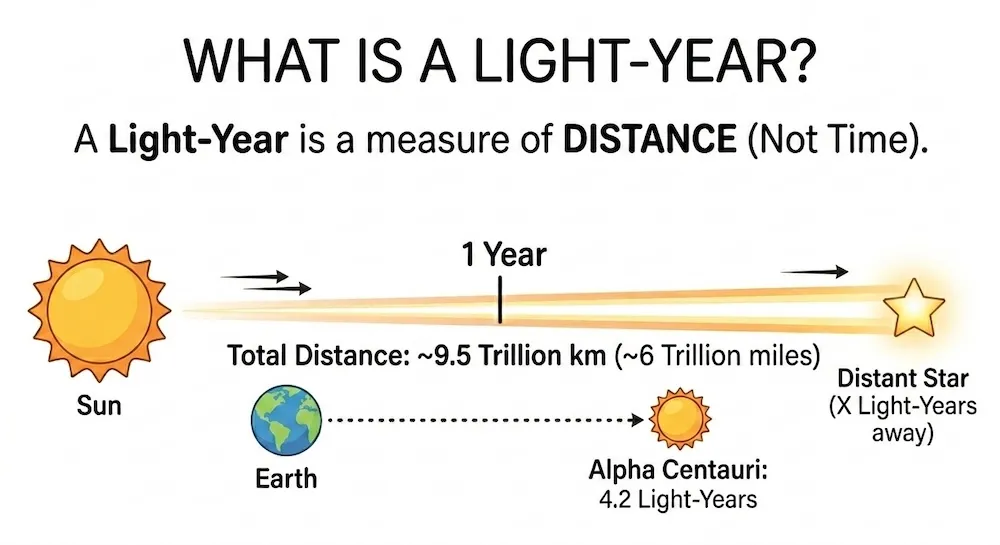
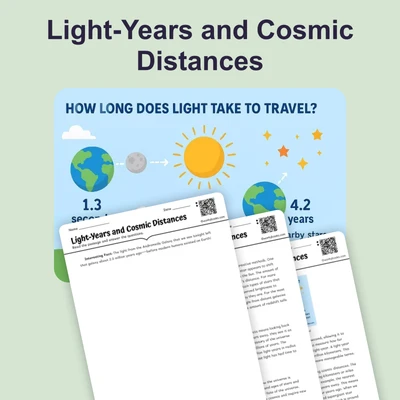
A light-year is the distance that light travels in one year. This measurement equals about 9.5 trillion kilometers. Scientists use light-years to measure the enormous distances between stars and galaxies in space.
Light moves incredibly fast through space at a speed of about 300,000 kilometers per second. Nothing in the universe travels faster than light. Even at this speed, light takes time to cross the vast emptiness between stars. When scientists measure these interstellar distances, using kilometers becomes impractical. For example, the nearest star to our Sun is about 40 trillion kilometers away. Writing such large numbers repeatedly can lead to errors and confusion.
Within our solar system, scientists often use astronomical units, or AUs, to measure distances. One AU equals the distance from Earth to the Sun, about 150 million kilometers. This unit works well for planets orbiting our Sun. Mars sits about 1.5 AUs from the Sun, while Neptune orbits at roughly 30 AUs. However, when measuring distances to other stars, even AUs become too small and awkward to use.
Consider Proxima Centauri, the closest star to our solar system. This star lies about 4.2 light-years away from Earth. In astronomical units, that same distance equals approximately 268,000 AUs. Scientists can see that light-years provide a more practical way to describe such distances. The scale of the universe demands a measurement unit that matches its size.
Understanding light-years helps scientists communicate about space exploration and observation. When astronomers study distant galaxies, they measure distances in millions or billions of light-years. This means the light we observe left those galaxies millions or billions of years ago. We see these distant objects as they appeared in the past. Light-years connect distance and time in a meaningful way.
Evidence shows that using the right measurement unit makes scientific work more accurate and efficient. Just as kilometers replaced meters for long road trips, light-years replace AUs for journeys between stars. This choice of units reflects how scientists adapt their tools to match the phenomena they study.
Interesting Fact: The Andromeda Galaxy, our nearest large galactic neighbor, sits about 2.5 million light-years from Earth. The light we see from Andromeda today actually left that galaxy 2.5 million years ago, when early human ancestors first walked on Earth.
What is a light-year?
The time it takes for light to reach EarthThe distance light travels in one yearThe speed at which light moves through spaceA unit used only within our solar system
How fast does light travel through space?
150,000 kilometers per second200,000 kilometers per second300,000 kilometers per second400,000 kilometers per second
What does the term 'astronomical unit' (AU) represent?
The distance between Earth and the MoonThe distance from Earth to the SunThe distance light travels in one monthThe distance between two stars
Why do scientists use light-years instead of astronomical units when measuring distances to other stars?
Light-years are more accurate than astronomical unitsAstronomical units become too small and awkward for such large distancesLight-years were invented more recentlyAstronomical units can only measure planets
How far is Proxima Centauri from Earth in light-years?
Based on the passage, what can you infer about viewing distant galaxies?
We see them exactly as they are right nowWe see them as they appeared in the pastWe cannot see them without special equipmentWe see them better than nearby stars
Why is using kilometers impractical for measuring interstellar distances?
Kilometers are not accurate enoughThe numbers become too large and can lead to errorsLight does not travel in kilometersScientists prefer smaller units
If a galaxy is 5 million light-years away, what does this tell us about the light we observe from it?
The light left the galaxy 5 million years agoThe light will reach us in 5 million yearsThe galaxy is 5 million kilometers awayThe light travels slower from that galaxy
True or False: Nothing in the universe travels faster than light.
TrueFalse
True or False: Astronomical units work better than light-years for measuring distances between stars.
TrueFalse
Who it's for
Perfect for the way you teach
Teachers
Build comprehension skills
Auto-graded quiz
Differentiated reading
Parents
Read together at home
Improve fluency
Quiet reading time
Homeschoolers
Reading curriculum support
Independent practice
Track Lexile growth
Topics
light-yearinterstellar distancespace measurementastronomical unitspeed of lightMS-ESS1-3middle school scienceastronomy
Reviews & Ratings
No reviews yet. Be the first to share your experience!
More reading you might love
20 more
Sunspots and Solar Flares
This quiz is designed to test your understanding of the fascinating phenomena of sunspots and solar flares, as described...
RI.4.1RI.4.4RI.5.1ESS1.A
The Hottest Planet in the Solar System
This NGSS-aligned middle school reading passage explains why Venus is the hottest planet in our solar system. Students l...
MS-ESS1-3
Mercury: Closest to the Sun
This comprehensive, standards-aligned passage explores Mercury—the smallest and closest planet to the Sun. Students in g...
MS-ESS1-2MS-ESS1-3
Venus: Earth's Twin?
This comprehensive science passage for grades 6-8 examines Venus—often called Earth's twin—by exploring its similarities...
MS-ESS1-2MS-ESS1-3
Mars: The Red Planet
This middle school science passage explores Mars, the Red Planet, providing students in grades 6-8 with a comprehensive ...
MS-ESS1-2MS-ESS1-3
What Is the Solar System?
This passage provides a comprehensive overview of the solar system for grades 6-8, aligned with NGSS standards MS-ESS1-2...
MS-ESS1-2MS-ESS1-3
Structure of the Solar System
This comprehensive science reading passage introduces middle school students (grades 6-8) to the structure of the solar ...
MS-ESS1-2MS-ESS1-3
Scale of the Solar System
This passage, aligned to NGSS standard MS-ESS1-3, helps middle school students grasp the immense scale of the solar syst...
MS-ESS1-3
Exploration of the Solar System
This comprehensive passage for grades 6-8 examines how humans explore the solar system, aligning with NGSS standards MS-...
MS-ESS1-3MS-ETS1-1
Optical Telescopes
This comprehensive passage explores the science of optical telescopes for middle school students, aligning with NGSS sta...
MS-ESS1-3MS-ETS1-1
Future of Alien Search
This informational passage for grades 6-8 explores how scientists are using cutting-edge missions and technology to sear...
MS-ESS1-3MS-ETS1-1
Communicating with Aliens
This middle school science passage, aligned with NGSS standard MS-ESS1-3, examines the scientific and technological chal...
MS-ESS1-3
Measuring Distances in Space
This middle school science passage explores how astronomers measure the vast distances in space, aligning with NGSS stan...
MS-ESS1-3
Astronomy
This comprehensive reading passage introduces middle school students to the science of astronomy, which is the study of ...
MS-ESS1-2MS-ESS1-3MS-PS4-2MS-ETS1-1
The Solar System
This middle school science passage introduces students to the solar system, aligning with NGSS standards MS-ESS1-2 and M...
MS-ESS1-2MS-ESS1-3
The Inner Planets
This comprehensive science passage for grades 6-8 explores the inner (terrestrial) planets of our solar system—Mercury, ...
MS-ESS1-2MS-ESS1-3
The Outer Planets
This engaging science passage for grades 6-8 introduces students to the outer planets—Jupiter, Saturn, Uranus, and Neptu...
MS-ESS1-2MS-ESS1-3
Light-Years and Cosmic Distances
This middle school science passage, aligned to NGSS MS-ESS1-3, explores how astronomers measure the vast distances in sp...
MS-ESS1-3
Space Stations
This informational science reading passage for grades 6-8 explores the complex systems and technology behind space stati...
MS-ESS1-3MS-ETS1-1
Types of Spacecraft
This passage introduces middle school students to the various types of spacecraft used to explore our solar system and b...