Reading PassagePremium

What Is a Tectonic Plate

Interactive passage with audio narration, comprehension questions, and printable PDF.

No ratings yet
Grades 5–8ScienceElaEnglish · SpanishInteractive · Printable
Aligned toMS-ESS2-2
Just this resource
$1.50
One-time purchase
Best value
Unlock everything
$49.99$24.99/yr
50% off until Sept 15 — 10,000+ resources
Renews at $49.99/year.

By completing this purchase you agree to our Terms of Use and Privacy Policy. Your subscription renews automatically until you cancel. You can cancel anytime from your account settings. All sales are final and non-refundable. Digital content is available for download in your account immediately upon purchase.

Unlock above to use these actions

What's included

Reading passage
Audio narration
Comprehension quiz
Writing activity
Glossary & flashcards
Differentiated version
Spanish translation

What Is a Tectonic Plate preview and details

About this printable What Is a Tectonic Plate science reading passage, NGSS-aligned (Grades 5-8)

This comprehensive 400-500 word reading passage explores the fundamental concept of tectonic plates for middle school students in grades 6-8. Aligned with NGSS standards MS-ESS2-2 and DCI MS-ESS2.B, the passage explains how Earth's rigid outer shell, the lithosphere, is broken into approximately a dozen enormous slabs called tectonic plates. Students discover how these plates fit together like a cracked eggshell and rest on the softer, flowing asthenosphere below. The passage connects to prior learning about Earth's interior layers and introduces the key concept that plates move slowly across the planet's surface. Audio integration supports diverse learners, while the passage maintains scientific accuracy using evidence-based language. Real-world examples help students understand the scale and significance of plate movement. The content includes essential vocabulary such as lithosphere, asthenosphere, tectonic plates, crust, mantle, and plate boundaries. Supporting activities include comprehension questions, writing prompts, and graphic organizers that reinforce understanding of Earth's dynamic structure and prepare students for deeper study of plate tectonics and geological processes.
Written by Workybooks TeamPublished by Workybooks
Preview

Sample passage and quiz from What Is a Tectonic Plate

Reading passage and comprehension quiz preview

What Is a Tectonic Plate
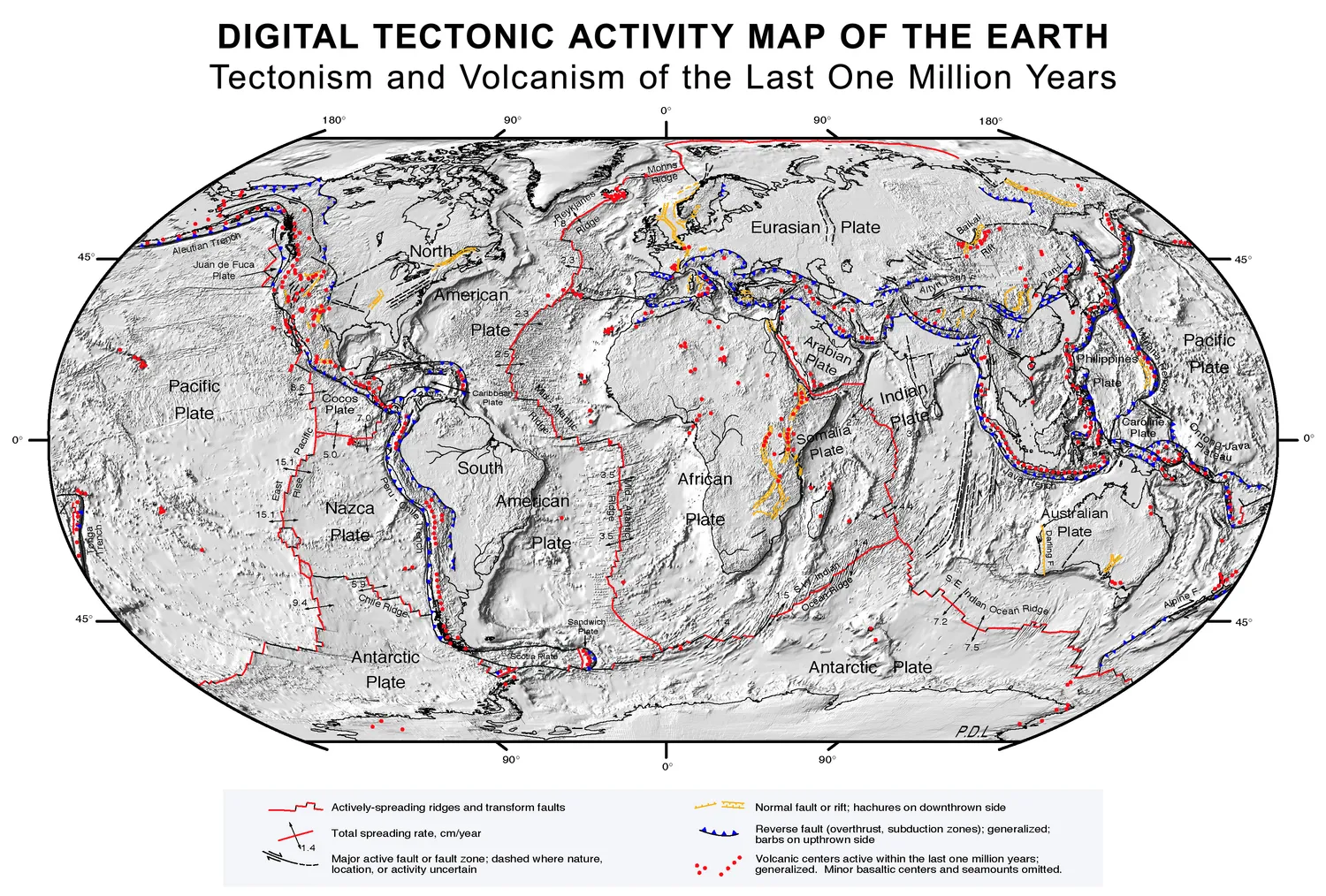
Plate tectonics map

"Plate tectonics map" by nagualdesign / Wikimedia Commons.

A tectonic plate is a massive slab of solid rock that forms part of Earth's outer shell. Earth's rigid outer layer, called the lithosphere, is not one continuous piece. Instead, it is broken into about a dozen enormous slabs that fit together like a cracked eggshell. These slabs are the tectonic plates. Each plate includes a section of crust and the uppermost part of the mantle beneath it.

The lithosphere sits on top of a softer layer called the asthenosphere. The asthenosphere is also part of the mantle, but it is hotter and flows slowly over time. Scientists explain that this flowing layer allows the rigid plates above to move. The plates drift across Earth's surface at rates of just a few inches per year. This movement happens because heat from deep inside Earth causes the asthenosphere to flow in slow currents. Evidence shows that these currents push and pull the plates in different directions.

Tectonic plates vary greatly in size and composition. Some plates carry entire continents, while others lie beneath ocean floors. The North American Plate, for example, includes most of North America and extends far into the Atlantic Ocean. Where plates meet, they form plate boundaries. At these boundaries, plates can move apart, collide, or slide past each other. Each type of boundary creates different geological features on Earth's surface.

Understanding tectonic plates helps scientists explain many Earth processes. Earthquakes occur when plates suddenly shift at their boundaries. Volcanic eruptions can happen where plates collide or pull apart. Mountains form when plates push together over millions of years. By studying how plates move, scientists can better understand Earth's changing surface and the forces that shape our planet.

Interesting Fact: The Pacific Plate moves about 2 to 3 inches per year, which means it has traveled thousands of miles over millions of years!

Comprehension quiz (10 questions)

1. What is a tectonic plate?

A massive slab of solid rock that forms part of Earth's outer shell
A thin layer of water covering Earth's surface
A type of volcanic rock found only in mountains
The liquid core at the center of Earth

2. How many tectonic plates make up Earth's lithosphere?

About 50 plates
Exactly 100 plates
About a dozen plates
Only 3 plates

3. What does the word 'asthenosphere' refer to in the passage?

The hard outer crust of Earth
A softer, hotter layer of the mantle that flows slowly
The center core of the planet
The atmosphere surrounding Earth

4. According to the passage, what causes tectonic plates to move?

Wind and water erosion on Earth's surface
The pull of the moon's gravity
Heat from deep inside Earth causing the asthenosphere to flow in slow currents
Earthquakes pushing the plates apart

5. Based on the passage, what can happen at plate boundaries?

Plates always stay completely still
Plates can move apart, collide, or slide past each other
Plates dissolve into liquid
Plates only move upward

6. Why is understanding tectonic plates important for scientists?

It helps predict weather patterns
It explains how oceans form waves
It helps explain earthquakes, volcanoes, and mountain formation
It shows how plants grow in different climates

7. Which example from the passage shows the size of a tectonic plate?

The Pacific Ocean is very deep
The North American Plate includes most of North America and extends into the Atlantic Ocean
Mountains are very tall structures
Earthquakes happen suddenly

8. How fast do tectonic plates typically move each year?

Several miles per year
About 100 feet per year
Just a few inches per year
They do not move at all

9. True or False: The lithosphere is broken into pieces that fit together like a cracked eggshell.

True
False

10. True or False: All tectonic plates are exactly the same size and carry only continents.

True
False
Who it's for

Perfect for the way you teach

Teachers
  • Build comprehension skills
  • Auto-graded quiz
  • Differentiated reading
Parents
  • Read together at home
  • Improve fluency
  • Quiet reading time
Homeschoolers
  • Reading curriculum support
  • Independent practice
  • Track Lexile growth
Topics

Reviews & Ratings

No reviews yet. Be the first to share your experience!

More reading you might love

20 more
Passage
Talus Slopes: Formation and Features - reading educational content
Grades 5–8

Talus Slopes: Formation and Features

science · MS-ESS2-1+2

Free
Passage
Stratigraphic Columns: Decoding Earth’s Geological Layers - reading educational content
Grades 5–8

Stratigraphic Columns: Decoding Earth’s Geological Layers

science · MS-ESS2-2+2

Free
Passage
Frost Wedging: How Ice Splits Rock - reading educational content
Grades 5–8

Frost Wedging: How Ice Splits Rock

earth and space science · MS-ESS2-1+2

$1.50
Passage
Chemical Weathering: The Breakdown of Rocks Through Chemical Reactions - reading educational content
Grades 5–8

Chemical Weathering: The Breakdown of Rocks Through Chemical Reactions

earth and space science · MS-ESS2-1+2

Free
Passage
What Is Space Weather and How Does It Affect the Earth? - reading educational content
Grades 3–7

What Is Space Weather and How Does It Affect the Earth?

earth and space science · MS-ESS2-2

$1.50
Passage
When Was The Last Ice Age - reading educational content
Grade 6

When Was The Last Ice Age

earth and space science · MS-ESS2-2

$1.50
Passage
Tools and Technology in Earth Science - reading educational content
Grades 5–8

Tools and Technology in Earth Science

science · MS-ESS2-2+4

$1.50
Passage
Maps and Mapping - reading educational content
Grades 5–8

Maps and Mapping

earth and space science · MS-ESS2-2

$1.50
Passage
Latitude and Longitude - reading educational content
Grades 5–8

Latitude and Longitude

earth and space science · MS-ESS2-2

$1.50
Passage
Topographic Maps - reading educational content
Grades 5–8

Topographic Maps

earth and space science · MS-ESS2-2+3

$1.50
Passage
Contour Lines and Elevation - reading educational content
Grades 5–8

Contour Lines and Elevation

earth and space science · MS-ESS2-2+3

$1.50
Passage
Maps and Their Uses - reading educational content
Grades 5–8

Maps and Their Uses

earth and space science · MS-ESS2-2+5

$1.50
Passage
Mountains and Mountain Building - reading educational content
Grades 5–8

Mountains and Mountain Building

earth and space science · MS-ESS2-1+1

$1.50
Passage
Earth's Interior - reading educational content
Grades 5–8

Earth's Interior

earth and space science · MS-ESS2-1+1

$1.50
Passage
Continental Drift Theory - reading educational content
Grades 5–8

Continental Drift Theory

earth and space science · MS-ESS2-2+1

Free
Passage
Seafloor Spreading - reading educational content
Grades 5–8

Seafloor Spreading

science · MS-ESS2-2+1

$1.50
Passage
Theory of Plate Tectonics - reading educational content
Grades 5–8

Theory of Plate Tectonics

earth and space science · MS-ESS2-2

$1.50
Passage
Divergent Plate Boundaries - reading educational content
Grades 5–8

Divergent Plate Boundaries

earth and space science · MS-ESS2-2

$1.50
Passage
Convergent Plate Boundaries - reading educational content
Grades 5–8

Convergent Plate Boundaries

earth and space science · MS-ESS2-2

$1.50
Passage
Transform Plate Boundaries - reading educational content
Grades 5–8

Transform Plate Boundaries

earth and space science · MS-ESS2-2

$1.50
Copyright © 2026 Workybooks Classroom. Made with ♥ in California.