What Is Continental Drift
Interactive passage with audio narration, comprehension questions, and printable PDF.
By completing this purchase you agree to our Terms of Use and Privacy Policy. Your subscription renews automatically until you cancel. You can cancel anytime from your account settings. All sales are final and non-refundable. Digital content is available for download in your account immediately upon purchase.
What's included
What Is Continental Drift preview and details
About this printable What Is Continental Drift science reading passage, NGSS-aligned (Grades 5-8)
Sample passage and quiz from What Is Continental Drift
Reading passage and comprehension quiz preview
What Is Continental Drift
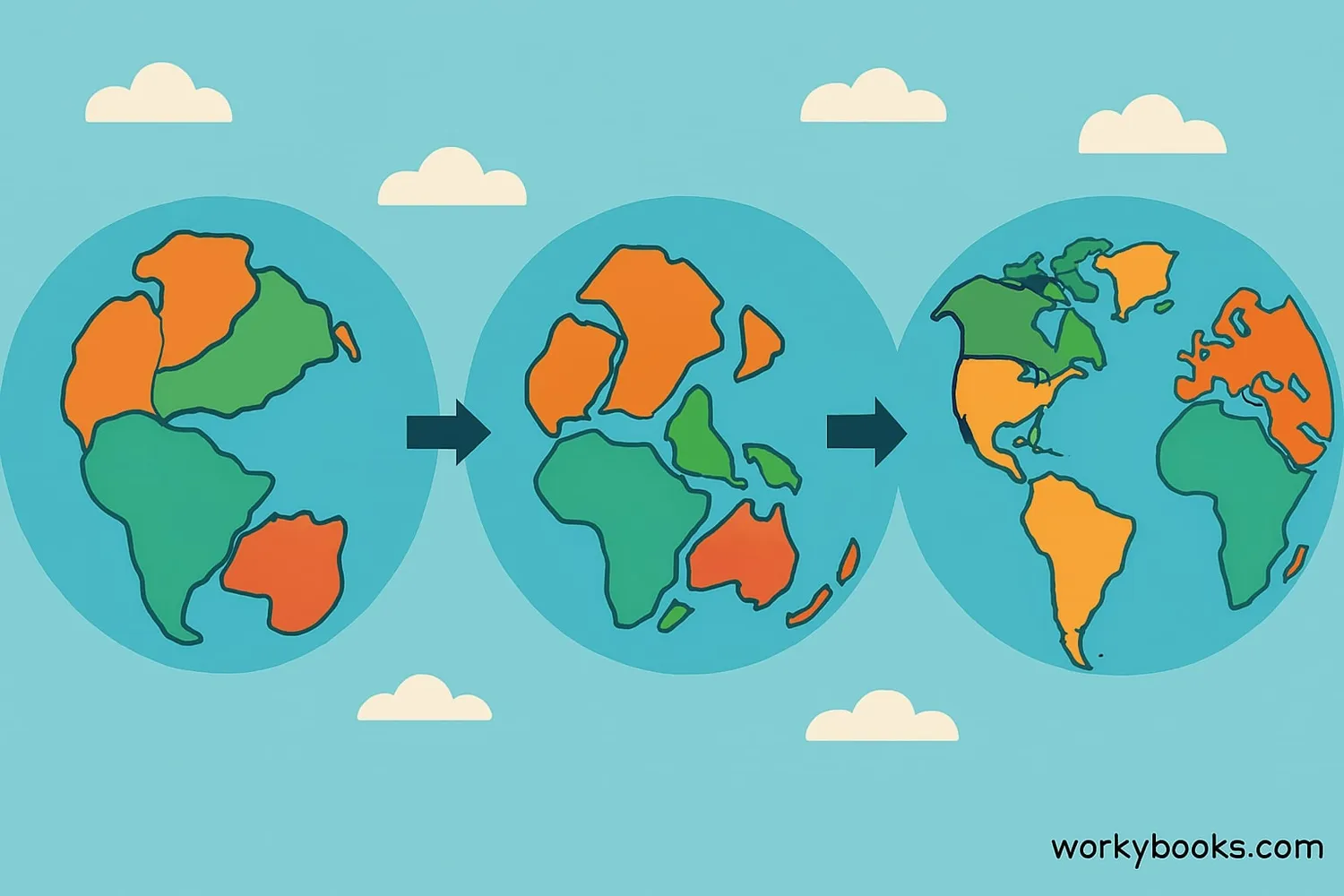
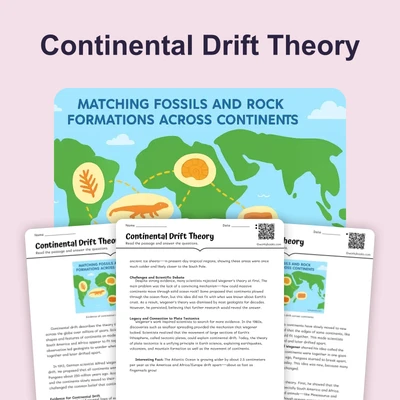
Continental drift is the idea that Earth's continents were once joined together and have slowly moved apart over millions of years. In the early 1900s, a German scientist named Alfred Wegener proposed this bold hypothesis. He noticed something remarkable when looking at world maps. The continents seemed to fit together like pieces of a jigsaw puzzle. The bulge of South America matched the curve of Africa almost perfectly. Wegener wondered if these landmasses had once been connected.
Wegener gathered several types of evidence to support his idea. First, he studied the coastlines of continents separated by vast oceans. The shapes matched too well to be coincidence. Second, scientists had discovered identical fossils of ancient plants and animals on continents now thousands of miles apart. For example, fossils of a reptile called Mesosaurus appeared in both South America and Africa. This creature could not have swum across the Atlantic Ocean. Third, Wegener found that rock layers and mountain ranges lined up across oceans. The Appalachian Mountains in North America matched mountain ranges in Scotland and Scandinavia in age and rock type.
Wegener proposed that all continents had once formed a single giant landmass he called Pangaea, meaning "all Earth." According to his hypothesis, Pangaea began breaking apart about 200 million years ago. The continents then drifted to their current positions. Evidence showed that this movement happened very slowly, only a few centimeters per year. Despite the strong evidence, most scientists rejected Wegener's idea. The main problem was that he could not explain what force could move massive continents through solid ocean floor.
The scientific community remained skeptical of continental drift for decades after Wegener's death in 1930. Scientists needed to understand the mechanism behind the movement. Without explaining how continents could move, the hypothesis seemed impossible. However, Wegener's careful observations and evidence collection laid important groundwork. His rejected idea eventually became the foundation of plate tectonics, the modern theory that explains how Earth's surface moves and changes. Today, scientists recognize continental drift as a key concept in understanding our planet's history.
Interesting Fact: If you could travel back 200 million years, you could walk from Africa to South America without crossing any ocean because they were connected as part of Pangaea!
Comprehension quiz (10 questions)
1. What is continental drift?
2. Who proposed the continental drift hypothesis?
3. What does the word 'hypothesis' mean in the passage?
4. What does 'Pangaea' mean?
5. Which piece of evidence did Wegener use to support his hypothesis?
6. Why did most scientists initially reject Wegener's idea?
7. Based on the passage, what can you infer about scientific progress?
8. If you found identical fossils of a land animal on two continents separated by an ocean, what would this suggest?
9. True or False: Wegener's continental drift hypothesis became the foundation of modern plate tectonics theory.
10. True or False: Continents move several miles per year according to Wegener's evidence.
Perfect for the way you teach
- Build comprehension skills
- Auto-graded quiz
- Differentiated reading
- Read together at home
- Improve fluency
- Quiet reading time
- Reading curriculum support
- Independent practice
- Track Lexile growth