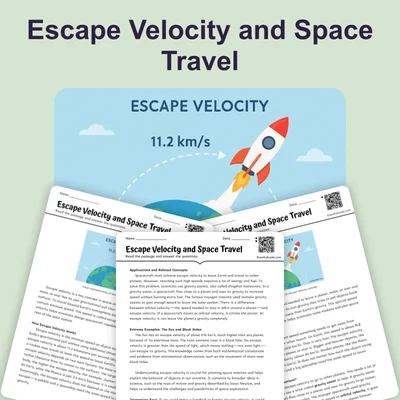
This engaging 400-500 word reading passage introduces middle school students to the concept of escape velocity, the minimum speed needed for an object to break free from a planet's gravitational pull. Students explore why Earth's escape velocity is approximately 11.2 kilometers per second and how this concept applies to space exploration. The passage is aligned with NGSS MS-ESS1-2 and MS-ESS1.B Earth and the Solar System standards. Through clear explanations and real-world examples, students learn how scientists use escape velocity to launch rockets and spacecraft. The content includes audio integration for enhanced accessibility, vocabulary development with 8-10 key science terms, and differentiated versions for English Language Learners. Activities include comprehension questions, writing prompts, and graphic organizers that help students analyze cause and effect relationships in gravitational systems. This resource supports evidence-based learning and helps students understand how gravity shapes space exploration.
Written by Workybooks TeamPublished by Workybooks
Preview
Sample passage and quiz content
CONTENT PREVIEW
Expand content preview
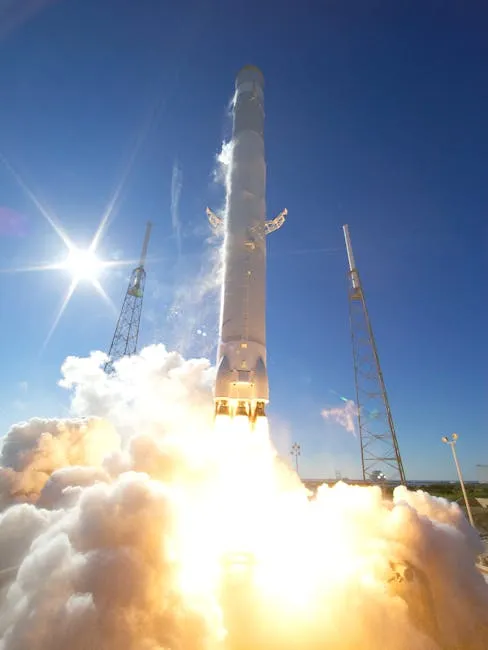
Escape velocity is the minimum speed an object needs to break free from a planet's gravitationalpull. Image by SpaceX / Pexels.
Escape velocity is the minimum speed an object needs to break free from a planet's gravitational pull. Once an object reaches this speed, it can leave the planet without falling back. For Earth, escape velocity is about 11.2 kilometers per second. That equals roughly 40,000 kilometers per hour. Scientists use this concept to plan space missions and launch rockets beyond Earth's atmosphere.
Gravity is a force that pulls objects toward the center of a planet. The stronger the gravity, the faster an object must travel to escape. Evidence shows that larger planets with more mass have higher escape velocities. Jupiter, for example, has an escape velocity of about 60 kilometers per second. Smaller bodies like Earth's Moon have lower escape velocities, around 2.4 kilometers per second. This difference happens because the Moon has less mass than Earth.
Scientists explain that escape velocity depends on two main factors. The first factor is the planet's mass, which determines how strong its gravitational pull is. The second factor is the distance from the planet's center to the object. An object on Earth's surface must overcome the full strength of Earth's gravity. Think of it like climbing a hill. The steeper the hill, the more effort you need to reach the top. Similarly, stronger gravity requires greater speed to escape.
Space agencies apply escape velocity calculations when launching spacecraft. In 1969, NASA launched Apollo 11 toward the Moon. The Saturn V rocket accelerated the spacecraft to exceed Earth's escape velocity. Once the spacecraft reached this speed, it could travel away from Earth. The rocket used powerful engines and multiple stages to build up enough speed. Without reaching escape velocity, the spacecraft would have fallen back to Earth due to gravity's pull.
Understanding escape velocity helps scientists design missions to other planets and beyond. It also explains why some objects, like meteorites, can enter Earth's atmosphere but others cannot escape. This concept connects to how celestial bodies interact in our solar system. Gravity shapes the motion of planets, moons, and spacecraft throughout space.
Interesting Fact: If Earth were compressed to the size of a marble while keeping the same mass, its escape velocity would increase dramatically. The stronger gravitational pull at the surface would require much greater speed to break free.
What is escape velocity?
The maximum speed a rocket can reachThe minimum speed needed to break free from a planet's gravitational pullThe speed at which planets orbit the SunThe speed of light in space
What is Earth's escape velocity?
About 2.4 kilometers per secondAbout 11.2 kilometers per secondAbout 60 kilometers per secondAbout 100 kilometers per second
In the passage, what does 'gravitational pull' mean?
The speed of a falling objectThe weight of a planetThe force that attracts objects toward the center of a planetThe distance between two planets
What does the word 'mass' refer to in this passage?
The size of a planetThe amount of matter in an objectThe temperature of a planetThe color of a planet
Why does Jupiter have a higher escape velocity than Earth?
Jupiter is farther from the SunJupiter has more mass and stronger gravityJupiter spins faster than EarthJupiter has more moons than Earth
Based on the passage, what can you infer about the Moon's escape velocity compared to Earth's?
The Moon's escape velocity is higher because it is smallerThe Moon's escape velocity is lower because it has less massThe Moon's escape velocity is the same as Earth'sThe Moon has no escape velocity
How would scientists apply the concept of escape velocity when planning a mission to Mars?
They would calculate the speed needed to leave Earth and enter Mars orbitThey would measure the distance between Earth and MarsThey would determine the color of MarsThey would count the number of rocks on Mars
If a planet had twice Earth's mass but the same size, what would happen to its escape velocity?
It would decreaseIt would stay the sameIt would increaseIt would become zero
True or False: An object that reaches escape velocity will eventually fall back to the planet's surface.
TrueFalse
True or False: The Apollo 11 spacecraft needed to reach Earth's escape velocity to travel to the Moon.
TrueFalse
Who it's for
Perfect for the way you teach
Teachers
Build comprehension skills
Auto-graded quiz
Differentiated reading
Parents
Read together at home
Improve fluency
Quiet reading time
Homeschoolers
Reading curriculum support
Independent practice
Track Lexile growth
Topics
escape velocitygravitygravitational pullspace explorationrocketsEarth scienceNGSS MS-ESS1-2middle school science
Reviews & Ratings
No reviews yet. Be the first to share your experience!
More reading you might love
20 more
Comets
This middle school science passage explores the fascinating world of comets, commonly known as 'dirty snowballs.' Studen...
MS-ESS1-2
Mercury: Closest to the Sun
This comprehensive, standards-aligned passage explores Mercury—the smallest and closest planet to the Sun. Students in g...
MS-ESS1-2MS-ESS1-3
Venus: Earth's Twin?
This comprehensive science passage for grades 6-8 examines Venus—often called Earth's twin—by exploring its similarities...
MS-ESS1-2MS-ESS1-3
Earth: Our Home Planet
This comprehensive science passage for grades 6-8 explores Earth’s unique characteristics and the interconnected systems...
MS-ESS1-2
Mars: The Red Planet
This middle school science passage explores Mars, the Red Planet, providing students in grades 6-8 with a comprehensive ...
MS-ESS1-2MS-ESS1-3
Kepler's Laws of Planetary Motion
This comprehensive middle school science passage explores Kepler's Laws of Planetary Motion, meeting NGSS Standard MS-ES...
MS-ESS1-2
Tides and Tidal Forces
This middle school science passage explores the mechanisms of tides and tidal forces, aligning with NGSS standards MS-ES...
MS-ESS1-1MS-ESS1-2
Escape Velocity and Space Travel
This middle school science passage introduces students to the concept of escape velocity—the minimum speed required to b...
MS-ESS1-2MS-PS2-4
Weightlessness and Microgravity
This science reading passage for middle school students explores the phenomenon of weightlessness and microgravity. Alig...
MS-PS2-4MS-ESS1-2
Orbits and Orbital Motion
This middle school science passage, aligned with NGSS MS-ESS1-2 and MS-PS2-4, explores the science of orbits and orbital...
MS-ESS1-2MS-PS2-4
What Is the Solar System?
This passage provides a comprehensive overview of the solar system for grades 6-8, aligned with NGSS standards MS-ESS1-2...
MS-ESS1-2MS-ESS1-3
Structure of the Solar System
This comprehensive science reading passage introduces middle school students (grades 6-8) to the structure of the solar ...
MS-ESS1-2MS-ESS1-3
Moons of the Solar System
This comprehensive passage, designed for grades 6-8 and aligned to NGSS standard MS-ESS1-2, delves into the fascinating ...
MS-ESS1-2
Defining Life: What Are We Looking For?
This informational science passage for middle school students explores the question: What is life, and how do we define ...
MS-LS1-1MS-ESS1-2
Astronomy
This comprehensive reading passage introduces middle school students to the science of astronomy, which is the study of ...
MS-ESS1-2MS-ESS1-3MS-PS4-2MS-ETS1-1
The Solar System
This middle school science passage introduces students to the solar system, aligning with NGSS standards MS-ESS1-2 and M...
MS-ESS1-2MS-ESS1-3
Gravity and Orbits
This comprehensive passage for grades 6-8 explains the science of gravity and orbits, aligning with NGSS standard MS-ESS...
MS-ESS1-2
The Inner Planets
This comprehensive science passage for grades 6-8 explores the inner (terrestrial) planets of our solar system—Mercury, ...
MS-ESS1-2MS-ESS1-3
The Outer Planets
This engaging science passage for grades 6-8 introduces students to the outer planets—Jupiter, Saturn, Uranus, and Neptu...
MS-ESS1-2MS-ESS1-3
Tides
This comprehensive middle school science reading passage explores the phenomenon of ocean tides, aligned to NGSS standar...