What Is Mercury Like
Interactive passage with audio narration, comprehension questions, and printable PDF.
By completing this purchase you agree to our Terms of Use and Privacy Policy. Your subscription renews automatically until you cancel. You can cancel anytime from your account settings. All sales are final and non-refundable. Digital content is available for download in your account immediately upon purchase.
What's included
What Is Mercury Like preview and details
About this printable What Is Mercury Like science reading passage, NGSS-aligned (Grades 5-8)
Sample passage and quiz from What Is Mercury Like
Reading passage and comprehension quiz preview
What Is Mercury Like
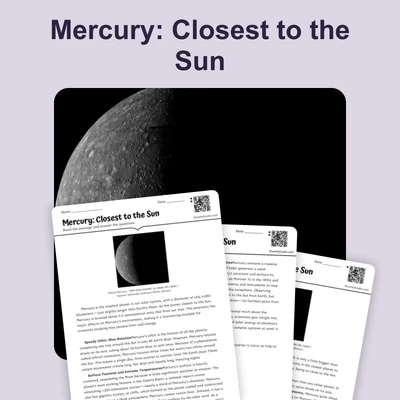
Mercury is the smallest planet in our solar system and the closest one to the Sun. This rocky world has a heavily cratered surface that looks similar to Earth's Moon. Mercury has almost no atmosphere to protect it or trap heat. Because of this, Mercury experiences the most extreme temperature swings of any planet in our solar system.
Scientists explain that Mercury's lack of atmosphere causes its dramatic temperature changes. During the day, the side facing the Sun can reach temperatures of about 430 degrees Celsius. This heat is intense enough to melt lead. At night, the same surface drops to around negative 180 degrees Celsius. Without an atmosphere to distribute warmth, heat escapes quickly into space. The planet rotates very slowly, so one side faces the Sun for a long time. This rotation pattern makes the temperature differences even more extreme.
Mercury's surface shows evidence of billions of years of impacts from space rocks. The craters formed when asteroids and comets crashed into the planet. The largest crater, called Caloris Basin, measures about 1,550 kilometers across. Scientists observe that Mercury has cliffs and ridges that may have formed when the planet's interior cooled and shrank. The surface also contains plains of ancient volcanic rock. Mercury has a large iron core that makes up about 75 percent of the planet's radius.
NASA's MESSENGER spacecraft studied Mercury from orbit between 2011 and 2015. This mission provided detailed maps and measurements of the planet's surface and composition. Scientists discovered ice in permanently shadowed craters near Mercury's poles. This finding surprised researchers because Mercury is so close to the Sun. The ice can exist because sunlight never reaches the bottoms of these deep craters. Understanding Mercury helps scientists learn how rocky planets form and change over time.
Interesting Fact: A year on Mercury (one orbit around the Sun) takes only 88 Earth days, but a single day on Mercury (one complete rotation) lasts 59 Earth days. This means Mercury completes three rotations for every two orbits around the Sun.
Comprehension quiz (10 questions)
1. What is Mercury's position in the solar system?
2. Why does Mercury experience extreme temperature swings?
3. What does the word 'atmosphere' mean in this passage?
4. How hot can Mercury's surface get during the day?
5. What caused the craters on Mercury's surface?
6. Based on the passage, what can you infer about planets without atmospheres?
7. Why was the discovery of ice on Mercury surprising to scientists?
8. If you were designing a spacecraft to land on Mercury, what challenge would the extreme temperatures create?
9. True or False: Mercury's surface looks similar to Earth's Moon because both have many craters.
10. True or False: Mercury has a thick atmosphere that protects it from temperature changes.
Perfect for the way you teach
- Build comprehension skills
- Auto-graded quiz
- Differentiated reading
- Read together at home
- Improve fluency
- Quiet reading time
- Reading curriculum support
- Independent practice
- Track Lexile growth