This engaging 450-word reading passage introduces middle school students to the concept of parallax and its crucial role in astronomy. Aligned with NGSS MS-ESS1.A and MS-ESS1-3, the passage begins with a relatable finger-blinking demonstration before scaling up to explain how astronomers use parallax to measure distances to nearby stars. Students learn about vantage points, baseline measurements, and the relationship between parallax angle and distance. The passage includes real-world applications, showing how the Hipparcos satellite used parallax to map over 100,000 stars. With integrated audio support, glossary terms, and differentiated versions, this resource helps students understand fundamental concepts in stellar astronomy. The content emphasizes scientific observation and evidence-based reasoning while maintaining appropriate vocabulary for grades 6-8. Activities include comprehension questions, writing prompts, and graphic organizers that reinforce understanding of this essential astronomical measurement technique.
Written by Workybooks TeamPublished by Workybooks
Preview
Sample passage and quiz content
CONTENT PREVIEW
Expand content preview
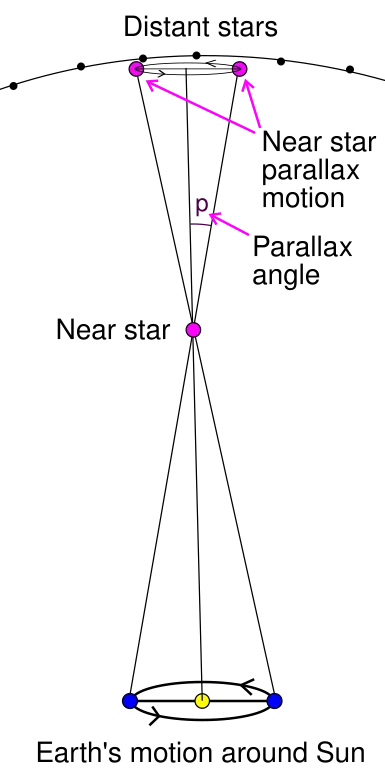
Parallax is the apparent shift in position of a nearby object when you view it from two different locations. "Stellarparallax2" by Booyabazooka at English Wikipedia. / Wikimedia Commons
Parallax is the apparent shift in position of a nearby object when you view it from two different locations. You can observe this effect right now with a simple demonstration. Hold your finger at arm's length and close your left eye. Now blink and look with only your right eye. Your finger appears to jump to a new position against the background. This shift happens because each eye provides a different vantage point.
Scientists use parallax to measure distances to stars in our galaxy. When Earth orbits the Sun, it travels millions of miles across space. Astronomers observe a nearby star from opposite sides of Earth's orbit, six months apart. The star appears to shift slightly against the background of more distant stars. This apparent movement is called stellar parallax. The size of the shift depends on how far away the star is located.
The measurement works through geometry and angles. Astronomers measure the parallax angle, which is half the total apparent shift of the star. The baseline is the distance between the two observation points, which equals the diameter of Earth's orbit. Scientists use these measurements to calculate the star's distance. A smaller parallax angle indicates a star is farther away. A larger angle means the star is relatively close to our solar system.
The Hipparcos satellite, launched by the European Space Agency in 1989, measured parallax for more than 100,000 stars. This data helped astronomers create accurate maps of nearby stars. The mission showed that parallax measurements can reach stars up to several hundred light-years away. Beyond this distance, the parallax angle becomes too small to measure accurately with current technology. Astronomers must use other methods to determine distances to more distant stars and galaxies.
Understanding parallax matters because it provides a fundamental way to measure cosmic distances. These measurements help scientists determine the size and scale of our galaxy. Parallax also allows astronomers to calculate the true luminosity of stars by comparing their actual brightness to how bright they appear from Earth. This technique serves as the first step in a distance measurement ladder that extends across the universe.
Interesting Fact: The nearest star to our Sun, Proxima Centauri, has a parallax angle of only 0.77 arcseconds—about the width of a dime viewed from two miles away!
What is parallax?
The actual movement of stars through spaceThe apparent shift in position of a nearby object when viewed from two different locationsThe brightness of a star as seen from EarthThe distance between Earth and the Sun
When you hold up your finger and blink each eye, why does your finger appear to move?
Your finger is actually moving back and forthEach eye provides a different vantage pointYour brain creates an optical illusionThe background behind your finger shifts position
What does the term 'baseline' refer to in parallax measurements of stars?
The distance from Earth to the nearest starThe apparent shift of a star against the backgroundThe distance between two observation pointsThe angle formed by the star's movement
What does a smaller parallax angle indicate about a star's distance?
The star is closer to EarthThe star is farther away from EarthThe star is moving faster through spaceThe star is brighter than other stars
According to the passage, how does parallax help astronomers calculate a star's luminosity?
By measuring how fast the star movesBy determining the star's colorBy comparing the star's actual brightness to how bright it appears from EarthBy counting how many planets orbit the star
The Hipparcos satellite measured parallax for stars up to several hundred light-years away.
TrueFalse
What is stellar parallax?
The actual movement of stars in our galaxyThe apparent shift of a nearby star against distant stars as Earth orbits the SunThe brightness of stars as measured from spaceThe distance between two stars in a binary system
Why must astronomers wait six months between observations when measuring stellar parallax?
To allow the star to move to a new positionTo observe Earth from opposite sides of its orbit around the SunTo wait for better weather conditionsTo give telescopes time to cool down
Parallax can be used to measure distances to all stars in the universe.
TrueFalse
Based on the passage, which statement best explains why parallax is important in astronomy?
It proves that Earth orbits the SunIt provides a fundamental way to measure cosmic distances and understand galaxy scaleIt shows that all stars are the same distance from EarthIt demonstrates that stars do not move through space
Who it's for
Perfect for the way you teach
Teachers
Build comprehension skills
Auto-graded quiz
Differentiated reading
Parents
Read together at home
Improve fluency
Quiet reading time
Homeschoolers
Reading curriculum support
Independent practice
Track Lexile growth
Topics
parallaxstellar parallaxastronomydistance measurementstarsgalaxiesNGSS MS-ESS1.Aperspectivevantage pointastronomical unit
Reviews & Ratings
No reviews yet. Be the first to share your experience!
More reading you might love
20 more
Sunspots and Solar Flares
This quiz is designed to test your understanding of the fascinating phenomena of sunspots and solar flares, as described...
RI.4.1RI.4.4RI.5.1ESS1.A
The Hottest Planet in the Solar System
This NGSS-aligned middle school reading passage explains why Venus is the hottest planet in our solar system. Students l...
MS-ESS1-3
Mercury: Closest to the Sun
This comprehensive, standards-aligned passage explores Mercury—the smallest and closest planet to the Sun. Students in g...
MS-ESS1-2MS-ESS1-3
Venus: Earth's Twin?
This comprehensive science passage for grades 6-8 examines Venus—often called Earth's twin—by exploring its similarities...
MS-ESS1-2MS-ESS1-3
Mars: The Red Planet
This middle school science passage explores Mars, the Red Planet, providing students in grades 6-8 with a comprehensive ...
MS-ESS1-2MS-ESS1-3
What Is the Solar System?
This passage provides a comprehensive overview of the solar system for grades 6-8, aligned with NGSS standards MS-ESS1-2...
MS-ESS1-2MS-ESS1-3
Structure of the Solar System
This comprehensive science reading passage introduces middle school students (grades 6-8) to the structure of the solar ...
MS-ESS1-2MS-ESS1-3
Scale of the Solar System
This passage, aligned to NGSS standard MS-ESS1-3, helps middle school students grasp the immense scale of the solar syst...
MS-ESS1-3
Exploration of the Solar System
This comprehensive passage for grades 6-8 examines how humans explore the solar system, aligning with NGSS standards MS-...
MS-ESS1-3MS-ETS1-1
Optical Telescopes
This comprehensive passage explores the science of optical telescopes for middle school students, aligning with NGSS sta...
MS-ESS1-3MS-ETS1-1
Future of Alien Search
This informational passage for grades 6-8 explores how scientists are using cutting-edge missions and technology to sear...
MS-ESS1-3MS-ETS1-1
Communicating with Aliens
This middle school science passage, aligned with NGSS standard MS-ESS1-3, examines the scientific and technological chal...
MS-ESS1-3
Measuring Distances in Space
This middle school science passage explores how astronomers measure the vast distances in space, aligning with NGSS stan...
MS-ESS1-3
Astronomy
This comprehensive reading passage introduces middle school students to the science of astronomy, which is the study of ...
MS-ESS1-2MS-ESS1-3MS-PS4-2MS-ETS1-1
The Solar System
This middle school science passage introduces students to the solar system, aligning with NGSS standards MS-ESS1-2 and M...
MS-ESS1-2MS-ESS1-3
The Inner Planets
This comprehensive science passage for grades 6-8 explores the inner (terrestrial) planets of our solar system—Mercury, ...
MS-ESS1-2MS-ESS1-3
The Outer Planets
This engaging science passage for grades 6-8 introduces students to the outer planets—Jupiter, Saturn, Uranus, and Neptu...
MS-ESS1-2MS-ESS1-3
Light-Years and Cosmic Distances
This middle school science passage, aligned to NGSS MS-ESS1-3, explores how astronomers measure the vast distances in sp...
MS-ESS1-3
Space Stations
This informational science reading passage for grades 6-8 explores the complex systems and technology behind space stati...
MS-ESS1-3MS-ETS1-1
Types of Spacecraft
This passage introduces middle school students to the various types of spacecraft used to explore our solar system and b...