What Is Per-Capita Consumption
Interactive passage with audio narration, comprehension questions, and printable PDF.
By completing this purchase you agree to our Terms of Use and Privacy Policy. Your subscription renews automatically until you cancel. You can cancel anytime from your account settings. All sales are final and non-refundable. Digital content is available for download in your account immediately upon purchase.
What's included
What Is Per-Capita Consumption preview and details
About this printable What Is Per-Capita Consumption science reading passage, NGSS-aligned (Grades 6-8)
Sample passage and quiz from What Is Per-Capita Consumption
Reading passage and comprehension quiz preview
What Per-Capita Consumption Means
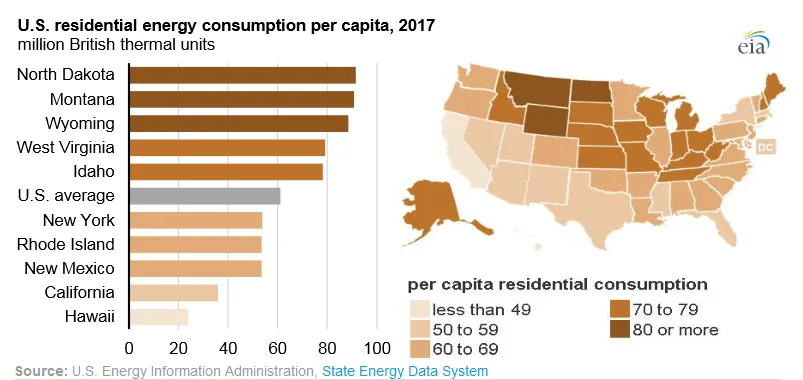
"U.S. residential energy consumption per capita in 2017 (48676866461)" by U.S. Energy Information Administration / Wikimedia Commons (Public domain).
Per-capita consumption is the average amount of resources used by each person in a population. The term "per capita" comes from Latin and means "per head" or "per person." Scientists calculate per-capita consumption by dividing the total resources a country uses by its total population. This measurement helps us understand how much energy, water, food, and materials each person in a nation typically uses.
Per-capita consumption varies dramatically across different nations. People in wealthy, industrialized countries generally consume far more resources than people in developing nations. For example, the average person in the United States uses about 80 kilograms of resources per day, while the average person in Bangladesh uses only about 4 kilograms per day. This difference exists because of factors like economic development, technology access, infrastructure, and lifestyle choices. Wealthier nations have more cars, larger homes, more appliances, and greater access to processed foods and manufactured goods.
Understanding per-capita consumption is crucial for analyzing environmental impact. A country's total impact on Earth's systems depends on both its population size and its per-capita consumption rate. This relationship can be expressed as: Total Impact = Population × Per-Capita Consumption. This means a smaller population with high consumption can strain Earth's resources and ecosystems just as much as a larger population with lower consumption.
Consider two hypothetical countries to illustrate this concept. Country A has 10 million people, and each person uses 50 units of resources per year. Country B has 50 million people, but each person uses only 10 units of resources per year. When we calculate total consumption, both countries use 500 million units of resources annually. Even though Country B has five times more people, both nations place equal demands on Earth's systems because of the difference in per-capita consumption.
This pattern appears in real-world data. The United States has about 330 million people, while India has over 1.4 billion people—more than four times the U.S. population. However, because per-capita consumption in the United States is so much higher, Americans consume more total resources in several categories despite having a much smaller population. This demonstrates how consumption patterns can matter as much as population size when evaluating environmental stress.
Several factors drive differences in per-capita consumption. Industrialization increases resource use through manufacturing and transportation. Urbanization concentrates people in cities where they rely on complex supply chains. Cultural values and expectations about standard of living also play important roles. In some societies, owning multiple vehicles and large homes is considered normal, while in others, public transportation and smaller living spaces are the standard. Climate also affects consumption, as heating and cooling buildings requires significant energy.
Reducing per-capita consumption in high-consuming nations could significantly decrease humanity's overall environmental footprint. Small changes in wealthy countries—like improving energy efficiency, reducing waste, choosing sustainable products, and using public transportation—can have large impacts because they affect populations with high consumption rates. Meanwhile, as developing nations work to improve living standards for their citizens, finding ways to do so without dramatically increasing per-capita consumption presents a major challenge for global sustainability.
Interesting Fact: If everyone on Earth consumed resources at the same rate as the average American, we would need approximately five Earths to sustainably provide all those resources.
Comprehension quiz (10 questions)
1. What does "per capita" mean?
2. How do scientists calculate per-capita consumption?
3. According to the passage, the average person in the United States uses approximately how much resources per day compared to a person in Bangladesh?
4. What does the formula "Total Impact = Population × Per-Capita Consumption" demonstrate?
5. In the context of the passage, what is "industrialization"?
6. Why can a smaller population with high consumption strain Earth's systems as much as a larger population with lower consumption?
7. Which factor does NOT contribute to differences in per-capita consumption according to the passage?
8. What can help reduce humanity's overall environmental footprint according to the passage?
9. True or False: According to the passage, the United States has a larger population than India.
10. True or False: If everyone consumed resources like the average American, we would need approximately five Earths to sustainably provide those resources.
Perfect for the way you teach
- Build comprehension skills
- Auto-graded quiz
- Differentiated reading
- Read together at home
- Improve fluency
- Quiet reading time
- Reading curriculum support
- Independent practice
- Track Lexile growth