Reading PassagePremium

What Is the Ring of Fire

Interactive passage with audio narration, comprehension questions, and printable PDF.

No ratings yet
Grades 5–8ScienceElaEnglish · SpanishInteractive · Printable
Aligned toMS-ESS2-2
Just this resource
$1.50
One-time purchase
Best value
Unlock everything
$49.99$24.99/yr
50% off until Sept 15 — 10,000+ resources
Renews at $49.99/year.

By completing this purchase you agree to our Terms of Use and Privacy Policy. Your subscription renews automatically until you cancel. You can cancel anytime from your account settings. All sales are final and non-refundable. Digital content is available for download in your account immediately upon purchase.

Unlock above to use these actions

What's included

Reading passage
Audio narration
Comprehension quiz
Writing activity
Glossary & flashcards
Differentiated version
Spanish translation

What Is the Ring of Fire preview and details

About this printable What Is the Ring of Fire science reading passage, NGSS-aligned (Grades 5-8)

This comprehensive 400-500 word reading passage explores the Ring of Fire, Earth's most active tectonic region. Aligned with NGSS MS-ESS2-2 and MS-ESS2.B standards, the passage explains how converging plates and subduction zones create concentrated volcanic and seismic activity around the Pacific Ocean. Students learn why approximately 75% of the world's volcanoes and 90% of earthquakes occur in this horseshoe-shaped belt. The lesson connects plate boundary concepts to real-world patterns, helping students understand why certain regions experience constant geologic hazards. Audio-integrated features support diverse learners. The passage includes relevant vocabulary such as subduction zones, tectonic plates, converging boundaries, trenches, seismic activity, and magma. Real-world examples and evidence-based explanations help students grasp the relationship between plate tectonics and natural hazards, making this abstract concept concrete and relevant to understanding Earth's dynamic systems.
Written by Workybooks TeamPublished by Workybooks
Preview

Sample passage and quiz from What Is the Ring of Fire

Reading passage and comprehension quiz preview

What Is the Ring of Fire?
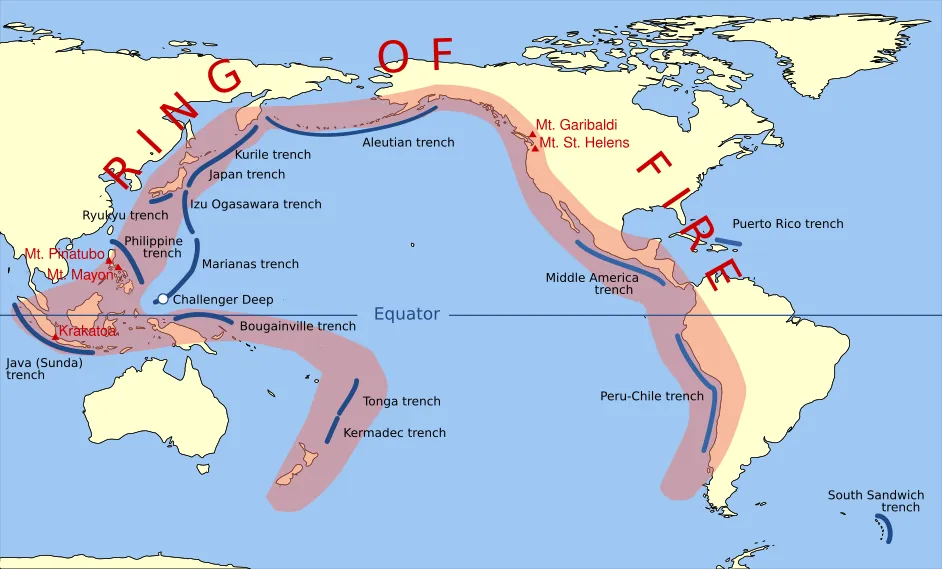
Pacific Ring of Fire

"Pacific Ring of Fire" by Gringer (talk) 23:52, 10 February 2009 (UTC) / Wikimedia Commons.

The Ring of Fire is a vast, horseshoe-shaped belt that surrounds the Pacific Ocean. It stretches along the west coasts of South and North America, across to Alaska, and down through Japan, the Philippines, and New Zealand. This region represents Earth's most dramatic showcase of plate tectonics in action. Scientists observe that about three-quarters of the world's volcanoes and roughly 90 percent of its earthquakes occur along this belt.

The Ring of Fire exists because of what happens at subduction zones. These are places where two tectonic plates collide and one plate dives beneath the other. As the denser oceanic plate sinks into Earth's mantle, it creates a deep ocean trench. The descending plate releases water and other materials as it heats up. This causes the rock above to melt and form magma. The magma rises through cracks in the overlying plate, eventually erupting as volcanoes. Evidence shows that this process creates chains of volcanoes parallel to the trenches.

The same collision that builds volcanoes also generates earthquakes. As plates grind past each other, they can stick together temporarily. Pressure builds until the plates suddenly slip, releasing energy as seismic waves. The 2011 earthquake near Japan demonstrates this process. That event occurred where the Pacific Plate subducts beneath the North American Plate. The earthquake triggered a massive tsunami and caused widespread damage.

Understanding the Ring of Fire helps explain why some regions face constant geologic hazards while others remain relatively calm. Countries along the ring must prepare for volcanic eruptions and earthquakes. Scientists monitor these areas carefully to protect communities. The Ring of Fire connects all the concepts from plate boundary studies: converging plates, subduction, trenches, volcanoes, and earthquakes concentrated in one giant loop around the Pacific.

Interesting Fact: Mount Ruapehu in New Zealand and Mount St. Helens in Washington State are both part of the Ring of Fire. Despite being thousands of miles apart, they formed through the same subduction process.

Comprehension quiz (10 questions)

1. What is the Ring of Fire?

A circular ocean current in the Pacific
A horseshoe-shaped belt around the Pacific Ocean with many volcanoes and earthquakes
A type of underwater volcano
A ring of islands in the Atlantic Ocean

2. Approximately what percentage of the world's earthquakes occur along the Ring of Fire?

50 percent
65 percent
75 percent
90 percent

3. What happens at a subduction zone?

Two plates slide past each other horizontally
Two plates move apart and create new crust
One plate dives beneath another plate
Plates stop moving completely

4. In the passage, the word 'magma' refers to:

Solid rock on Earth's surface
Melted rock beneath Earth's surface
Water released from sinking plates
Energy released during earthquakes

5. Based on the passage, why do volcanoes form along subduction zones?

The sinking plate releases water that causes rock above to melt and rise
Ocean water seeps down and creates steam
Plates moving apart allow lava to escape
Earthquakes crack the surface and release magma

6. What example does the passage give to demonstrate how subduction causes earthquakes?

The 1906 San Francisco earthquake
The 2011 earthquake near Japan
The eruption of Mount St. Helens
The formation of the Hawaiian Islands

7. Why do some regions experience more geologic hazards than others?

They are closer to the equator
They have more rainfall
They are located along active plate boundaries like the Ring of Fire
They have older rocks

8. According to the passage, what do scientists do to help protect communities along the Ring of Fire?

Build walls around volcanoes
Monitor the areas carefully
Stop plates from moving
Fill in ocean trenches

9. True or False: The Ring of Fire stretches along the east coast of Asia.

True
False

10. True or False: Mount Ruapehu and Mount St. Helens formed through different geological processes.

True
False
Who it's for

Perfect for the way you teach

Teachers
  • Build comprehension skills
  • Auto-graded quiz
  • Differentiated reading
Parents
  • Read together at home
  • Improve fluency
  • Quiet reading time
Homeschoolers
  • Reading curriculum support
  • Independent practice
  • Track Lexile growth
Topics

Reviews & Ratings

No reviews yet. Be the first to share your experience!

More reading you might love

20 more
Passage
Talus Slopes: Formation and Features - reading educational content
Grades 5–8

Talus Slopes: Formation and Features

science · MS-ESS2-1+2

Free
Passage
Stratigraphic Columns: Decoding Earth’s Geological Layers - reading educational content
Grades 5–8

Stratigraphic Columns: Decoding Earth’s Geological Layers

science · MS-ESS2-2+2

Free
Passage
Frost Wedging: How Ice Splits Rock - reading educational content
Grades 5–8

Frost Wedging: How Ice Splits Rock

earth and space science · MS-ESS2-1+2

$1.50
Passage
Chemical Weathering: The Breakdown of Rocks Through Chemical Reactions - reading educational content
Grades 5–8

Chemical Weathering: The Breakdown of Rocks Through Chemical Reactions

earth and space science · MS-ESS2-1+2

Free
Passage
What Is Space Weather and How Does It Affect the Earth? - reading educational content
Grades 3–7

What Is Space Weather and How Does It Affect the Earth?

earth and space science · MS-ESS2-2

$1.50
Passage
When Was The Last Ice Age - reading educational content
Grade 6

When Was The Last Ice Age

earth and space science · MS-ESS2-2

$1.50
Passage
Tools and Technology in Earth Science - reading educational content
Grades 5–8

Tools and Technology in Earth Science

science · MS-ESS2-2+4

$1.50
Passage
Maps and Mapping - reading educational content
Grades 5–8

Maps and Mapping

earth and space science · MS-ESS2-2

$1.50
Passage
Latitude and Longitude - reading educational content
Grades 5–8

Latitude and Longitude

earth and space science · MS-ESS2-2

$1.50
Passage
Topographic Maps - reading educational content
Grades 5–8

Topographic Maps

earth and space science · MS-ESS2-2+3

$1.50
Passage
Contour Lines and Elevation - reading educational content
Grades 5–8

Contour Lines and Elevation

earth and space science · MS-ESS2-2+3

$1.50
Passage
Maps and Their Uses - reading educational content
Grades 5–8

Maps and Their Uses

earth and space science · MS-ESS2-2+5

$1.50
Passage
Mountains and Mountain Building - reading educational content
Grades 5–8

Mountains and Mountain Building

earth and space science · MS-ESS2-1+1

$1.50
Passage
Earth's Interior - reading educational content
Grades 5–8

Earth's Interior

earth and space science · MS-ESS2-1+1

$1.50
Passage
Continental Drift Theory - reading educational content
Grades 5–8

Continental Drift Theory

earth and space science · MS-ESS2-2+1

Free
Passage
Seafloor Spreading - reading educational content
Grades 5–8

Seafloor Spreading

science · MS-ESS2-2+1

$1.50
Passage
Theory of Plate Tectonics - reading educational content
Grades 5–8

Theory of Plate Tectonics

earth and space science · MS-ESS2-2

$1.50
Passage
Divergent Plate Boundaries - reading educational content
Grades 5–8

Divergent Plate Boundaries

earth and space science · MS-ESS2-2

$1.50
Passage
Convergent Plate Boundaries - reading educational content
Grades 5–8

Convergent Plate Boundaries

earth and space science · MS-ESS2-2

$1.50
Passage
Transform Plate Boundaries - reading educational content
Grades 5–8

Transform Plate Boundaries

earth and space science · MS-ESS2-2

$1.50
Copyright © 2026 Workybooks Classroom. Made with ♥ in California.