What Makes a Mineral Valuable — Reading Comprehension
Premium Resource
Grades
6
7
8
Standards
MS-ESS3-1
PRINT+DIGITAL RESOURCE
This learning resource is available in interactive and printable formats. The interactive worksheet can be played online and assigned to students. The Printable PDF version can be downloaded and printed for completion by hand.
This comprehensive 650-word reading passage for middle school students (grades 6-8) explores what makes minerals economically valuable. Aligned with NGSS science standard MS-ESS3-1, the passage describes key properties including hardness, rarity, chemical composition, and industrial usefulness. Students learn how value is determined by both physical properties and human demand for specific applications. The passage includes real-world examples like diamond cutting tools and smartphone minerals, with audio integration for enhanced learning. Activities include multiple-choice questions, writing prompts, and graphic organizers that help students understand the relationship between mineral properties and economic value. The curriculum includes a simplified differentiated version for English Language Learners and struggling readers, Spanish translations, a comprehensive glossary of scientific terms, and engaging activities that reinforce understanding of natural resource economics and earth science concepts.
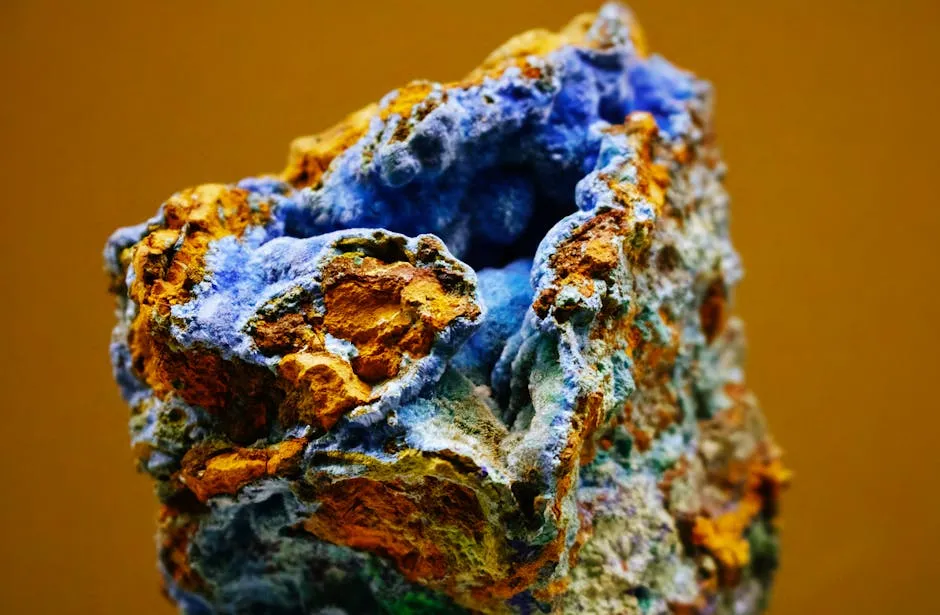
"Vibrant blue azurite minerals on a rugged orange-brown matrix." Image by James Lee / Pexels.
Minerals are naturally occurring solid substances found in Earth's crust. Not all minerals are equally valuable to humans. A mineral's value depends on specific physical properties and how useful it is for human needs. Understanding what makes minerals valuable helps explain why some minerals cost more than others and why certain minerals are essential for modern technology and industry.
One important property that affects mineral value is hardness. Hardness measures how well a mineral resists being scratched or worn down. Scientists use the Mohs scale, which ranks minerals from 1 (softest) to 10 (hardest). Diamond, the hardest natural mineral at 10 on the Mohs scale, is extremely valuable for cutting and drilling tools because it can cut through almost any material. In contrast, talc, the softest mineral at 1 on the Mohs scale, has different uses like making powder. Hard minerals are often more valuable for industrial applications where durability matters.
Rarity also significantly impacts mineral value. When a mineral is rare, meaning it exists in limited quantities or in only a few locations on Earth, it becomes more valuable. Gold and platinum are valuable partly because they are rare. The principle of supply and demand applies to minerals just as it does to other resources. When supply is low but demand is high, prices increase. However, rarity alone does not guarantee value—a mineral must also be useful or desirable to humans.
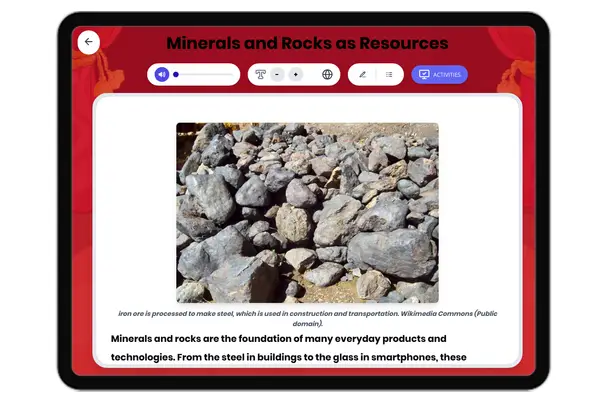
The chemical composition of minerals determines their specific properties and uses. Chemical composition refers to the elements that make up a mineral and how those atoms are arranged. For example, copper minerals contain copper atoms that can be extracted and used to make electrical wiring because copper conducts electricity well. Iron-containing minerals are valuable because iron can be processed into steel for construction. The specific elements in a mineral determine whether it will be useful for electronics, construction, medicine, or other applications.
Perhaps most importantly, a mineral's industrial usefulness drives its economic value. Industrial usefulness means how well a mineral serves practical purposes in manufacturing, technology, or construction. Quartz, which contains silicon, is essential for making computer chips and glass. Lithium minerals have become increasingly valuable because lithium is needed for rechargeable batteries in smartphones, laptops, and electric vehicles. As technology changes, the demand for certain minerals can increase dramatically. Rare earth elements, once considered less important, are now highly valuable because they are essential components in smartphones, wind turbines, and military equipment.
The relationship between mineral properties and value is complex. A mineral might possess excellent physical properties but have little value if humans have not discovered useful applications for it. Conversely, a relatively common mineral can become valuable when new technologies create demand. Economic factors, including mining costs, processing difficulty, and transportation expenses, also affect whether extracting a mineral is profitable. Environmental regulations and political factors in mineral-rich regions can influence availability and price as well.
Scientists and engineers continually evaluate Earth's mineral resources to meet changing human needs. As populations grow and technology advances, the demand for specific minerals shifts. Understanding mineral properties helps society make informed decisions about resource use, recycling, and finding substitutes for scarce materials. The value of minerals ultimately reflects both their physical characteristics and humanity's evolving needs.
Interesting Fact: Your smartphone contains more than 30 different minerals, including gold, silver, copper, and rare earth elements. Some of these minerals are more concentrated in your phone than in the ore originally mined from the ground, which is why recycling old electronics is becoming an important source of valuable minerals.
What does hardness measure in minerals?
How well a mineral resists being scratched or worn downHow rare a mineral is in Earth's crustHow many elements make up a mineralHow much a mineral costs in the market
According to the passage, what rank does diamond have on the Mohs scale?
15810
What does the term 'chemical composition' mean in the context of minerals?
The color and texture of a mineralThe elements that make up a mineral and how atoms are arrangedThe location where a mineral is foundThe price of a mineral in different countries
Why have lithium minerals become increasingly valuable?
They are the hardest minerals on EarthThey are needed for rechargeable batteries in electronics and electric vehiclesThey can be used to make jewelryThey are the rarest minerals ever discovered
According to the principle of supply and demand, what happens when supply is low but demand is high?
Prices decreasePrices stay the samePrices increaseThe mineral becomes worthless
Based on the passage, which factor does NOT directly affect a mineral's economic value?
Industrial usefulnessThe color of the mineralRarityChemical composition
Why is copper valuable according to the passage?
It is the hardest mineral availableIt conducts electricity well and can be used for electrical wiringIt is extremely rare and difficult to findIt can be made into jewelry
What can be inferred about rare earth elements from the passage?
They have always been considered highly valuableThey are only used in jewelryTheir value increased as technology created new uses for themThey are the most common minerals on Earth
True or False: A mineral's rarity alone guarantees that it will be valuable.
TrueFalse
True or False: Your smartphone contains more than 30 different minerals.
TrueFalse
Perfect For:
👩🏫 Teachers
• Reading comprehension practice
• Auto-graded assessments
• Literacy skill development
👨👩👧👦 Parents
• Reading practice at home
• Comprehension improvement
• Educational reading time
🏠 Homeschoolers
• Reading curriculum support
• Independent reading practice
• Progress monitoring
Reading Features:
📖
Reading Passage
Engaging fiction or nonfiction text
❓
Comprehension Quiz
Auto-graded questions
📊
Instant Feedback
Immediate results and scoring
📄
Printable Version
Download for offline reading
🔊
Read Aloud
Voice-over with word highlighting
Reviews & Ratings
No reviews yet. Be the first to share your experience!
Related Content
How Do Solar Panels Work?
This middle school reading passage explains how solar panels work by turning sunlight into electricity. The passage desc...
MS-ESS3-1
How Do Wind Turbines Work?
This NGSS-aligned reading passage for middle school students explains how wind turbines convert the energy of moving air...
MS-ESS3-1
How Does a Hydroelectric Dam Work?
This NGSS-aligned science passage for middle school students explains how hydroelectric dams work to produce clean, rene...
MS-ESS3-1
What Is Biofuel?
This NGSS-aligned middle school science passage explains what biofuel is, how it is made, and why it is important as a c...
MS-ESS3-1
What Is Tidal Energy?
This engaging reading passage for middle school students introduces tidal energy, a form of renewable energy that uses t...
MS-ESS3-1
What Is Wave Energy?
This passage introduces middle school students to wave energy—a clean, renewable energy source that comes from the movem...
MS-ESS3-1
What Is Green Energy?
This science passage introduces middle school students to the concept of green energy—clean, renewable energy that comes...
MS-ESS3-1
Igneous Rocks
This comprehensive passage introduces middle school students to igneous rocks, focusing on how these rocks form from mol...
MS-ESS2-1MS-ESS3-1
Sedimentary Rocks
This comprehensive middle school science passage introduces students to sedimentary rocks, detailing their step-by-step ...
MS-ESS2-1MS-ESS2-3MS-ESS3-1
Metamorphic Rocks
This engaging middle school science passage introduces students to the fascinating world of metamorphic rocks. Aligned w...
MS-ESS2-1MS-ESS3-1
Topographic Maps
This comprehensive passage introduces middle school students to topographic maps, with a focus on how these maps represe...
MS-ESS2-2MS-ESS3-1SEP.4SEP.7
Minerals and Rocks as Resources
This middle school science passage, aligned to NGSS standards MS-ESS3-1 and MS-ESS3-4, explores the critical role that m...
MS-ESS3-1MS-ESS3-4
Benefits of Volcanic Activity
This middle school science passage explores the many positive impacts of volcanic activity, aligning with NGSS standards...
MS-ESS2-2MS-ESS3-1
Groundwater
This middle school science passage explores the essential topic of groundwater, aligned to NGSS standards MS-ESS2-4 and ...
MS-ESS2-4MS-ESS3-1
Distribution of Water on Earth
This middle school science reading passage explores the distribution of water on Earth, aligned with NGSS standards MS-E...
MS-ESS2-4MS-ESS3-1
Water as a Resource
This middle school science passage examines water as a critical resource, focusing on how it is used, managed, and conse...
MS-ESS3-1MS-ESS3-4
Water Quality
This middle school science reading passage covers the topic of water quality, aligned with NGSS standards MS-ESS3-1 and ...
MS-ESS3-1MS-ESS3-3
Why Is Uranium Found in Certain Rock Types
This informative science reading passage for middle school students (grades 6-8) explains why uranium concentrates in ce...
MS-ESS3-1
How Minerals Are Mined
This comprehensive 650-word informational science reading passage teaches middle school students (grades 6-8) about mine...
MS-ESS3-1
Why Are Resources Unevenly Distributed on Earth
This comprehensive 650-word reading passage explains why natural resources are unevenly distributed across Earth's surfa...