What Makes Something a Mineral — Reading Comprehension
Rate this
Premium Resource
Present
Present in classroom. No work saved
Assign
Classroom with student accounts, Track progress
Quick Play
No student accounts, assign with a link
Grades
6
7
8
Standards
MS-ESS3-1
PRINT+DIGITAL RESOURCE
This learning resource is available in interactive and printable formats. The interactive worksheet can be played online and assigned to students. The Printable PDF version can be downloaded and printed for completion by hand.
This comprehensive 650-word reading passage for grades 6-8 teaches students what makes something a mineral using the four essential criteria: naturally occurring, inorganic, solid, and having a definite crystalline structure. The passage aligns with NGSS standard MS-ESS3-1 and uses familiar examples like quartz, calcite, and halite to help students distinguish true minerals from rocks, organic materials, and synthetic substances. Students explore how each criterion applies to real minerals and learn why understanding mineral properties matters for identifying Earth's resources. The passage includes audio integration, a simplified version for struggling readers, Spanish translations, a comprehensive glossary of key terms, multiple-choice questions assessing various comprehension levels, writing activities that encourage analysis and explanation, and graphic organizers including classification and compare-contrast tables. This standards-aligned resource provides differentiated instruction suitable for diverse middle school learners studying earth science and mineral properties.
CONTENT PREVIEW
Expand content preview
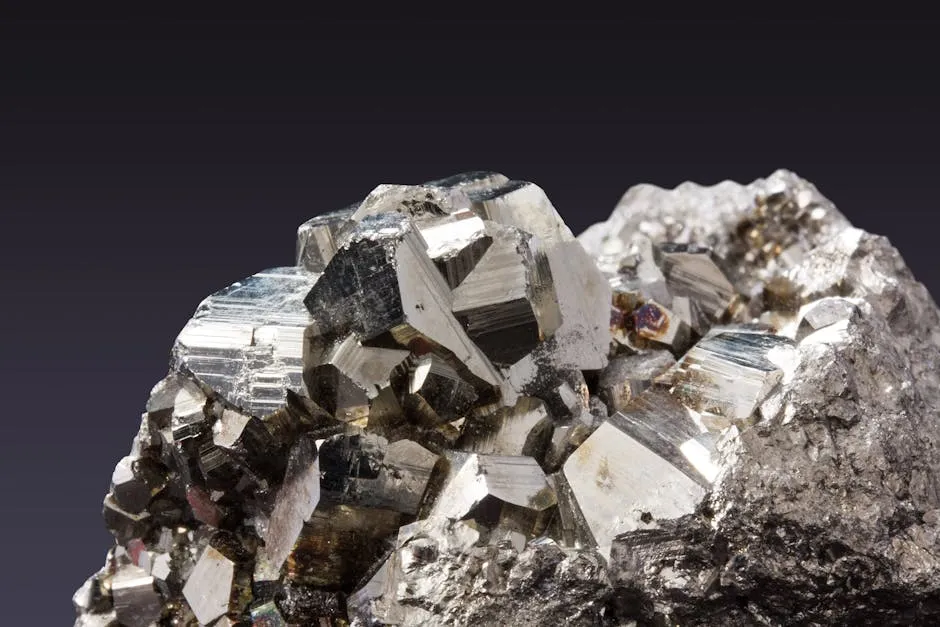
"Close-up image of sparkling pyrite crystals showcasing their metallic luster." by Pixabay / Pexels.
A mineral is a substance found in nature that meets four specific criteria. To be classified as a mineral, a substance must be naturally occurring, inorganic, solid, and have a definite crystalline structure. These four requirements help scientists distinguish minerals from other materials like rocks, living things, and human-made substances. Understanding what makes something a mineral is essential for identifying Earth's natural resources and studying how our planet formed.
The first criterion is that a mineral must be naturally occurring. This means it forms through natural processes in the Earth, not in a laboratory or factory. For example, quartz crystals grow naturally in rocks deep underground when hot water carries dissolved silica through cracks in the Earth's crust. Even though scientists can create quartz-like substances in labs, these synthetic materials are not considered true minerals because they are human-made. Only substances that form without human intervention qualify as minerals.
The second criterion states that minerals must be inorganic, meaning they are not made by living organisms and do not contain carbon-hydrogen bonds typical of living things. Calcite, a common mineral found in limestone, forms from chemical processes in water rather than from plant or animal activity. While some organisms like clams create calcite shells, the calcite itself is still considered a mineral because its chemical structure is inorganic. This criterion excludes materials like wood, bone, and coal, which come from once-living organisms.
The third requirement is that minerals must be solid at normal Earth surface temperatures. This means minerals have a definite shape and volume, unlike liquids or gases. Halite, commonly known as table salt, is a solid mineral that forms when salty water evaporates from oceans or lakes. Water and mercury are not minerals because they are liquid at room temperature, even though they occur naturally. Ice, however, qualifies as a mineral when it forms naturally because it is solid and meets all other criteria.
The fourth and final criterion is that minerals must have a definite crystalline structure. This means the atoms inside a mineral are arranged in an orderly, repeating pattern. In quartz, silicon and oxygen atoms bond together in a specific geometric arrangement that repeats throughout the entire crystal. This internal order gives minerals their characteristic shapes and physical properties. Substances like volcanic glass, which cools too quickly for atoms to arrange in patterns, are not minerals because they lack this crystalline structure.
These four criteria work together to define what qualifies as a mineral. Quartz meets all requirements: it forms naturally in the Earth, contains no carbon-based organic compounds, remains solid at surface temperatures, and has silicon-oxygen atoms arranged in repeating hexagonal patterns. Calcite and halite also satisfy all four criteria, making them true minerals. By contrast, rocks are not minerals because they are mixtures of different minerals rather than pure substances with uniform composition. Understanding these distinctions helps geologists identify and classify the thousands of different minerals found on Earth.
Interesting Fact: Scientists have identified more than 5,000 different minerals on Earth, but only about 100 are common. New minerals are still being discovered every year as geologists explore remote locations and examine rocks more closely with advanced technology.
What are the four criteria that define a mineral?
Naturally occurring, inorganic, solid, and has a definite crystalline structureHuman-made, organic, liquid, and has no structureNaturally occurring, organic, solid, and colorfulInorganic, liquid, rare, and valuable
Which of the following is an example of a naturally occurring mineral mentioned in the passage?
PlasticQuartzWoodGlass made in a factory
What does 'inorganic' mean in the context of minerals?
Made by living organisms with carbon-hydrogen bondsNot made by living organisms and does not contain carbon-hydrogen bonds typical of living thingsFound only in oceansCreated in laboratories
Why is volcanic glass NOT considered a mineral?
It is not naturally occurringIt is not inorganicIt lacks a definite crystalline structure because it cools too quicklyIt is not solid
According to the passage, why are rocks NOT considered minerals?
Rocks are too large to be mineralsRocks are mixtures of different minerals rather than pure substancesRocks are always liquidRocks are made by humans
If a substance is created in a laboratory but has all other mineral characteristics, can it be classified as a true mineral?
Yes, because it has the right chemical structureNo, because it must be naturally occurring to be a true mineralYes, if it is solidNo, because laboratory substances are always organic
What gives minerals their characteristic shapes and physical properties?
Their colorTheir sizeTheir definite crystalline structure with atoms arranged in orderly, repeating patternsThe temperature at which they form
Why does ice qualify as a mineral when it forms naturally?
Because it is colorlessBecause it is solid and meets all four criteria for mineralsBecause it is found in cold placesBecause it contains oxygen
True or False: Coal is considered a mineral because it is solid and found naturally in the Earth.
TrueFalse
True or False: Scientists have identified more than 5,000 different minerals on Earth.
TrueFalse
Perfect For:
👩🏫 Teachers
• Reading comprehension practice
• Auto-graded assessments
• Literacy skill development
👨👩👧👦 Parents
• Reading practice at home
• Comprehension improvement
• Educational reading time
🏠 Homeschoolers
• Reading curriculum support
• Independent reading practice
• Progress monitoring
Reading Features:
📖
Reading Passage
Engaging fiction or nonfiction text
❓
Comprehension Quiz
Auto-graded questions
📊
Instant Feedback
Immediate results and scoring
📄
Printable Version
Download for offline reading
🔊
Read Aloud
Voice-over with word highlighting
Reviews & Ratings
No reviews yet. Be the first to share your experience!
Related Content
How Do Solar Panels Work?
This middle school reading passage explains how solar panels work by turning sunlight into electricity. The passage desc...
MS-ESS3-1
How Do Wind Turbines Work?
This NGSS-aligned reading passage for middle school students explains how wind turbines convert the energy of moving air...
MS-ESS3-1
How Does a Hydroelectric Dam Work?
This NGSS-aligned science passage for middle school students explains how hydroelectric dams work to produce clean, rene...
MS-ESS3-1
What Is Biofuel?
This NGSS-aligned middle school science passage explains what biofuel is, how it is made, and why it is important as a c...
MS-ESS3-1
What Is Tidal Energy?
This engaging reading passage for middle school students introduces tidal energy, a form of renewable energy that uses t...
MS-ESS3-1
What Is Wave Energy?
This passage introduces middle school students to wave energy—a clean, renewable energy source that comes from the movem...
MS-ESS3-1
What Is Green Energy?
This science passage introduces middle school students to the concept of green energy—clean, renewable energy that comes...
MS-ESS3-1
Igneous Rocks
This comprehensive passage introduces middle school students to igneous rocks, focusing on how these rocks form from mol...
MS-ESS2-1MS-ESS3-1
Sedimentary Rocks
This comprehensive middle school science passage introduces students to sedimentary rocks, detailing their step-by-step ...
MS-ESS2-1MS-ESS2-3MS-ESS3-1
Metamorphic Rocks
This engaging middle school science passage introduces students to the fascinating world of metamorphic rocks. Aligned w...
MS-ESS2-1MS-ESS3-1
Topographic Maps
This comprehensive passage introduces middle school students to topographic maps, with a focus on how these maps represe...
MS-ESS2-2MS-ESS3-1SEP.4SEP.7
Minerals and Rocks as Resources
This middle school science passage, aligned to NGSS standards MS-ESS3-1 and MS-ESS3-4, explores the critical role that m...
MS-ESS3-1MS-ESS3-4
Benefits of Volcanic Activity
This middle school science passage explores the many positive impacts of volcanic activity, aligning with NGSS standards...
MS-ESS2-2MS-ESS3-1
Groundwater
This middle school science passage explores the essential topic of groundwater, aligned to NGSS standards MS-ESS2-4 and ...
MS-ESS2-4MS-ESS3-1
Distribution of Water on Earth
This middle school science reading passage explores the distribution of water on Earth, aligned with NGSS standards MS-E...
MS-ESS2-4MS-ESS3-1
Water as a Resource
This middle school science passage examines water as a critical resource, focusing on how it is used, managed, and conse...
MS-ESS3-1MS-ESS3-4
Water Quality
This middle school science reading passage covers the topic of water quality, aligned with NGSS standards MS-ESS3-1 and ...
MS-ESS3-1MS-ESS3-3
Why Is Uranium Found in Certain Rock Types
This informative science reading passage for middle school students (grades 6-8) explains why uranium concentrates in ce...
MS-ESS3-1
How Minerals Are Mined
This comprehensive 650-word informational science reading passage teaches middle school students (grades 6-8) about mine...
MS-ESS3-1
Why Are Resources Unevenly Distributed on Earth
This comprehensive 650-word reading passage explains why natural resources are unevenly distributed across Earth's surfa...