Reading PassagePremium

What Mars Rovers Have Discovered

Interactive passage with audio narration, comprehension questions, and printable PDF.

No ratings yet
Grades 5–8ScienceElaEnglish · SpanishInteractive · Printable
Aligned toMS-ESS1-3
Just this resource
$1.50
One-time purchase
Best value
Unlock everything
$49.99$29.99/yr
40% off until Aug 1 — 10,000+ resources
Renews at $49.99/year.
Unlock above to use these actions

What's included

Reading passage
Audio narration
Comprehension quiz
Writing activity
Glossary & flashcards
Differentiated version
Spanish translation

What Mars Rovers Have Discovered preview and details

About this printable What Mars Rovers Have Discovered science reading passage, NGSS-aligned (Grades 5-8)

This comprehensive 400-500 word informational science passage for grades 6-8 explores how Mars rovers make discoveries about the Red Planet. Aligned with NGSS standards MS-ESS1.B and MS-ESS1-3, the passage focuses on the mechanisms rovers use to conduct science: driving across Martian terrain, drilling into rock samples, analyzing materials with onboard laboratories, and transmitting data back to Earth. Students learn how Curiosity and Perseverance have found evidence of ancient water, organic molecules, and conditions that may have once supported life. The passage emphasizes scientific processes and evidence-based reasoning. Audio-integrated features support diverse learners, while differentiated versions ensure accessibility for English Language Learners and struggling readers. Supplementary activities include comprehension questions, writing prompts, and graphic organizers that reinforce understanding of rover-based planetary science and the nature of scientific investigation.
Written by Workybooks TeamPublished by Workybooks
Preview

Sample passage and quiz from What Mars Rovers Have Discovered

Reading passage and comprehension quiz preview

What Have Mars Rovers Discovered
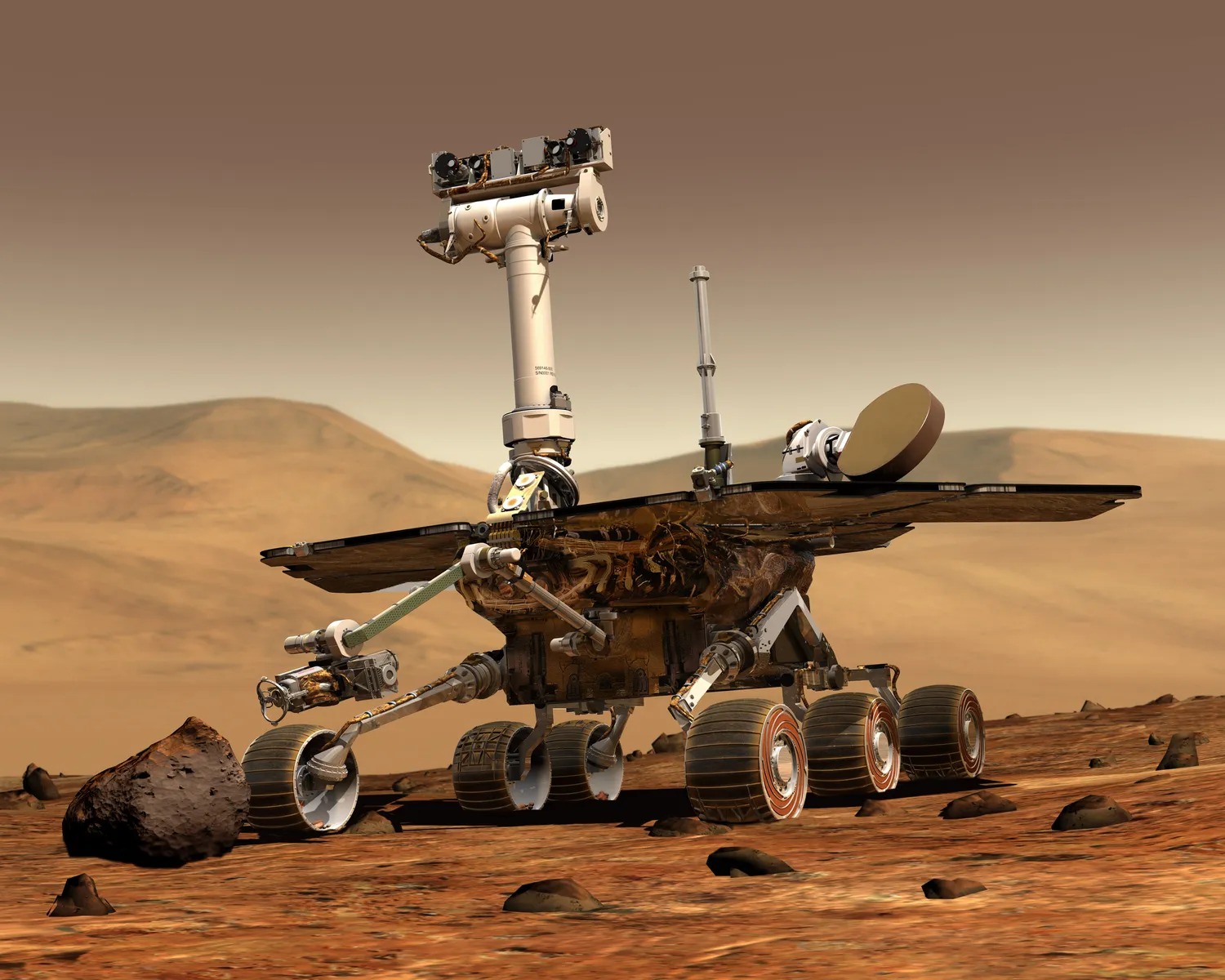
NASA Mars Rover

"NASA Mars Rover" by NASA/JPL/Cornell University, Maas Digital LLC / Wikimedia Commons

Mars rovers have discovered evidence that Mars once had liquid water and conditions that could have supported life. Scientists use these robotic explorers to study the Red Planet's surface and geology. Rovers like Curiosity and Perseverance carry sophisticated instruments that act as mobile science laboratories.

These rovers explore Mars using a careful process. First, they drive across the Martian surface using six wheels designed for rocky terrain. Scientists on Earth examine images sent by the rover's cameras. They identify interesting rocks or soil that may contain important clues. The rover then positions its robotic arm over the target location. A drill on the arm bores into the rock and collects powdered samples.

The collected samples move into the rover's onboard laboratory for analysis. Instruments heat the samples and measure the gases released. Other tools use lasers and X-rays to identify chemical elements present in the rocks. Scientists look for specific minerals that form only in the presence of water. Evidence shows that Curiosity found clay minerals in Gale Crater in 2013. These clays can only form when water interacts with rock over long periods.

Rovers have also detected organic molecules in Martian rocks. Organic molecules contain carbon and hydrogen atoms bonded together. While these molecules can come from living things, they can also form through non-biological processes. Scientists explain that finding organic molecules shows Mars had the chemical building blocks necessary for life. Perseverance recently collected samples from an ancient river delta in Jezero Crater. The layered rocks there suggest water flowed on Mars billions of years ago.

The rovers measure environmental conditions as they explore. Instruments track temperature, humidity, radiation levels, and atmospheric composition. Data indicates that ancient Mars had thicker air and warmer temperatures than today. These conditions may have made parts of Mars habitable for microbial life in the distant past.

Understanding how rovers make discoveries helps scientists plan future missions. The evidence collected by these robots guides our search for signs of ancient life. Each new finding teaches us more about how planets change over time.

Interesting Fact: The Curiosity rover has traveled over 18 miles on Mars since 2012, climbing 2,000 feet up Mount Sharp while analyzing dozens of rock samples along the way.

Comprehension quiz (10 questions)

1. What is the main purpose of Mars rovers like Curiosity and Perseverance?

To transport astronauts across Mars
To study Mars's surface and search for evidence of past water and life
To build settlements on Mars
To mine minerals from Martian rocks

2. How do rovers collect rock samples on Mars?

They pick up rocks with their wheels
They use a robotic arm with a drill to bore into rocks and collect powder
They melt rocks with lasers
They scoop up loose soil from the surface

3. What does the term 'organic molecules' mean in the context of the passage?

Molecules that can only come from living organisms
Molecules made entirely of oxygen
Chemical compounds containing carbon and hydrogen that may or may not come from life
Minerals found only in water

4. Why is the discovery of clay minerals in Gale Crater significant?

Clay minerals prove that aliens lived on Mars
Clay minerals form only when water interacts with rock over long periods
Clay minerals can be used as fuel for rovers
Clay minerals show that Mars has no atmosphere

5. Based on the passage, what can scientists infer about ancient Mars compared to present-day Mars?

Ancient Mars was colder and drier than today
Ancient Mars had thicker air, warmer temperatures, and liquid water
Ancient Mars had no atmosphere at all
Ancient Mars was exactly the same as it is today

6. Which instrument analysis method do rovers use to identify chemical elements in rocks?

Tasting the rock samples
Listening to sounds the rocks make
Using lasers and X-rays to analyze the samples
Comparing rocks to pictures in a database

7. What does 'habitable' mean when scientists describe ancient Mars?

A place where humans could live without spacesuits
Capable of supporting life with appropriate conditions
A place with buildings and cities
Completely covered in water

8. If a rover finds layered rocks in an ancient river delta, what can scientists conclude?

The rocks were brought from Earth
Water flowed in that location over time, depositing sediments in layers
Martians built structures there
The rocks contain no useful information

9. True or False: Finding organic molecules on Mars proves that life currently exists there.

True
False

10. True or False: Rovers send data and images back to Earth so scientists can analyze them and make decisions about what to study next.

True
False
Who it's for

Perfect for the way you teach

Teachers
  • Build comprehension skills
  • Auto-graded quiz
  • Differentiated reading
Parents
  • Read together at home
  • Improve fluency
  • Quiet reading time
Homeschoolers
  • Reading curriculum support
  • Independent practice
  • Track Lexile growth
Topics

Reviews & Ratings

No reviews yet. Be the first to share your experience!

More reading you might love

20 more
Passage
Sunspots and Solar Flares - reading educational content
Grades 4–5

Sunspots and Solar Flares

earth science · RI.4.1

Free
Passage
The Hottest Planet in the Solar System - reading educational content
Grades 3–7

The Hottest Planet in the Solar System

science · MS-ESS1-3

Free
Passage
Mercury: Closest to the Sun - reading educational content
Grades 5–8

Mercury: Closest to the Sun

science · MS-ESS1-2

$1.50
Passage
Venus: Earth's Twin? - reading educational content
Grades 5–8

Venus: Earth's Twin?

science · MS-ESS1-2

$1.50
Passage
Mars: The Red Planet - reading educational content
Grades 5–8

Mars: The Red Planet

science · MS-ESS1-2

$1.50
Passage
What Is the Solar System? - reading educational content
Grades 5–8

What Is the Solar System?

science · MS-ESS1-2

$1.50
Passage
Structure of the Solar System - reading educational content
Grades 5–8

Structure of the Solar System

science · MS-ESS1-2

$1.50
Passage
Scale of the Solar System - reading educational content
Grades 5–8

Scale of the Solar System

science · MS-ESS1-3

$1.50
Passage
Exploration of the Solar System - reading educational content
Grades 5–8

Exploration of the Solar System

science · MS-ESS1-3

$1.50
Passage
Optical Telescopes - reading educational content
Grades 5–8

Optical Telescopes

science · MS-ESS1-3

$1.50
Passage
Future of Alien Search - reading educational content
Grades 5–8

Future of Alien Search

science · MS-ESS1-3

$1.50
Passage
Communicating with Aliens - reading educational content
Grades 5–8

Communicating with Aliens

science · MS-ESS1-3

$1.50
Passage
Measuring Distances in Space - reading educational content
Grades 5–8

Measuring Distances in Space

earth science · MS-ESS1-3

$1.50
Passage
 Astronomy - reading educational content
Grades 5–8

Astronomy

earth science · MS-ESS1-2

$1.50
Passage
The Solar System - reading educational content
Grades 5–8

The Solar System

science · MS-ESS1-2

$1.50
Passage
The Inner Planets - reading educational content
Grades 5–8

The Inner Planets

science · MS-ESS1-2

$1.50
Passage
The Outer Planets - reading educational content
Grades 5–8

The Outer Planets

science · MS-ESS1-2

$1.50
Passage
Light-Years and Cosmic Distances - reading educational content
Grades 5–8

Light-Years and Cosmic Distances

science · MS-ESS1-3

$1.50
Passage
Space Stations - reading educational content
Grades 5–8

Space Stations

science · MS-ESS1-3

$1.50
Passage
Types of Spacecraft - reading educational content
Grades 5–8

Types of Spacecraft

science · MS-ESS1-3

$1.50
Copyright © 2026 Workybooks. Made with ♥ in California.