Why Are Minerals Hard to Replace
Interactive passage with audio narration, comprehension questions, and printable PDF.
By completing this purchase you agree to our Terms of Use and Privacy Policy. Your subscription renews automatically until you cancel. You can cancel anytime from your account settings. All sales are final and non-refundable. Digital content is available for download in your account immediately upon purchase.
What's included
Why Are Minerals Hard to Replace preview and details
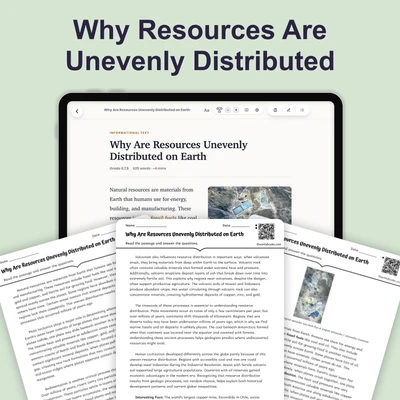
About this printable Why Are Minerals Hard to Replace science reading passage, NGSS-aligned (Grades 6-8)
Sample passage and quiz from Why Are Minerals Hard to Replace
Reading passage and comprehension quiz preview
Why Mineral Resources Are Limited
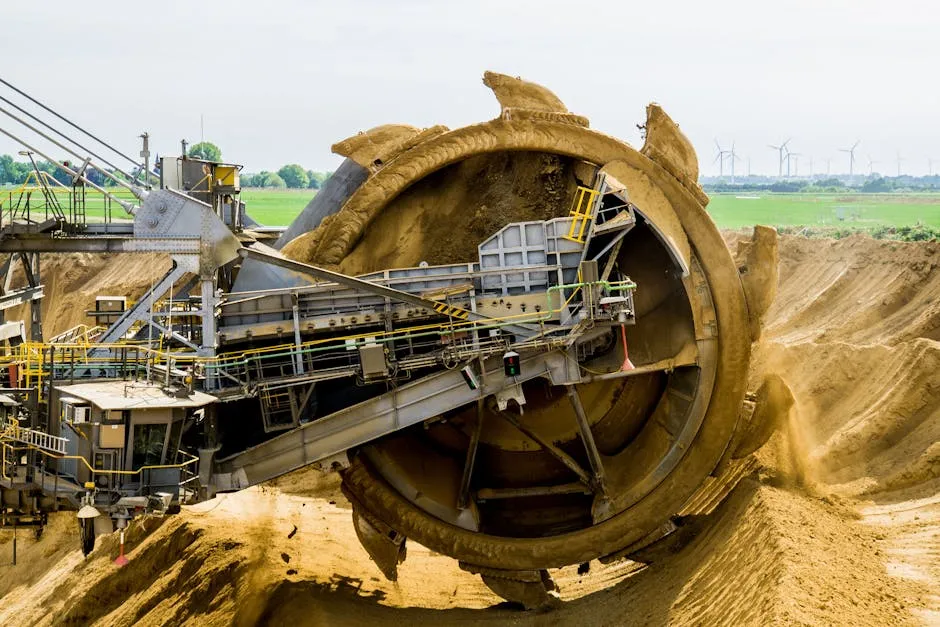
"A massive bucket-wheel excavator performing large-scale industrial mineral extraction." Image by Pixabay / Pexels.
Mineral resources are materials found in Earth's crust that humans extract and use for various purposes. These resources include metals like copper and iron, as well as non-metallic minerals like salt and gypsum. Unlike renewable resources such as trees or fish populations, mineral resources are finite, meaning they exist in limited quantities that cannot be replaced within human timescales. Understanding why minerals are limited requires examining the specific geological conditions needed for their formation.
Minerals form through geological processes that occur deep within Earth over millions of years. Most valuable mineral deposits concentrate through three main processes. First, magma—molten rock beneath Earth's surface—cools slowly, allowing heavy metals to settle and concentrate in specific zones. Second, hot water moving through cracks in rocks dissolves minerals and redeposits them in concentrated veins, a process called hydrothermal activity. Third, weathering and erosion can concentrate certain minerals when lighter materials wash away, leaving heavier minerals behind. Each process requires precise conditions of temperature, pressure, and chemical composition that occur only in specific locations.
The geological conditions necessary for mineral formation are rare and temporary. For example, copper deposits often form at tectonic plate boundaries where oceanic crust slides beneath continental crust. This process, called subduction, creates the exact combination of heat, pressure, and chemical reactions needed to concentrate copper. However, plate boundaries shift over millions of years, and the conditions that created ancient copper deposits no longer exist in those locations. Similarly, iron ore deposits formed billions of years ago when Earth's atmosphere changed composition, but those specific atmospheric conditions will never return.
Because mineral formation requires millions of years and specific geological events, the total amount of accessible minerals is fixed by Earth's geological history. When humans extract minerals through mining, we are removing material that accumulated over vast time periods. A copper mine might extract ore that took 50 million years to form, but the extraction happens in just decades. This creates a fundamental mismatch between the rate of formation and the rate of depletion. As high-quality, easily accessible deposits are exhausted, mining companies must dig deeper or process lower-grade ores, which requires more energy and resources.
The distribution of mineral resources across Earth is also uneven because geological processes occur in specific locations. Major gold deposits exist in South Africa and Nevada because ancient geological events concentrated gold there. Chile contains much of the world's copper because of its position along a major subduction zone. Countries without the right geological history simply lack significant mineral deposits, regardless of exploration efforts. This uneven distribution reflects the random nature of plate tectonics and volcanic activity over Earth's 4.6-billion-year history.
Human demand for minerals continues to increase as populations grow and technology advances. Smartphones alone contain dozens of different minerals, from lithium in batteries to rare earth elements in screens. However, the geological processes that created these mineral deposits operated on timescales completely disconnected from human needs. The copper used in electrical wiring today formed during geological events tens of millions of years ago, long before humans existed. This means our current mineral supply represents a fixed inheritance from Earth's past, not a renewable flow of resources.
Understanding that mineral resources are finite has important implications for how society uses these materials. Since geological processes cannot create new concentrated deposits on human timescales, every ton of metal extracted represents a permanent reduction in Earth's accessible supply. Conservation, recycling, and developing alternative materials become essential strategies for managing limited resources. The absolute ceiling on mineral availability, set by past geological processes, means that current extraction rates cannot continue indefinitely without eventually depleting economically viable deposits.
Interesting Fact: The largest gold deposits on Earth formed around 2.7 billion years ago during a unique period when geological and atmospheric conditions allowed gold to concentrate in ways that have never been repeated in Earth's history.
Comprehension quiz (10 questions)
1. What does it mean that mineral resources are finite?
2. Which of the following is NOT one of the three main processes through which minerals concentrate?
3. In the passage, the word 'hydrothermal' most closely means:
4. According to the passage, what is 'subduction'?
5. Why can't the geological conditions that created ancient copper deposits create new deposits in the same locations today?
6. What fundamental mismatch does the passage describe regarding mineral resources?
7. Based on the passage, why does Chile contain much of the world's copper?
8. What does the passage suggest about the relationship between geological processes and human needs?
9. True or False: According to the passage, recycling and conservation are essential strategies because geological processes cannot create new concentrated mineral deposits on human timescales.
10. True or False: The passage states that mineral resources are renewable because weathering and erosion continuously create new deposits.
Perfect for the way you teach
- Build comprehension skills
- Auto-graded quiz
- Differentiated reading
- Read together at home
- Improve fluency
- Quiet reading time
- Reading curriculum support
- Independent practice
- Track Lexile growth