This 400-500 word informational science reading passage explores why Saturn has rings, aligned to NGSS standard MS-ESS1-3 and DCI MS-ESS1.B Earth and the Solar System. Students in grades 6-8 learn how Saturn's rings formed through a cause-and-effect process involving tidal forces and gravitational disruption. The passage explains how a moon or large icy body came too close to Saturn, causing the planet's gravity to pull more strongly on the near side than the far side, ultimately tearing the object apart. The resulting debris spread into the thin, wide ring system we observe today. This audio-integrated passage includes real-world connections to space exploration, vocabulary development with 8-10 key science terms, and activities that promote scientific reasoning. Students engage with multiple-choice questions, writing prompts, and graphic organizers that reinforce understanding of gravitational forces, planetary systems, and evidence-based explanations in astronomy.
Written by Workybooks TeamPublished by Workybooks
Preview
Sample passage and quiz content
CONTENT PREVIEW
Expand content preview
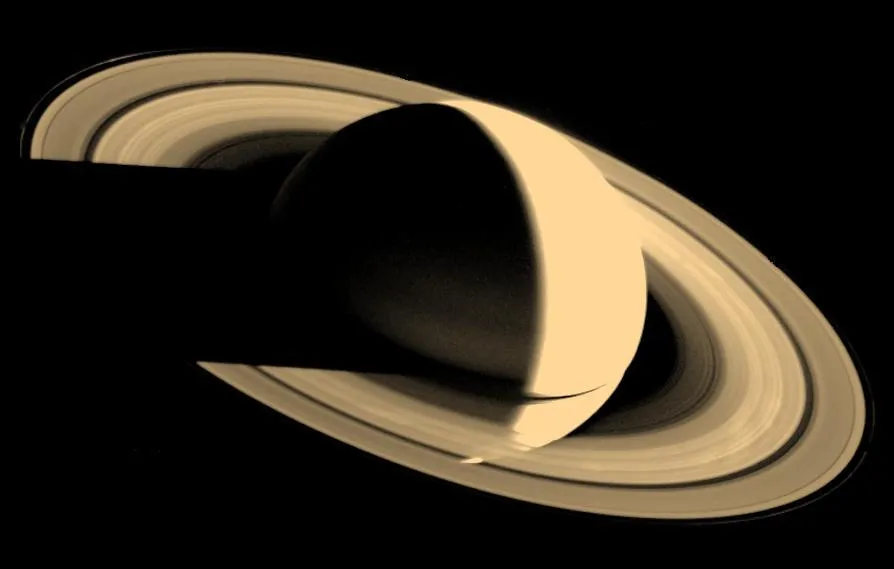
"Saturn and its Rings" / NASA
Saturn's stunning rings make it one of the most recognizable planets in our solar system. Scientists explain that these rings formed when a moon or large icy body came too close to Saturn. The planet's powerful gravity tore the object apart, creating the debris field we see today.
The leading explanation involves a process called tidal forces. When an object moves close to a massive planet like Saturn, gravity pulls more strongly on the side nearest the planet than on the far side. This difference in gravitational pull creates stress across the object. If the object crosses a boundary called the Roche limit, the tidal forces become strong enough to overcome the object's own gravity. Evidence shows that this process can tear moons or comets into millions of pieces.
Once the object broke apart, the debris did not fall into Saturn or drift away into space. Instead, the fragments began orbiting the planet in the same path the original object followed. Over time, collisions between pieces caused the debris to spread outward and flatten into a thin disk. The ring system we observe today extends more than 280,000 kilometers from Saturn but measures only about 10 meters thick in some places. The rings contain countless particles ranging from dust-sized grains to chunks as large as houses. Most of this material consists of water ice mixed with rocky dust.
Scientists use spacecraft observations to study Saturn's rings. The Cassini mission, which orbited Saturn from 2004 to 2017, provided detailed images and data about ring composition and structure. These observations revealed that Saturn's rings may be relatively young, possibly forming within the last 100 million years. This finding surprised researchers who previously thought the rings formed when Saturn did, billions of years ago.
Understanding how Saturn's rings formed helps scientists learn about planetary systems and the role of gravity in shaping celestial objects. The same tidal forces that created Saturn's rings affect moons throughout our solar system. Studying these processes reveals how gravity shapes the universe around us.
Interesting Fact: Saturn is not the only planet with rings—Jupiter, Uranus, and Neptune also have ring systems, but Saturn's rings are by far the largest and brightest.
What caused Saturn's rings to form?
A moon or icy body came too close and was torn apart by tidal forcesSaturn collected dust from passing comets over billions of yearsA large asteroid crashed into Saturn and broke into piecesSaturn's moons gradually broke apart from spinning too fast
What are tidal forces?
Forces that cause ocean tides on EarthThe difference in gravitational pull on different parts of an objectForces that push objects away from planetsThe spinning motion of planets around the Sun
What is the Roche limit?
The maximum distance a moon can orbit from SaturnThe temperature at which ice melts in spaceThe boundary where tidal forces become strong enough to break apart an objectThe speed at which particles must travel to form rings
According to the passage, what happened to the debris after the object broke apart?
It fell into Saturn's atmosphereIt drifted away into deep spaceIt began orbiting Saturn and spread into a thin diskIt formed new moons around Saturn
How thick are Saturn's rings in some places?
About 1 kilometerAbout 100 metersAbout 10 metersAbout 1 meter
What did the Cassini mission reveal about Saturn's rings?
They are made entirely of rock with no iceThey may be relatively young, forming within the last 100 million yearsThey are getting larger every yearThey formed at the same time as Saturn billions of years ago
What are Saturn's rings mostly made of?
Iron and nickelCarbon dioxide iceWater ice mixed with rocky dustPure rock with no ice
Why is studying Saturn's rings important for scientists?
It helps them understand planetary systems and how gravity shapes celestial objectsIt allows them to predict weather patterns on EarthIt helps them find new planets outside our solar systemIt teaches them how to build better spacecraft
Saturn is the only planet in our solar system with rings.
TrueFalse
The debris from the broken object fell into Saturn rather than forming rings.
TrueFalse
Who it's for
Perfect for the way you teach
Teachers
Build comprehension skills
Auto-graded quiz
Differentiated reading
Parents
Read together at home
Improve fluency
Quiet reading time
Homeschoolers
Reading curriculum support
Independent practice
Track Lexile growth
Topics
Saturn ringstidal forcesplanetary formationgravitydebris fieldsolar systemNGSS MS-ESS1-3middle school science
Reviews & Ratings
No reviews yet. Be the first to share your experience!
More reading you might love
20 more
Sunspots and Solar Flares
This quiz is designed to test your understanding of the fascinating phenomena of sunspots and solar flares, as described...
RI.4.1RI.4.4RI.5.1ESS1.A
The Hottest Planet in the Solar System
This NGSS-aligned middle school reading passage explains why Venus is the hottest planet in our solar system. Students l...
MS-ESS1-3
Mercury: Closest to the Sun
This comprehensive, standards-aligned passage explores Mercury—the smallest and closest planet to the Sun. Students in g...
MS-ESS1-2MS-ESS1-3
Venus: Earth's Twin?
This comprehensive science passage for grades 6-8 examines Venus—often called Earth's twin—by exploring its similarities...
MS-ESS1-2MS-ESS1-3
Mars: The Red Planet
This middle school science passage explores Mars, the Red Planet, providing students in grades 6-8 with a comprehensive ...
MS-ESS1-2MS-ESS1-3
What Is the Solar System?
This passage provides a comprehensive overview of the solar system for grades 6-8, aligned with NGSS standards MS-ESS1-2...
MS-ESS1-2MS-ESS1-3
Structure of the Solar System
This comprehensive science reading passage introduces middle school students (grades 6-8) to the structure of the solar ...
MS-ESS1-2MS-ESS1-3
Scale of the Solar System
This passage, aligned to NGSS standard MS-ESS1-3, helps middle school students grasp the immense scale of the solar syst...
MS-ESS1-3
Exploration of the Solar System
This comprehensive passage for grades 6-8 examines how humans explore the solar system, aligning with NGSS standards MS-...
MS-ESS1-3MS-ETS1-1
Optical Telescopes
This comprehensive passage explores the science of optical telescopes for middle school students, aligning with NGSS sta...
MS-ESS1-3MS-ETS1-1
Future of Alien Search
This informational passage for grades 6-8 explores how scientists are using cutting-edge missions and technology to sear...
MS-ESS1-3MS-ETS1-1
Communicating with Aliens
This middle school science passage, aligned with NGSS standard MS-ESS1-3, examines the scientific and technological chal...
MS-ESS1-3
Measuring Distances in Space
This middle school science passage explores how astronomers measure the vast distances in space, aligning with NGSS stan...
MS-ESS1-3
Astronomy
This comprehensive reading passage introduces middle school students to the science of astronomy, which is the study of ...
MS-ESS1-2MS-ESS1-3MS-PS4-2MS-ETS1-1
The Solar System
This middle school science passage introduces students to the solar system, aligning with NGSS standards MS-ESS1-2 and M...
MS-ESS1-2MS-ESS1-3
The Inner Planets
This comprehensive science passage for grades 6-8 explores the inner (terrestrial) planets of our solar system—Mercury, ...
MS-ESS1-2MS-ESS1-3
The Outer Planets
This engaging science passage for grades 6-8 introduces students to the outer planets—Jupiter, Saturn, Uranus, and Neptu...
MS-ESS1-2MS-ESS1-3
Light-Years and Cosmic Distances
This middle school science passage, aligned to NGSS MS-ESS1-3, explores how astronomers measure the vast distances in sp...
MS-ESS1-3
Space Stations
This informational science reading passage for grades 6-8 explores the complex systems and technology behind space stati...
MS-ESS1-3MS-ETS1-1
Types of Spacecraft
This passage introduces middle school students to the various types of spacecraft used to explore our solar system and b...