Why Doesn't the Moon Have Air
Interactive passage with audio narration, comprehension questions, and printable PDF.
By completing this purchase you agree to our Terms of Use and Privacy Policy. Your subscription renews automatically until you cancel. You can cancel anytime from your account settings. All sales are final and non-refundable. Digital content is available for download in your account immediately upon purchase.
What's included
Why Doesn't the Moon Have Air preview and details
About this printable Why Doesn't the Moon Have Air science reading passage, NGSS-aligned (Grades 5-8)
Sample passage and quiz from Why Doesn't the Moon Have Air
Reading passage and comprehension quiz preview
Why Doesn't the Moon Have Air
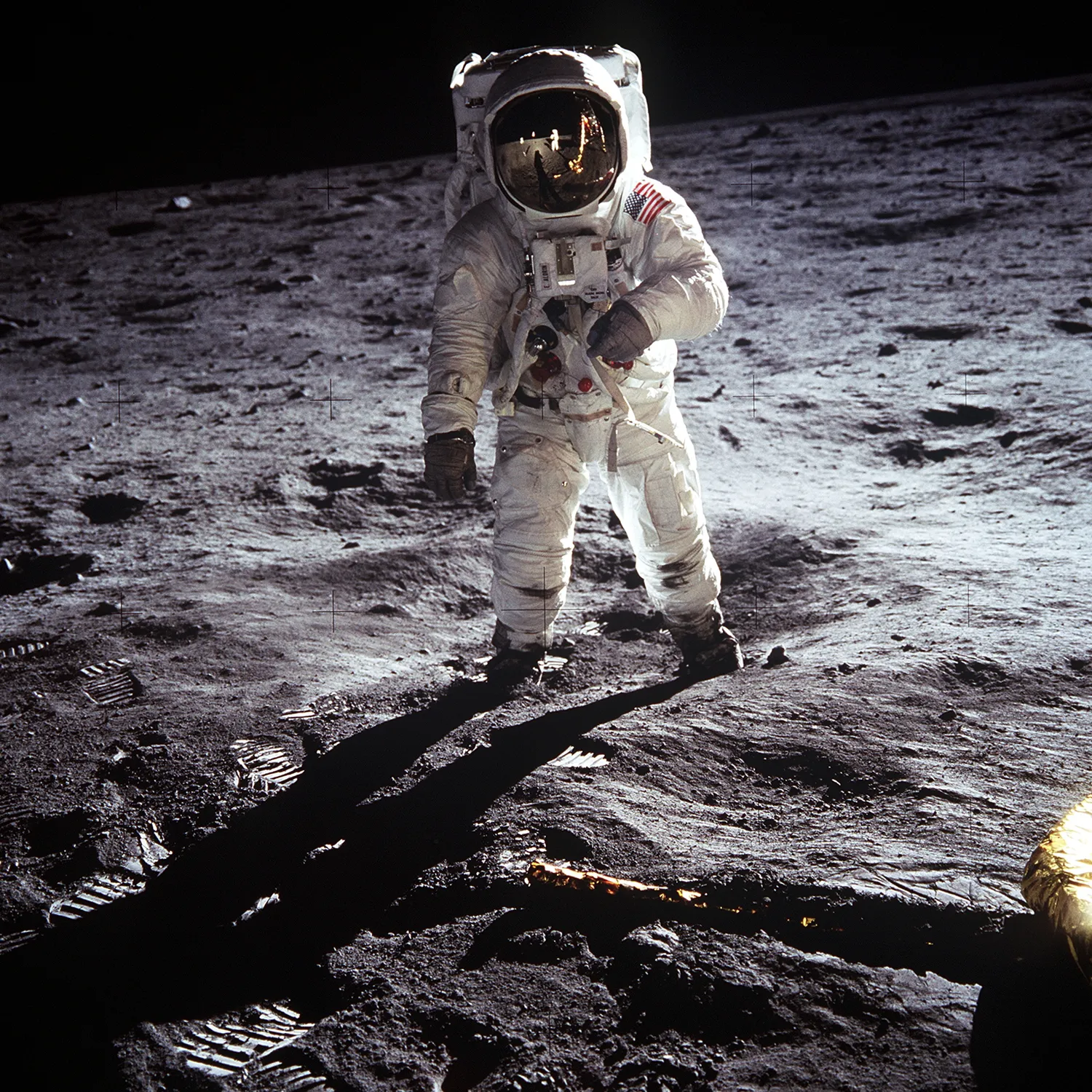
The Moon has almost no atmosphere because its gravity is too weak to hold onto gases. Unlike Earth, which has strong gravity that keeps air molecules close to the surface, the Moon cannot trap the gases needed to form an atmosphere. Scientists explain that any gas molecules on the Moon quickly drift away into space.
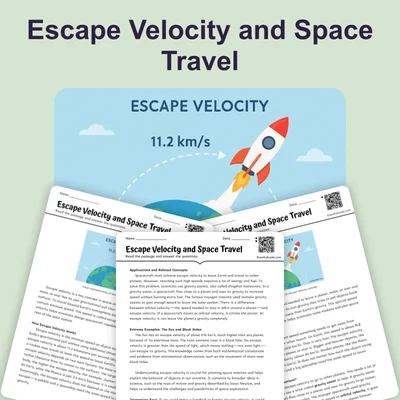
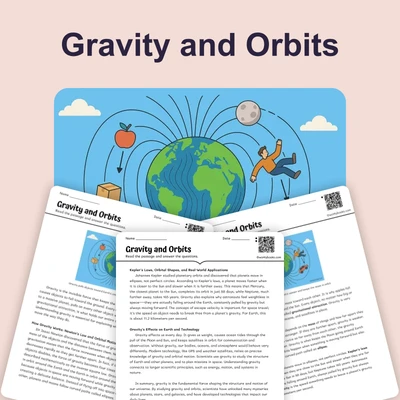
The key to understanding this lies in escape velocity. This is the speed an object needs to break free from a celestial body's gravitational pull. Earth's escape velocity is about 11 kilometers per second. The Moon's escape velocity is only 2.4 kilometers per second. Gas molecules on the Moon move fast enough to exceed this low escape velocity. They simply float away into space. Evidence shows that the Moon's mass is too small to create strong gravity. The Moon has only about 1/6 of Earth's gravitational force.
Without an atmosphere, the Moon experiences extreme conditions. There is no weather because weather requires air to create wind, clouds, and storms. Sound cannot travel on the Moon because sound waves need air molecules to move through. Temperature swings are dramatic and sudden. In direct sunlight, the lunar surface can reach 127 degrees Celsius. In shadow, temperatures plummet to negative 173 degrees Celsius. On Earth, our atmosphere acts like a blanket that spreads heat around. The Moon has no such protection.
NASA's Apollo missions provided direct observations of these conditions. Astronauts had to wear spacesuits with life support systems to survive. Their footprints remain unchanged after decades because there is no wind to disturb them. The astronauts could not hear each other speak outside their spacecraft. They had to communicate through radio signals inside their helmets.
Understanding why the Moon lacks an atmosphere helps scientists study other celestial bodies in our solar system. Mars has a thin atmosphere because its gravity is stronger than the Moon's but weaker than Earth's. Mercury, like the Moon, has almost no atmosphere due to weak gravity and proximity to the Sun. This knowledge matters for future space exploration and potential lunar bases.
Interesting Fact: The Moon does have an extremely thin layer of atoms called an exosphere, but it is so sparse that atoms rarely collide with each other. This exosphere is about 10 trillion times less dense than Earth's atmosphere at sea level.
Comprehension quiz (10 questions)
1. Why doesn't the Moon have an atmosphere?
2. What is the Moon's escape velocity?
3. What does the term 'escape velocity' mean in the passage?
4. How does the Moon's gravitational force compare to Earth's?
5. Based on the passage, why can't sound travel on the Moon?
6. What temperature can the lunar surface reach in direct sunlight?
7. Why do astronaut footprints remain unchanged on the Moon for decades?
8. How might understanding the Moon's lack of atmosphere help scientists study Mars?
9. The Moon has absolutely no gases at all around it.
10. Earth's atmosphere acts like a blanket that spreads heat around the planet.
Perfect for the way you teach
- Build comprehension skills
- Auto-graded quiz
- Differentiated reading
- Read together at home
- Improve fluency
- Quiet reading time
- Reading curriculum support
- Independent practice
- Track Lexile growth