Why Inner Planets Are Rocky
Interactive passage with audio narration, comprehension questions, and printable PDF.
By completing this purchase you agree to our Terms of Use and Privacy Policy. Your subscription renews automatically until you cancel. You can cancel anytime from your account settings. All sales are final and non-refundable. Digital content is available for download in your account immediately upon purchase.
What's included
Why Inner Planets Are Rocky preview and details
About this printable Why Inner Planets Are Rocky science reading passage, NGSS-aligned (Grades 5-8)
Sample passage and quiz from Why Inner Planets Are Rocky
Reading passage and comprehension quiz preview
Why Inner Planets Are Rocky
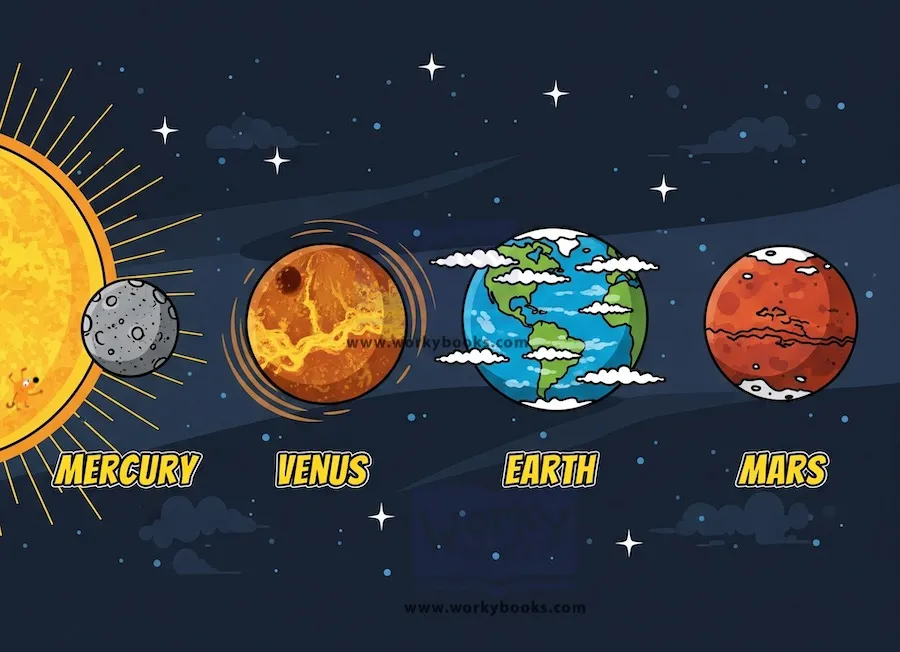
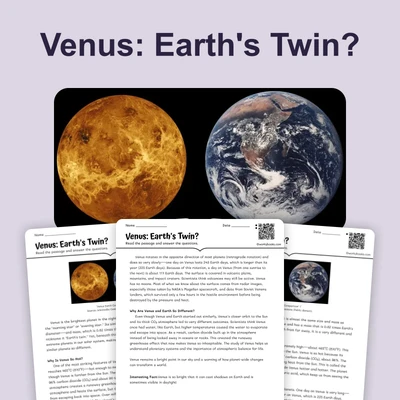
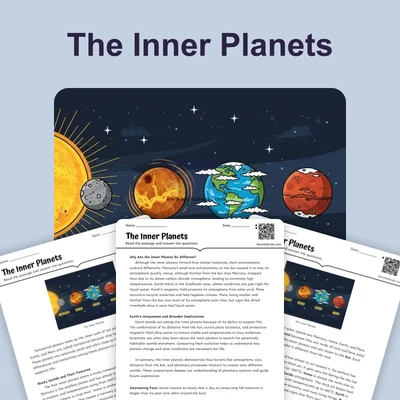
The four planets closest to the Sun are made of rock and metal. Mercury, Venus, Earth, and Mars are called terrestrial planets because of their solid surfaces. Scientists explain that temperature and location determined what materials could form these worlds.
About 4.6 billion years ago, our solar system formed from a spinning cloud of gas and dust called a protoplanetary disk. The young Sun at the center was extremely hot. Close to the Sun, temperatures reached thousands of degrees. In this hot inner region, only materials with high melting points could remain solid. Metals like iron and nickel stayed solid, as did rocky minerals like silicates. Light materials such as hydrogen and helium remained as gases. These gases could not condense into solid or liquid form in the intense heat.
The young Sun also produced a powerful solar wind. This stream of charged particles blew outward through the solar system. The solar wind pushed light gases away from the inner regions. Hydrogen and helium drifted to the cooler outer solar system. There, temperatures were cold enough for these gases to remain and eventually form the giant gas planets. Meanwhile, the inner region was left with mostly rocky and metallic material.
Evidence shows that planets formed when small particles stuck together through gravity. In the inner solar system, only rock and metal particles were available. These materials clumped together over millions of years to form the four terrestrial planets. Scientists study meteorites that fall to Earth today. Many meteorites contain the same rocky and metallic materials found in inner planets. This supports the explanation that temperature and solar wind shaped planetary composition.
Understanding why inner planets are rocky helps scientists learn about planetary formation throughout the universe. Astronomers have discovered thousands of planets orbiting other stars. Many of these exoplanets show similar patterns. Rocky planets tend to orbit close to their stars, while gas giants orbit farther away. This pattern suggests that temperature and stellar wind affect planet formation in other solar systems too.
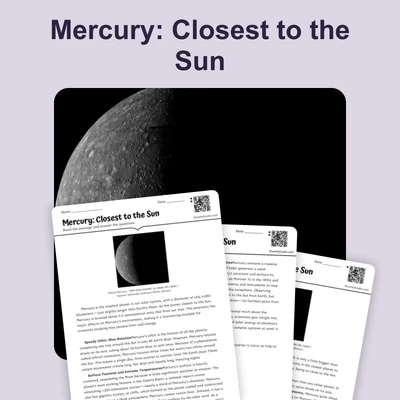
Interesting Fact: Mercury has the largest iron core relative to its size of any planet in our solar system. Scientists think a giant impact may have stripped away much of its rocky outer layer early in solar system history.
Comprehension quiz (10 questions)
1. What are the four inner planets of our solar system called?
2. What is a protoplanetary disk?
3. Why could only metals and rocks remain solid in the inner solar system?
4. What does the term 'condense' mean in the passage?
5. What role did solar wind play in planet formation?
6. How do scientists find evidence that supports the explanation of rocky planet formation?
7. Based on the passage, what can scientists infer about exoplanets that orbit close to their stars?
8. If a planet formed in a very cold region far from a star, what materials would most likely make up that planet?
9. True or False: Light gases like hydrogen and helium could condense into solid form in the hot inner solar system.
10. True or False: The pattern of rocky planets near stars and gas giants farther away has been observed in other solar systems.
Perfect for the way you teach
- Build comprehension skills
- Auto-graded quiz
- Differentiated reading
- Read together at home
- Improve fluency
- Quiet reading time
- Reading curriculum support
- Independent practice
- Track Lexile growth