Why Neptune Has Strong Winds
Interactive passage with audio narration, comprehension questions, and printable PDF.
By completing this purchase you agree to our Terms of Use and Privacy Policy. Your subscription renews automatically until you cancel. You can cancel anytime from your account settings. All sales are final and non-refundable. Digital content is available for download in your account immediately upon purchase.
What's included
Why Neptune Has Strong Winds preview and details
About this printable Why Neptune Has Strong Winds science reading passage, NGSS-aligned (Grades 5-8)
Sample passage and quiz from Why Neptune Has Strong Winds
Reading passage and comprehension quiz preview
Why Does Neptune Have Strong Winds
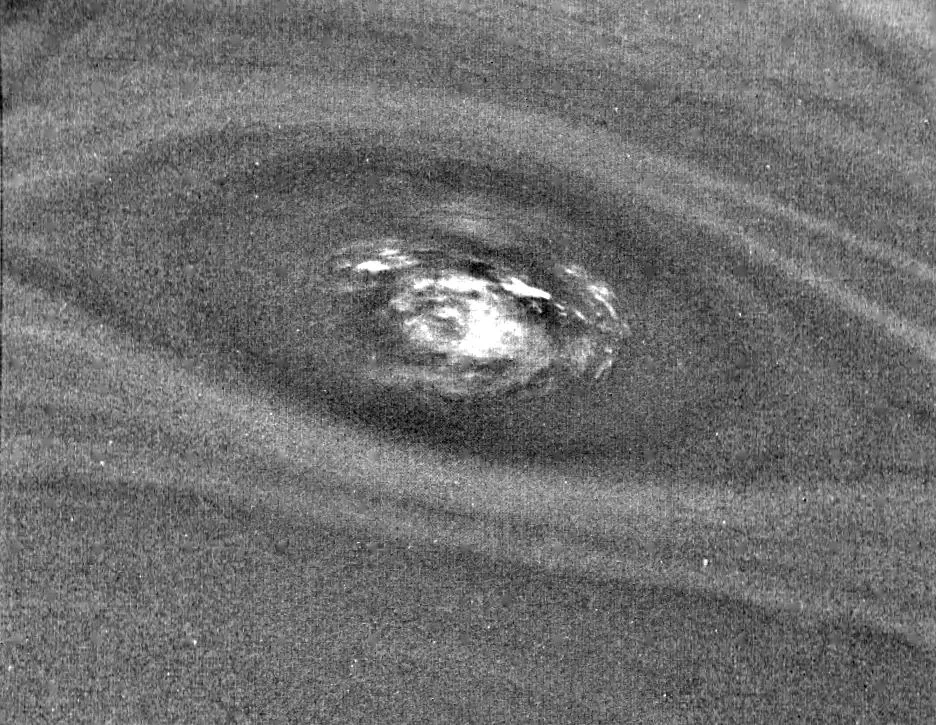
This bulls-eye view of Neptune's small dark spot (D2) was obtained by Voyager 2's narrow-angle camera. Banding surrounding the feature indicates unseen strong winds. The Voyager Mission is conducted by JPL for NASA's Office of Space Science and Applications."PIA02223" by NASA/JPL / Wikimedia Commons
Neptune holds the record for the fastest winds in our solar system. Scientists have measured wind speeds on this distant planet exceeding 2,000 kilometers per hour. To understand why Neptune has such extreme winds, we need to examine three key factors: its distance from the Sun, its internal heat source, and its atmospheric conditions.
Neptune orbits far from the Sun, about 30 times farther than Earth. This distance means very little solar energy reaches the planet's surface. Scientists initially expected Neptune to have calm weather because of this limited energy input. However, observations showed the opposite. Neptune generates its own internal heat from its core. This heat rises through the planet's atmosphere in a process called convection. The rising heat creates temperature differences in the atmosphere, which drives powerful wind patterns.
The composition of Neptune's atmosphere also plays an important role. As a gas giant, Neptune lacks a solid surface. Its atmosphere consists mainly of hydrogen, helium, and methane gases. These gases create very low friction compared to planets with solid surfaces. On Earth, mountains, forests, and oceans slow down wind movement through friction. Neptune's smooth gaseous layers allow winds to accelerate without obstacles. Once winds start moving, they can reach incredible speeds because nothing slows them down.
Evidence from the Voyager 2 spacecraft provides concrete data about Neptune's weather. In 1989, Voyager 2 flew past Neptune and photographed a massive storm system called the Great Dark Spot. Scientists measured winds around this storm at 2,400 kilometers per hour. These observations confirmed that Neptune's winds exceed those on any other planet, including Jupiter and Saturn, which also have internal heat sources but experience more atmospheric friction.
Understanding Neptune's extreme winds matters for planetary science. Scientists use Neptune as a natural laboratory to study how energy transfer works in planetary atmospheres. The combination of internal heating and low friction demonstrates how different energy sources can create diverse weather patterns across the solar system. This knowledge helps researchers predict atmospheric behavior on newly discovered planets beyond our solar system.
Interesting Fact: Neptune's winds blow in the opposite direction of the planet's rotation, a phenomenon scientists are still working to fully explain. This backward wind pattern makes Neptune's atmosphere even more mysterious and unique in our solar system.
Comprehension quiz (10 questions)
1. What is the maximum wind speed measured on Neptune?
2. How far is Neptune from the Sun compared to Earth?
3. What does the term 'convection' mean in the context of this passage?
4. What does 'friction' refer to in this passage?
5. Why did scientists initially expect Neptune to have calm weather?
6. What role does Neptune's internal heat play in creating strong winds?
7. How does Neptune's lack of a solid surface affect its winds?
8. What evidence did Voyager 2 provide about Neptune's winds?
9. True or False: Neptune's winds blow in the same direction as the planet's rotation.
10. True or False: Jupiter and Saturn have faster winds than Neptune.
Perfect for the way you teach
- Build comprehension skills
- Auto-graded quiz
- Differentiated reading
- Read together at home
- Improve fluency
- Quiet reading time
- Reading curriculum support
- Independent practice
- Track Lexile growth