This 400-500 word informational science passage explains why planets move faster when closer to the Sun and slower when farther away, aligned with NGSS standards MS-ESS1.B and MS-ESS1-2. Students in grades 6-8 explore the cause-and-effect relationship between distance from the Sun and orbital speed, understanding how gravity's changing strength affects planetary motion. The passage introduces Kepler's second law through accessible explanations and real-world examples, including Earth's orbital variations. Audio-integrated content supports diverse learners, while differentiated versions assist English Language Learners and struggling readers. Activities include multiple-choice questions assessing comprehension at various DOK levels, writing prompts encouraging scientific explanation, and graphic organizers for analyzing cause-and-effect relationships. Students develop understanding of gravitational force, elliptical orbits, perihelion, aphelion, and orbital velocity while practicing scientific reasoning and evidence-based thinking essential for middle school Earth and space science.
Written by Workybooks TeamPublished by Workybooks
Preview
Sample passage and quiz content
CONTENT PREVIEW
Expand content preview
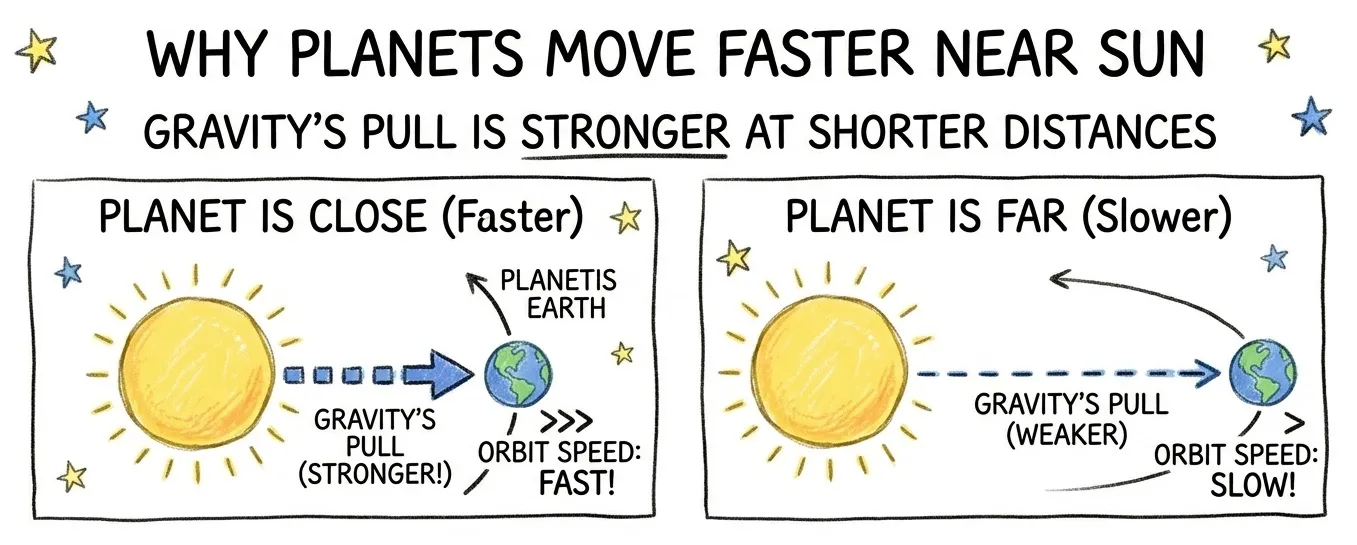
Planets do not move at constant speeds as they orbit the Sun. Instead, they speed up when closer to the Sun and slow down when farther away. This happens because gravity changes in strength depending on distance. When a planet swings near the Sun, gravity pulls harder and accelerates the planet. When the planet travels to the far side of its path, gravity weakens and the planet slows down.
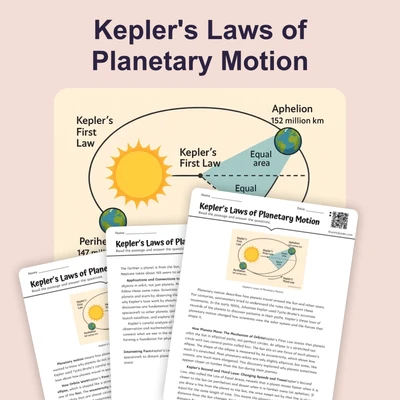
Scientists explain this pattern through understanding elliptical orbits. Most planets follow oval-shaped paths rather than perfect circles. At the closest point, called perihelion, the Sun's gravitational pull is strongest because the distance is smallest. The planet responds by moving faster through space. At the farthest point, called aphelion, gravity's influence decreases because the distance is greatest. The planet then travels more slowly. This cause-and-effect relationship between distance and speed creates a predictable pattern. Think of it like swinging a ball on a string in a circle. When you pull the string tighter, the ball moves faster. When you let it out, the ball slows down.
Evidence shows this effect clearly in Earth's motion. Our planet reaches perihelion around January 3 each year, when it sits about 147 million kilometers from the Sun. At this point, Earth moves at approximately 30.3 kilometers per second. Six months later, around July 4, Earth reaches aphelion at about 152 million kilometers away. Earth's orbital velocity then drops to roughly 29.3 kilometers per second. That difference of one kilometer per second may seem small, but it demonstrates how gravity controls planetary motion across vast distances.
Understanding why planets change speed matters for predicting their positions accurately. Astronomers use this knowledge to calculate where planets will appear in the night sky. Space agencies apply these principles when planning spacecraft missions to other worlds. The relationship between distance and speed, described by Kepler's second law, helps scientists explain how gravity shapes motion throughout our solar system. This law states that planets sweep out equal areas in equal times, meaning they must move faster when closer to the Sun to cover the same area as when they move slower farther away.
Interesting Fact: Mars experiences an even more dramatic speed change than Earth because its orbit is more elliptical. Mars travels about 26.5 kilometers per second at perihelion but slows to only 22 kilometers per second at aphelion.
What happens to a planet's speed when it moves closer to the Sun?
It speeds up because gravity pulls harderIt slows down because gravity weakensIt stays the same throughout the orbitIt stops moving temporarily
What is the term for the point in a planet's orbit where it is closest to the Sun?
What does the term 'gravitational pull' mean in the passage?
The speed at which planets orbitThe oval shape of planetary pathsThe attractive force the Sun exerts on planetsThe distance between planets and the Sun
According to the passage, approximately how much does Earth's orbital velocity change between perihelion and aphelion?
About 5 kilometers per secondAbout 1 kilometer per secondAbout 10 kilometers per secondIt does not change at all
Why do planets travel in elliptical orbits rather than perfect circles?
Because gravity's strength varies with distanceBecause planets rotate on their axesBecause the Sun moves through spaceBecause planets collide with asteroids
What does Kepler's second law explain about planetary motion?
Why planets are different sizesWhy planets sweep out equal areas in equal timesWhy the Sun is at the center of the solar systemWhy some planets have moons
How does the passage compare planetary motion to a ball on a string?
Both slow down when pulled tighterBoth speed up when the string or distance increasesBoth speed up when pulled tighter or closerBoth maintain constant speed
Which planet experiences a more dramatic speed change than Earth due to its more elliptical orbit?
VenusMarsJupiterSaturn
True or False: Planets move at constant speeds throughout their entire orbit around the Sun.
TrueFalse
True or False: Earth reaches perihelion around January 3 each year.
TrueFalse
Who it's for
Perfect for the way you teach
Teachers
Build comprehension skills
Auto-graded quiz
Differentiated reading
Parents
Read together at home
Improve fluency
Quiet reading time
Homeschoolers
Reading curriculum support
Independent practice
Track Lexile growth
Topics
planetary motiongravityorbital speedKepler's second lawsolar systemelliptical orbitgravitational pullMS-ESS1-2
Reviews & Ratings
No reviews yet. Be the first to share your experience!
More reading you might love
20 more
Comets
This middle school science passage explores the fascinating world of comets, commonly known as 'dirty snowballs.' Studen...
MS-ESS1-2
Mercury: Closest to the Sun
This comprehensive, standards-aligned passage explores Mercury—the smallest and closest planet to the Sun. Students in g...
MS-ESS1-2MS-ESS1-3
Venus: Earth's Twin?
This comprehensive science passage for grades 6-8 examines Venus—often called Earth's twin—by exploring its similarities...
MS-ESS1-2MS-ESS1-3
Earth: Our Home Planet
This comprehensive science passage for grades 6-8 explores Earth’s unique characteristics and the interconnected systems...
MS-ESS1-2
Mars: The Red Planet
This middle school science passage explores Mars, the Red Planet, providing students in grades 6-8 with a comprehensive ...
MS-ESS1-2MS-ESS1-3
Kepler's Laws of Planetary Motion
This comprehensive middle school science passage explores Kepler's Laws of Planetary Motion, meeting NGSS Standard MS-ES...
MS-ESS1-2
Tides and Tidal Forces
This middle school science passage explores the mechanisms of tides and tidal forces, aligning with NGSS standards MS-ES...
MS-ESS1-1MS-ESS1-2
Escape Velocity and Space Travel
This middle school science passage introduces students to the concept of escape velocity—the minimum speed required to b...
MS-ESS1-2MS-PS2-4
Weightlessness and Microgravity
This science reading passage for middle school students explores the phenomenon of weightlessness and microgravity. Alig...
MS-PS2-4MS-ESS1-2
Orbits and Orbital Motion
This middle school science passage, aligned with NGSS MS-ESS1-2 and MS-PS2-4, explores the science of orbits and orbital...
MS-ESS1-2MS-PS2-4
What Is the Solar System?
This passage provides a comprehensive overview of the solar system for grades 6-8, aligned with NGSS standards MS-ESS1-2...
MS-ESS1-2MS-ESS1-3
Structure of the Solar System
This comprehensive science reading passage introduces middle school students (grades 6-8) to the structure of the solar ...
MS-ESS1-2MS-ESS1-3
Moons of the Solar System
This comprehensive passage, designed for grades 6-8 and aligned to NGSS standard MS-ESS1-2, delves into the fascinating ...
MS-ESS1-2
Defining Life: What Are We Looking For?
This informational science passage for middle school students explores the question: What is life, and how do we define ...
MS-LS1-1MS-ESS1-2
Astronomy
This comprehensive reading passage introduces middle school students to the science of astronomy, which is the study of ...
MS-ESS1-2MS-ESS1-3MS-PS4-2MS-ETS1-1
The Solar System
This middle school science passage introduces students to the solar system, aligning with NGSS standards MS-ESS1-2 and M...
MS-ESS1-2MS-ESS1-3
Gravity and Orbits
This comprehensive passage for grades 6-8 explains the science of gravity and orbits, aligning with NGSS standard MS-ESS...
MS-ESS1-2
The Inner Planets
This comprehensive science passage for grades 6-8 explores the inner (terrestrial) planets of our solar system—Mercury, ...
MS-ESS1-2MS-ESS1-3
The Outer Planets
This engaging science passage for grades 6-8 introduces students to the outer planets—Jupiter, Saturn, Uranus, and Neptu...
MS-ESS1-2MS-ESS1-3
Tides
This comprehensive middle school science reading passage explores the phenomenon of ocean tides, aligned to NGSS standar...