Why the Moon Stays in Orbit
Interactive passage with audio narration, comprehension questions, and printable PDF.
By completing this purchase you agree to our Terms of Use and Privacy Policy. Your subscription renews automatically until you cancel. You can cancel anytime from your account settings. All sales are final and non-refundable. Digital content is available for download in your account immediately upon purchase.
What's included
Why the Moon Stays in Orbit preview and details
About this printable Why the Moon Stays in Orbit science reading passage, NGSS-aligned (Grades 5-8)
Sample passage and quiz from Why the Moon Stays in Orbit
Reading passage and comprehension quiz preview
Why the Moon Stays in Orbit
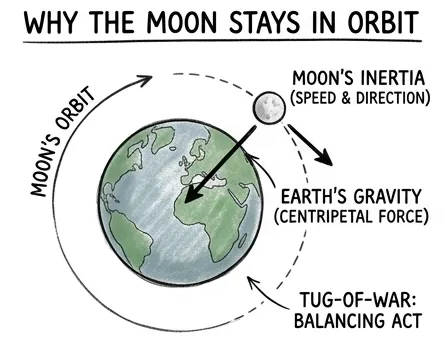
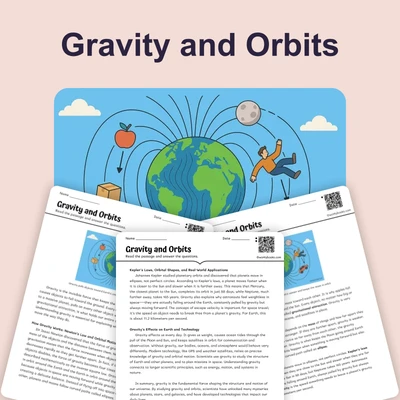
The Moon stays in orbit because of a balance between two forces: gravity and inertia. Gravity is the force that pulls objects toward each other. Earth's gravity pulls the Moon toward our planet constantly. Without this pull, the Moon would drift away into space. Inertia is the tendency of an object to keep moving in a straight line. The Moon's inertia makes it want to travel forward in a straight path. When gravity pulls the Moon toward Earth and inertia pushes it forward, the result is a curved path called an orbit. The Moon falls toward Earth but also moves forward at the same time. This creates a continuous loop around our planet.
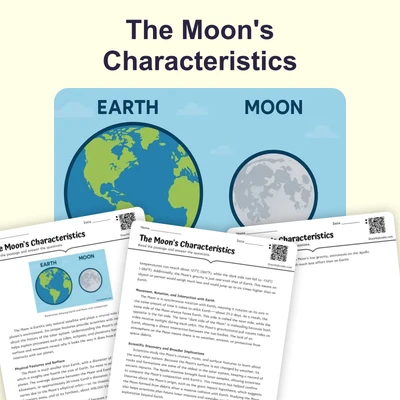
No, the Moon does not stay in orbit because Earth is spinning. This is a common misconception that confuses two separate motions. Earth's rotation is the daily spin that gives us day and night. The Moon's orbit is the path it follows around Earth once every 27.3 days. These two motions are independent of each other.
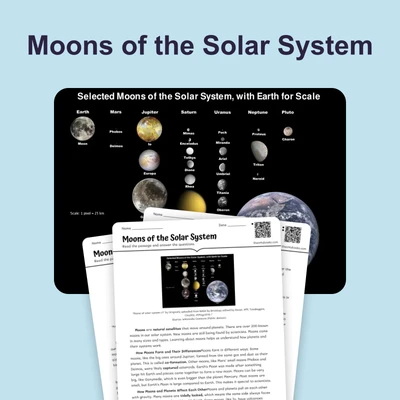
Scientists can demonstrate this independence by observing other celestial bodies. For example, Mars has two moons, Phobos and Deimos, that orbit the planet. Mars rotates once every 24.6 hours, similar to Earth. However, Phobos completes an orbit in just 7.7 hours. This moon orbits faster than Mars rotates. Evidence shows that a planet's rotation does not control how fast its moons orbit. The orbital velocity depends on the planet's mass and the distance between the planet and moon.
During the Apollo 8 mission in 1968, astronauts observed Earth and the Moon from space. They saw Earth rotating on its axis while the Moon maintained its steady orbit. The astronauts confirmed that these are separate processes. The Moon would continue orbiting even if Earth suddenly stopped spinning. The gravitational force between Earth and Moon would remain unchanged. Only the balance between gravity and the Moon's forward motion matters for maintaining the orbit.
Understanding this concept matters because it helps us predict satellite behavior and plan space missions. Artificial satellites orbit Earth using the same gravity-inertia balance. Engineers must calculate the correct speed and altitude for satellites. If they relied on Earth's rotation instead of orbital mechanics, satellites would fail. This knowledge also helps scientists study other planetary systems throughout the universe.
Interesting Fact: The Moon is slowly moving away from Earth at a rate of about 3.8 centimeters per year. This happens because of tidal forces, not because of any change in Earth's rotation speed.
Comprehension quiz (10 questions)
1. What keeps the Moon in orbit around Earth?
2. How long does it take the Moon to complete one orbit around Earth?
3. What is inertia?
4. Which example from the passage shows that a planet's rotation does not control moon orbits?
5. What does orbital velocity depend on?
6. Why does the Moon follow a curved path instead of moving in a straight line?
7. What did Apollo 8 astronauts observe in 1968?
8. Why is understanding orbital mechanics important?
9. True or False: If Earth suddenly stopped spinning, the Moon would fall out of orbit.
10. True or False: The Moon is slowly moving away from Earth at about 3.8 centimeters per year.
Perfect for the way you teach
- Build comprehension skills
- Auto-graded quiz
- Differentiated reading
- Read together at home
- Improve fluency
- Quiet reading time
- Reading curriculum support
- Independent practice
- Track Lexile growth