Why Venus Is So Hot
Interactive passage with audio narration, comprehension questions, and printable PDF.
By completing this purchase you agree to our Terms of Use and Privacy Policy. Your subscription renews automatically until you cancel. You can cancel anytime from your account settings. All sales are final and non-refundable. Digital content is available for download in your account immediately upon purchase.
What's included
Why Venus Is So Hot preview and details
About this printable Why Venus Is So Hot science reading passage, NGSS-aligned (Grades 5-8)
Sample passage and quiz from Why Venus Is So Hot
Reading passage and comprehension quiz preview
Why Is Venus So Hot

"Surface Warmth on a Venus Volcano" / NASA
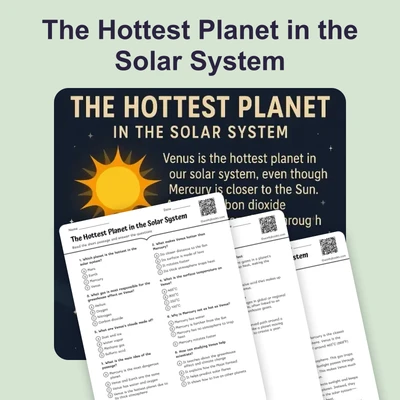
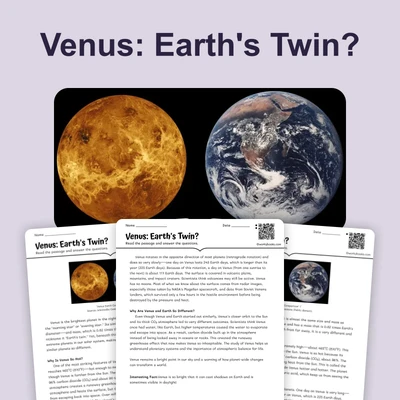
Venus is the hottest planet in our solar system. Surface temperatures on Venus reach about 465°C, which is hot enough to melt lead. This might seem surprising because Mercury is closer to the Sun. However, distance from the Sun is not the only factor that determines a planet's temperature. Venus's extreme heat comes from its thick atmosphere, which creates a powerful greenhouse effect.
The atmosphere of Venus is made up of about 96% carbon dioxide. This gas acts like a thick blanket around the planet. When sunlight reaches Venus, it passes through the atmosphere and warms the surface. The surface then releases heat as thermal radiation. Normally, this heat would escape back into space. On Venus, however, the carbon dioxide traps the heat and prevents it from leaving. Scientists explain that this process creates a runaway greenhouse effect. The trapped heat keeps building up over time, making the planet hotter and hotter.
Evidence shows that Venus was not always this hot. Scientists believe that Venus may have once had oceans like Earth. Over millions of years, however, volcanic activity released massive amounts of carbon dioxide into the atmosphere. As more carbon dioxide accumulated, more heat became trapped. This created a cycle where rising temperatures caused more water to evaporate, which trapped even more heat. Eventually, all the water disappeared, leaving behind the scorching planet we observe today.
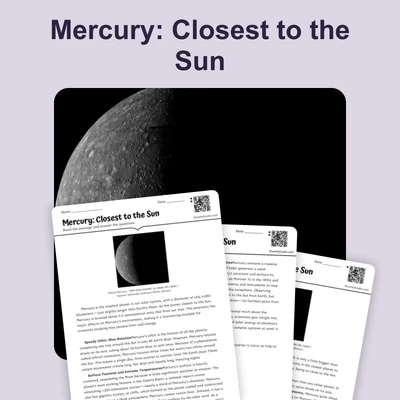
Mercury, the closest planet to the Sun, has temperatures that can reach 430°C on its sunny side. However, Mercury has almost no atmosphere to trap heat. At night, Mercury's temperature drops to about -180°C. Venus, on the other hand, stays at 465°C both day and night because its thick atmosphere holds the heat constantly. This comparison demonstrates how atmospheric composition affects planetary temperature more than distance from the Sun alone.
Understanding Venus helps scientists learn about climate change on Earth. Earth's atmosphere also contains carbon dioxide, though in much smaller amounts. When humans burn fossil fuels, they release more carbon dioxide into Earth's atmosphere. This increases the greenhouse effect on our planet. By studying Venus's extreme greenhouse effect, scientists can better predict how rising carbon dioxide levels might affect Earth's climate in the future.
Interesting Fact: The atmospheric pressure on Venus is 92 times greater than Earth's, which is similar to the pressure you would feel 900 meters deep in Earth's oceans.
Comprehension quiz (10 questions)
1. What is the approximate surface temperature of Venus?
2. What percentage of Venus's atmosphere is made up of carbon dioxide?
3. What does the term 'thermal radiation' mean in the context of the passage?
4. What does 'greenhouse effect' refer to in this passage?
5. Why is Venus hotter than Mercury even though Mercury is closer to the Sun?
6. Based on the passage, what can scientists learn by studying Venus?
7. What caused Venus to lose its oceans over millions of years?
8. How does Mercury's temperature change between day and night?
9. True or False: Distance from the Sun is the only factor that determines a planet's temperature.
10. True or False: Venus stays at approximately the same temperature both day and night.
Perfect for the way you teach
- Build comprehension skills
- Auto-graded quiz
- Differentiated reading
- Read together at home
- Improve fluency
- Quiet reading time
- Reading curriculum support
- Independent practice
- Track Lexile growth