Bernoulli's Principle
Interactive passage with audio narration, comprehension questions, and printable PDF.
By completing this purchase you agree to our Terms of Use and Privacy Policy. Your subscription renews automatically until you cancel. You can cancel anytime from your account settings. All sales are final and non-refundable. Digital content is available for download in your account immediately upon purchase.
What's included
Bernoulli's Principle preview and details
About this printable Bernoulli's Principle science reading passage, NGSS-aligned (Grades 5-8)
Sample passage and quiz from Bernoulli's Principle
Reading passage and comprehension quiz preview
Bernoulli's Principle
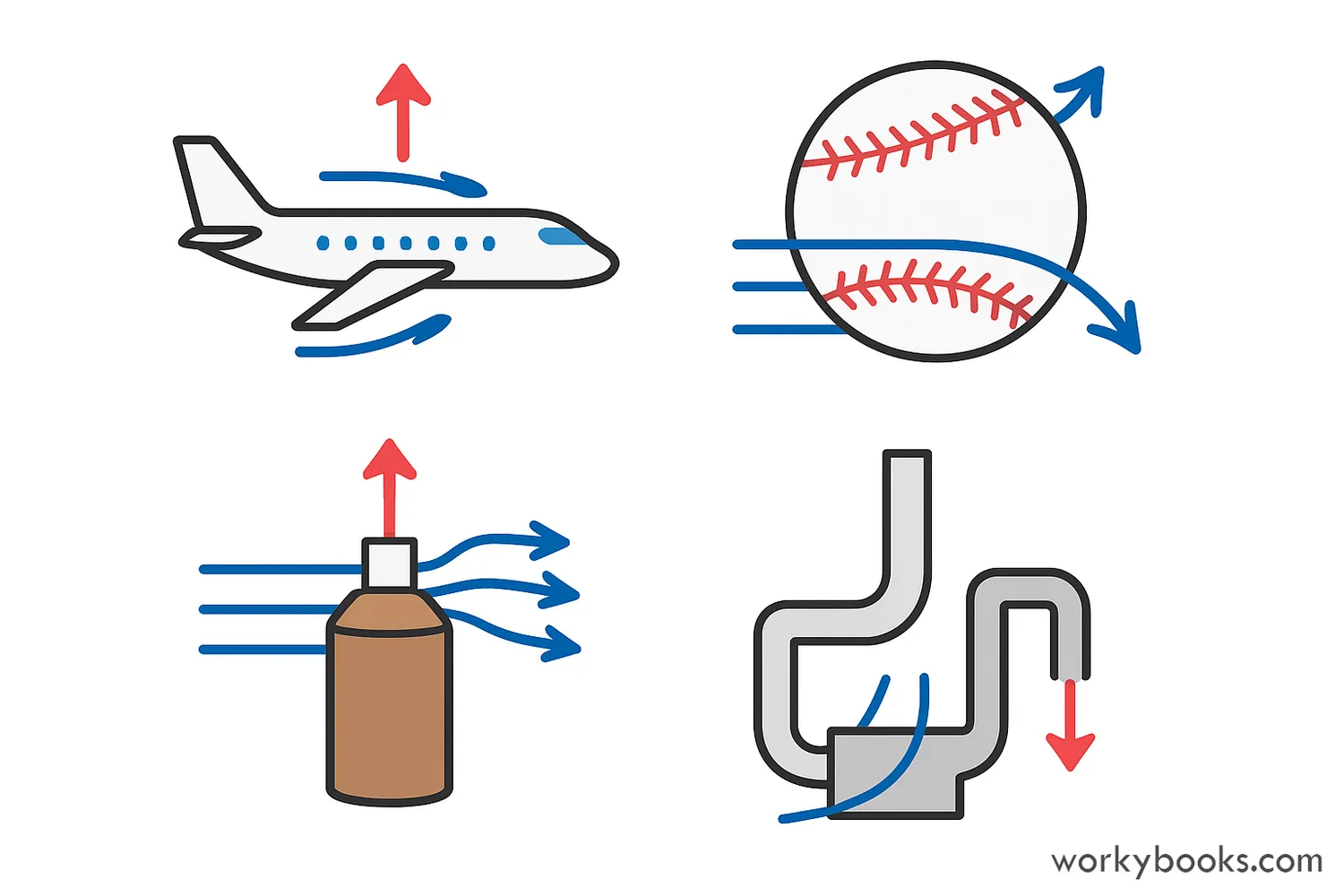
Bernoulli's Principle describes a crucial relationship between the speed of a fluid and the pressure it exerts. In the world of science and engineering, this principle helps explain how airplanes fly, how curveballs curve, and even why a shower curtain moves inward when the water is on. Understanding Bernoulli's Principle lets us predict and control the behavior of air and water in countless situations, making it a foundation for many modern technologies.
How Bernoulli's Principle Works
When a fluid—such as air or water—moves faster, it exerts less pressure than when it moves more slowly. This relationship was first described by Daniel Bernoulli, an 18th-century Swiss scientist. The key is that as the speed of a fluid increases, its pressure decreases. For example, when air flows quickly over the curved top of an airplane wing, the pressure above the wing drops. Meanwhile, the slower-moving air beneath the wing maintains higher pressure. This difference in pressure creates an upward force called lift, allowing the airplane to rise. Bernoulli's Principle is not only seen in flight, but also in the way a curveball moves in baseball. The spinning ball causes air to move faster on one side, lowering the pressure and making the ball curve in that direction.
Real-World Applications
Bernoulli's Principle is vital in many everyday devices and natural events. In your bathroom, you might notice the shower curtain blowing inward when you turn on the water. The fast-moving water and air inside the shower lower the pressure, while the air outside remains at higher pressure, pushing the curtain in. Sprayers like perfume atomizers and carburetors in engines also use Bernoulli's Principle. When you squeeze an atomizer, air moves quickly over a tube, reducing pressure and drawing liquid up and out as a fine mist. Engineers measure these pressure differences using tools called manometers and design wings, fans, and even sports equipment to take advantage of these effects. Quantitatively, even a small difference in speed can result in significant pressure changes; for example, doubling the airflow speed can reduce pressure by about 75% in a closed system.
Complexities and Connections
Bernoulli's Principle connects to other scientific ideas, such as the conservation of energy. The total energy in a moving fluid is shared between kinetic energy (from its speed) and pressure energy. While Bernoulli’s Principle explains many phenomena, exceptions exist when turbulent flow or other forces interfere. In real-world engineering, designers must account for these complexities, using wind tunnels and computer simulations to test their ideas. The principle also helps us understand natural processes, like why birds shape their wings during flight or how weather systems move.
Bernoulli's Principle is a powerful tool that links the motion of fluids to the forces they create. By understanding this relationship, scientists and engineers have shaped transportation, sports, and even daily life, showing how physical principles can be used to solve complex problems in the real world.
Interesting Fact:
Did you know that the wings of some fast birds, like falcons, are specially shaped to maximize the effects of Bernoulli’s Principle, helping them reach speeds over 200 miles per hour?
Comprehension quiz (10 questions)
1. What does Bernoulli's Principle state about the relationship between fluid speed and pressure?
2. What real-world phenomenon does Bernoulli's Principle help explain?
3. Which device uses Bernoulli's Principle to create a fine spray?
4. What is the function of a manometer?
5. In the context of the passage, what does 'lift' mean?
6. What does the word 'turbulent' most nearly mean as used in the passage?
7. If air travels twice as fast over an airplane wing, what happens to the pressure, according to the passage?
8. A baseball curveball curves because of Bernoulli's Principle. What causes this curve?
9. True or False: Bernoulli's Principle only applies to liquids, not gases.
10. True or False: Bernoulli's Principle is connected to the conservation of energy.
Perfect for the way you teach
- Build comprehension skills
- Auto-graded quiz
- Differentiated reading
- Read together at home
- Improve fluency
- Quiet reading time
- Reading curriculum support
- Independent practice
- Track Lexile growth