This 400-500 word informational science reading passage introduces middle school students to the concept of a galaxy's center. Aligned with NGSS MS-ESS1-2 and MS-ESS1.A, the passage defines the galactic center as the dense core that most stars orbit around. Students discover that the Milky Way, like most large galaxies, contains a supermassive black hole at its center called Sagittarius A*. The passage maintains a descriptive focus appropriate for foundational understanding, avoiding complex mechanistic explanations. Audio-integrated content supports diverse learners. The passage includes real-world examples, scientific terminology, and evidence-based language. Supplementary materials include a simplified differentiated version, Spanish translations, glossary of key terms, multiple-choice comprehension questions, writing activities, and graphic organizers. These resources help students understand galaxy structure, stellar orbits, and the role of supermassive black holes in galactic centers while building scientific literacy skills.
Written by Workybooks TeamPublished by Workybooks
Preview
Sample passage and quiz content
CONTENT PREVIEW
Expand content preview
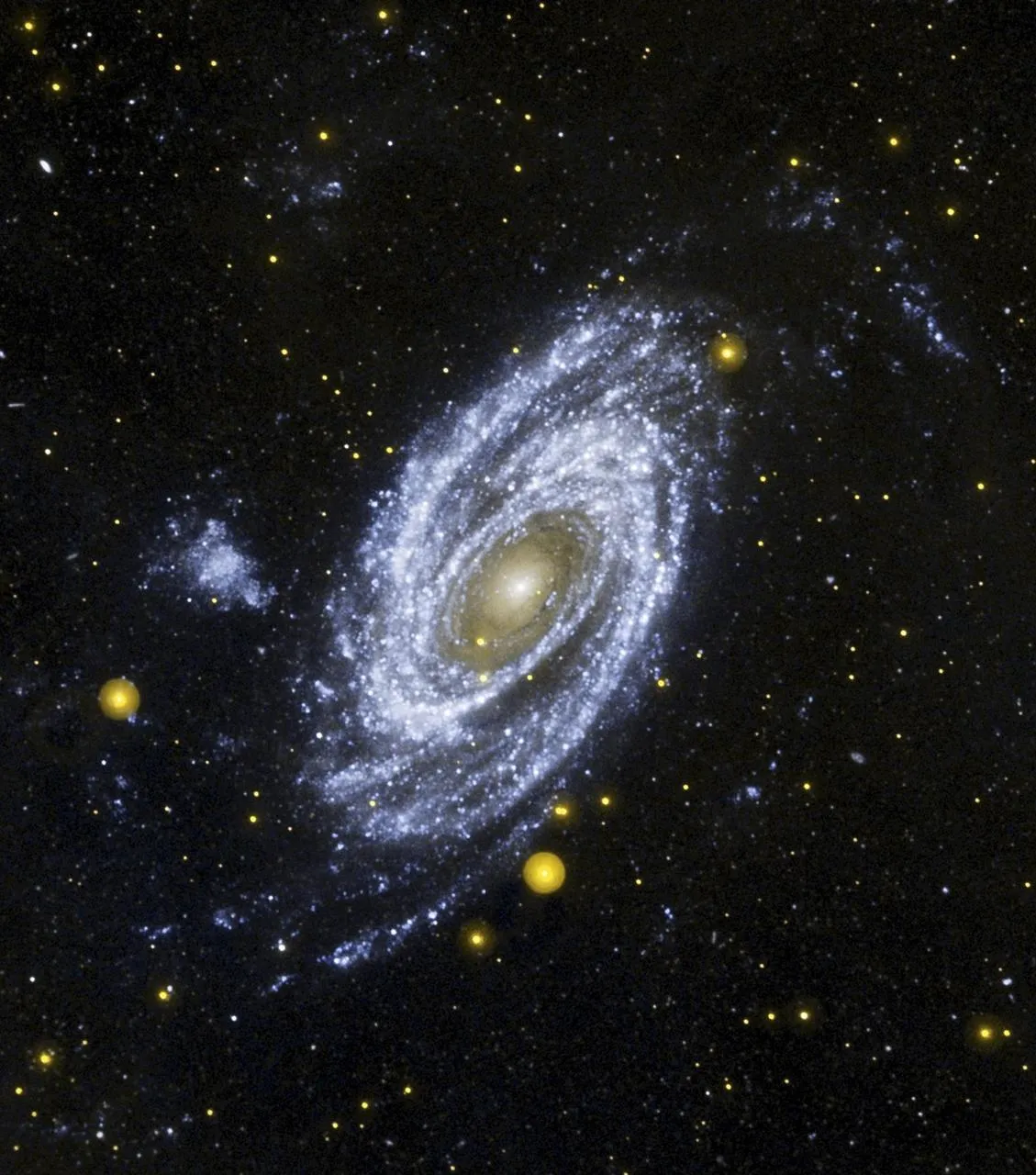
M81 spiral galaxy is shown. "Galaxy Mission Completes Four Star-Studded Years in Space" / NASA.
A galaxy's center is the dense core around which most stars orbit. This region contains a much higher concentration of stars than other parts of the galaxy. Scientists observe that stars move in organized patterns around this central point. Evidence shows that gravity holds these billions of stars in their orbital paths.
The galactic center acts like a hub in a spinning wheel. Just as wheel spokes connect to a central hub, stars orbit around the galaxy's core. Our own galaxy, the Milky Way, has a galactic center located about 26,000 light-years from Earth. This distance is so vast that light takes 26,000 years to travel from there to us. The center appears as a bright band across the night sky when viewed from dark locations.
Scientists explain that most large galaxies contain a supermassive black hole at their centers. These objects have masses millions or billions of times greater than our Sun. The Milky Way's center holds a supermassive black hole called Sagittarius A*. This black hole has a mass about four million times that of the Sun. Despite its enormous mass, Sagittarius A* occupies a relatively small space. A black hole's intense gravity pulls on surrounding stars and gas. This gravitational force keeps stars moving in their orbits around the galactic center.
Astronomers cannot see black holes directly because light cannot escape them. However, scientists can observe how stars move near the galactic center. By tracking these stellar motions over many years, researchers gathered evidence for the black hole's existence. In 2020, scientist Andrea Ghez received the Nobel Prize in Physics for this work. Her team observed stars orbiting an invisible object at the Milky Way's center. The stars' speeds and paths revealed the presence of Sagittarius A*.
Understanding galactic centers helps scientists explain how galaxies form and change over time. The supermassive black hole may influence star formation in surrounding regions. Studying our own galactic center provides clues about billions of other galaxies throughout the universe. This research connects us to the larger cosmic structures we inhabit.
Interesting Fact: In 2022, scientists captured the first image of Sagittarius A* using a network of radio telescopes around Earth. The image shows a glowing ring of hot gas swirling around the black hole's dark center.
What is a galaxy's center?
The dense core around which most stars orbitThe outermost edge of a galaxyA region with fewer stars than other areasThe place where new galaxies form
How far is the Milky Way's galactic center from Earth?
2,600 light-years26,000 light-years260,000 light-years2.6 million light-years
What does the term 'supermassive black hole' mean in the passage?
A small black hole at the edge of a galaxyA black hole with mass millions or billions of times greater than the SunA region where no stars existA type of star that produces lots of light
What is the name of the supermassive black hole at the Milky Way's center?
AndromedaOrion's BeltSagittarius A*Alpha Centauri
Based on the passage, why can't astronomers see black holes directly?
They are too far awayLight cannot escape from themThey are too small to detectTelescopes are not powerful enough
How did scientists gather evidence for the existence of Sagittarius A*?
By taking photographs of the black holeBy tracking the motion of stars near the galactic centerBy measuring temperature changes in spaceBy listening to radio signals from the black hole
What keeps stars moving in their orbits around the galactic center?
Solar windMagnetic fieldsGravityLight pressure
According to the passage, studying galactic centers helps scientists understand how galaxies form and change over time.
TrueFalse
The passage states that Sagittarius A* has a mass about four million times that of the Sun.
TrueFalse
Why is understanding our galactic center important for astronomy?
It only helps us understand the Milky WayIt provides clues about billions of other galaxies in the universeIt proves that black holes don't existIt shows that all galaxies are the same
Who it's for
Perfect for the way you teach
Teachers
Build comprehension skills
Auto-graded quiz
Differentiated reading
Parents
Read together at home
Improve fluency
Quiet reading time
Homeschoolers
Reading curriculum support
Independent practice
Track Lexile growth
Topics
galactic centerMilky Waysupermassive black holegalaxy structurestars orbitSagittarius A*NGSS MS-ESS1-2space science
Reviews & Ratings
No reviews yet. Be the first to share your experience!
More reading you might love
20 more
Comets
This middle school science passage explores the fascinating world of comets, commonly known as 'dirty snowballs.' Studen...
MS-ESS1-2
Mercury: Closest to the Sun
This comprehensive, standards-aligned passage explores Mercury—the smallest and closest planet to the Sun. Students in g...
MS-ESS1-2MS-ESS1-3
Venus: Earth's Twin?
This comprehensive science passage for grades 6-8 examines Venus—often called Earth's twin—by exploring its similarities...
MS-ESS1-2MS-ESS1-3
Earth: Our Home Planet
This comprehensive science passage for grades 6-8 explores Earth’s unique characteristics and the interconnected systems...
MS-ESS1-2
Mars: The Red Planet
This middle school science passage explores Mars, the Red Planet, providing students in grades 6-8 with a comprehensive ...
MS-ESS1-2MS-ESS1-3
Kepler's Laws of Planetary Motion
This comprehensive middle school science passage explores Kepler's Laws of Planetary Motion, meeting NGSS Standard MS-ES...
MS-ESS1-2
Tides and Tidal Forces
This middle school science passage explores the mechanisms of tides and tidal forces, aligning with NGSS standards MS-ES...
MS-ESS1-1MS-ESS1-2
Escape Velocity and Space Travel
This middle school science passage introduces students to the concept of escape velocity—the minimum speed required to b...
MS-ESS1-2MS-PS2-4
Weightlessness and Microgravity
This science reading passage for middle school students explores the phenomenon of weightlessness and microgravity. Alig...
MS-PS2-4MS-ESS1-2
Orbits and Orbital Motion
This middle school science passage, aligned with NGSS MS-ESS1-2 and MS-PS2-4, explores the science of orbits and orbital...
MS-ESS1-2MS-PS2-4
What Is the Solar System?
This passage provides a comprehensive overview of the solar system for grades 6-8, aligned with NGSS standards MS-ESS1-2...
MS-ESS1-2MS-ESS1-3
Structure of the Solar System
This comprehensive science reading passage introduces middle school students (grades 6-8) to the structure of the solar ...
MS-ESS1-2MS-ESS1-3
Moons of the Solar System
This comprehensive passage, designed for grades 6-8 and aligned to NGSS standard MS-ESS1-2, delves into the fascinating ...
MS-ESS1-2
Defining Life: What Are We Looking For?
This informational science passage for middle school students explores the question: What is life, and how do we define ...
MS-LS1-1MS-ESS1-2
Astronomy
This comprehensive reading passage introduces middle school students to the science of astronomy, which is the study of ...
MS-ESS1-2MS-ESS1-3MS-PS4-2MS-ETS1-1
The Solar System
This middle school science passage introduces students to the solar system, aligning with NGSS standards MS-ESS1-2 and M...
MS-ESS1-2MS-ESS1-3
Gravity and Orbits
This comprehensive passage for grades 6-8 explains the science of gravity and orbits, aligning with NGSS standard MS-ESS...
MS-ESS1-2
The Inner Planets
This comprehensive science passage for grades 6-8 explores the inner (terrestrial) planets of our solar system—Mercury, ...
MS-ESS1-2MS-ESS1-3
The Outer Planets
This engaging science passage for grades 6-8 introduces students to the outer planets—Jupiter, Saturn, Uranus, and Neptu...
MS-ESS1-2MS-ESS1-3
Tides
This comprehensive middle school science reading passage explores the phenomenon of ocean tides, aligned to NGSS standar...