Charlemagne: Building a Christian Empire — Reading Comprehension
Rate this
Premium Resource
Present
Present in classroom. No work saved
Assign
Classroom with student accounts, Track progress
Quick Play
No student accounts, assign with a link
Grades
5
6
7
8
PRINT+DIGITAL RESOURCE
This learning resource is available in interactive and printable formats. The interactive worksheet can be played online and assigned to students. The Printable PDF version can be downloaded and printed for completion by hand.
This engaging and rigorous world history reading passage examines the reign of Charlemagne, the King of the Franks, who united much of Western Europe and was crowned Holy Roman Emperor in 800 CE. Students will learn how Charlemagne expanded his empire, promoted Christianity, and influenced the development of medieval society. The passage features strong academic vocabulary, primary source references, and analysis of key historical cause-and-effect relationships. Activities include multiple-choice questions, writing prompts, and graphic organizers that help students think like historians. The content aligns with HSS 7.1 and CCSS ELA-Literacy RI.6.1, RI.6.4, RI.7.1, and RI.7.4 standards. This resource also provides a Spanish translation, differentiated text for struggling readers, and a read-aloud audio option, making it accessible for all learners interested in the legacy of Charlemagne and the early Middle Ages.
CONTENT PREVIEW
Expand content preview
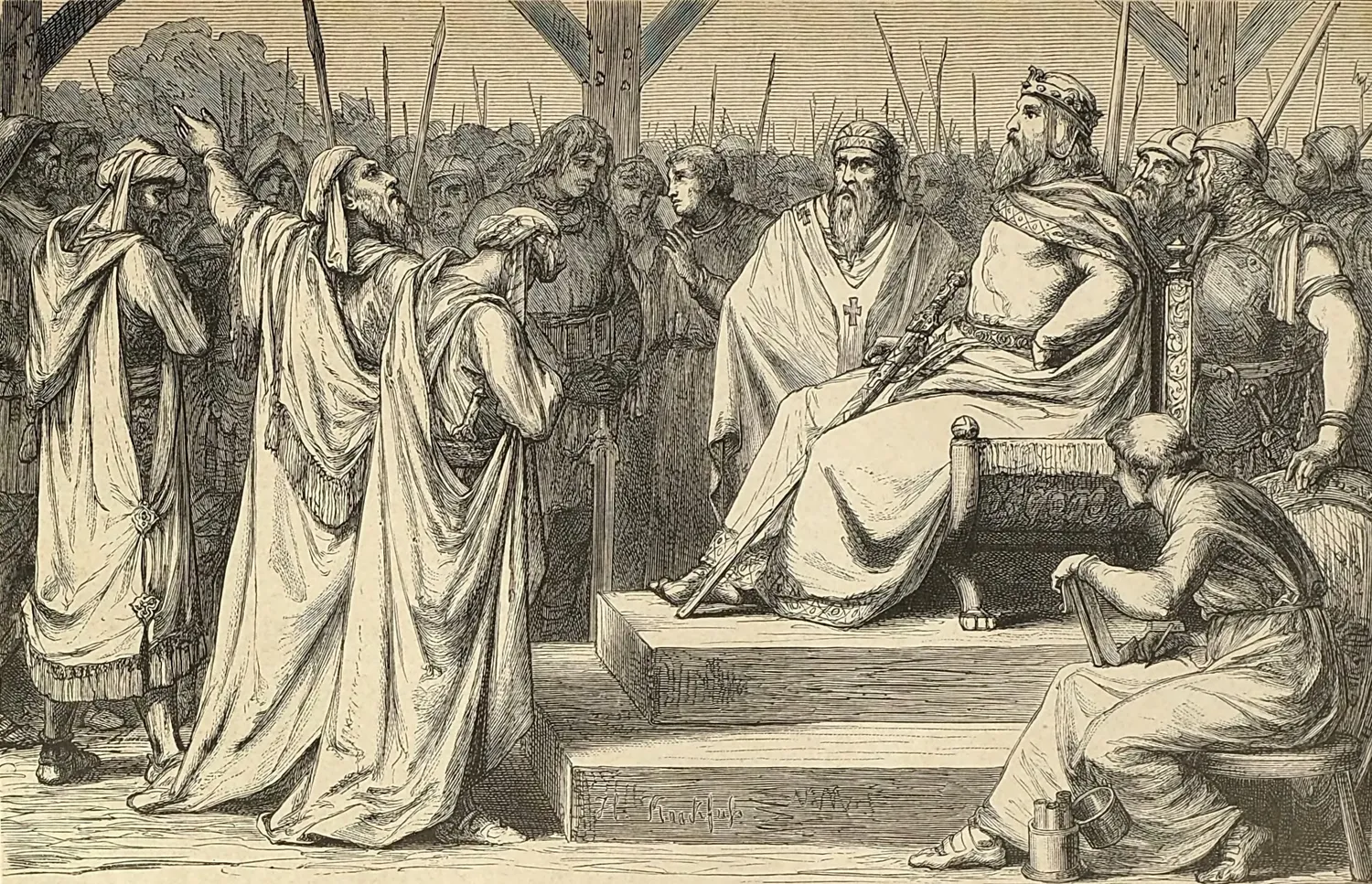
"Hermann Knackfuß - Exiled emirs before Charlemagne in Paderborn, Wikimedia Commons (Public domain).
Charlemagne was one of the most influential rulers of the Middle Ages. As King of the Franks from 768 CE and later crowned Holy Roman Emperor in 800 CE, Charlemagne united much of Western Europe under his rule. His reign marked a turning point in European history, as he expanded his empire, promoted Christianity, and laid the foundations for medieval European society.
Charlemagne inherited the Frankish throne after the death of his father, Pepin the Short. He ruled over lands that included present-day France, Germany, Belgium, and the Netherlands. Through a series of military campaigns, Charlemagne defeated rival kingdoms such as the Lombards in Italy (774 CE) and the Saxons in northern Germany. According to the Royal Frankish Annals, Charlemagne spent over thirty years fighting the Saxons and eventually forced them to accept Christianity. Archaeological evidence, such as the remains of fortified towns and churches, shows how Charlemagne used both force and faith to strengthen his empire.
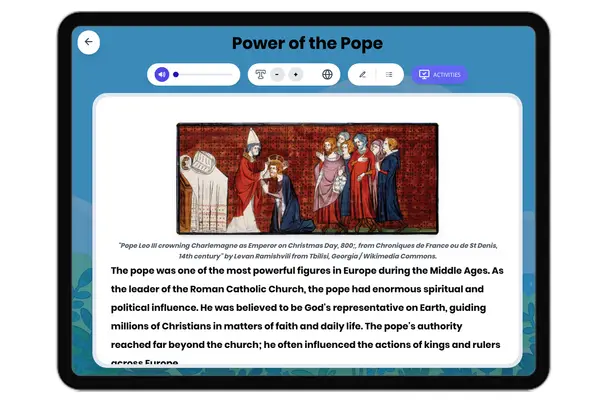
Charlemagne worked closely with the Pope and the Catholic Church. In 800 CE, Pope Leo III crowned him Emperor in Rome, an act recorded in the famous illuminated manuscript, the "Life of Charlemagne" by Einhard. This event symbolized the close alliance between the Church and the ruler. Charlemagne encouraged the building of monasteries and schools, helping to preserve ancient texts and promote learning. The Carolingian Renaissance, a period of cultural revival, began under his reign. Scholars like Alcuin of York were invited to Charlemagne's court to teach and copy important works of literature and science.
Charlemagne also improved government by dividing his empire into counties, each led by a trusted noble called a count. He sent inspectors known as "missi dominici" to make sure the counts ruled fairly and collected taxes. This system helped maintain order and loyalty across the empire’s vast territory. Daily life for most people centered on farming, but Charlemagne’s laws brought some stability and justice to the social hierarchy.
Charlemagne’s empire changed over time. After his death in 814 CE, the empire was divided among his grandsons, leading to new kingdoms that would become France and Germany. Still, Charlemagne’s legacy of uniting Europe, spreading Christianity, and supporting education shaped the development of Western civilization for centuries. His reign demonstrates how powerful leaders, religious beliefs, and geographic challenges influenced the history of Europe.
Interesting Fact: Charlemagne reportedly could not write well himself, but he valued education so much that he encouraged learning for everyone in his empire.
Who crowned Charlemagne Emperor?
Pope Leo IIIAlcuin of YorkPepin the ShortA count
Which group did Charlemagne defeat in 774 CE?
SaxonsLombardsRomansVikings
What did Charlemagne encourage?
Building schoolsDestroying churchesIgnoring lawsTrading with Vikings
Why was the Carolingian Renaissance important?
It improved farmingIt spread learningIt started warsIt ended Christianity
How did Charlemagne keep control of his empire?
Sent inspectorsLet everyone ruleIgnored problemsStopped collecting taxes
What happened after Charlemagne died?
Empire united foreverEmpire dividedHe was crowned againVikings ruled Europe
Charlemagne valued education. True or false?
TrueFalse
What is a 'count'?
A noble ruling a countyA teacherA monkA farmer
Perfect For:
👩🏫 Teachers
• Reading comprehension practice
• Auto-graded assessments
• Literacy skill development
👨👩👧👦 Parents
• Reading practice at home
• Comprehension improvement
• Educational reading time
🏠 Homeschoolers
• Reading curriculum support
• Independent reading practice
• Progress monitoring
Reading Features:
📖
Reading Passage
Engaging fiction or nonfiction text
❓
Comprehension Quiz
Auto-graded questions
📊
Instant Feedback
Immediate results and scoring
📄
Printable Version
Download for offline reading
🔊
Read Aloud
Voice-over with word highlighting
Reviews & Ratings
No reviews yet. Be the first to share your experience!
Related Content
Middle Ages Legacy
This history reading passage examines the lasting legacy of the Middle Ages, including the development of universities, ...
Early Middle Ages
This comprehensive reading passage explores the Early Middle Ages (500-1000 CE), a transformative period in European his...
High Middle Ages
This detailed world history reading passage explores the High Middle Ages (1000-1300 CE), a transformative era in Europe...
What Were the Middle Ages?
This engaging world history reading passage introduces students to the Middle Ages, the period in European history betwe...
Late Middle Ages
This rigorous world history reading passage explores the Late Middle Ages (1300-1500 CE), a time marked by the devastati...
Dark Ages
This passage offers a rigorous, engaging examination of why the early Middle Ages are often called the 'Dark Ages.' Stud...
Life in Middle Ages
This rigorous history reading passage explores life in Europe during the Middle Ages, focusing on the structure of feuda...
Medieval Islamic World
This rigorous reading passage delves into the Medieval Islamic World's golden age, when a vast civilization stretched fr...
Islamic Golden Age
This history reading passage explores the Islamic Golden Age, a period from the 8th to 14th centuries marked by outstand...
Medieval to Modern Transition
This engaging world history reading passage explores the dramatic transformation from the Middle Ages to the modern era,...
Medieval Words in English
This engaging history reading passage examines the evolution of the English language during the Middle Ages, focusing on...
Age of Exploration Begins
This engaging history reading passage explores the Age of Exploration, a turning point in world history when European po...
Italian City-States
This passage explores the rise and significance of the Italian city-states—Venice, Florence, and Genoa—during the Middle...
Attila the Hun
This engaging world history reading passage examines Attila the Hun, a powerful and feared ruler during the Middle Ages....
Medieval Guilds
This engaging world history reading passage explores the important role of guilds—worker groups that shaped the economy ...
Medieval Christian Worship
This detailed passage examines how people worshiped during the Middle Ages, focusing on essential religious practices su...
Power of the Pope
This history reading passage examines the power of the pope during the Middle Ages, focusing on his role as spiritual le...
Carolingian Renaissance
This engaging world history passage explores how Charlemagne, ruler of the Franks, transformed education and learning in...
Islamic Golden Age Inventions
This world history reading passage explores the remarkable inventions and scientific advances made in the medieval Islam...
Medieval Agricultural Innovations
This history reading passage explores how farming inventions like the heavy plow, three-field system, and horse collar r...