Charlemagne: Father of Europe — Reading Comprehension
Rate this
Premium Resource
Present
Present in classroom. No work saved
Assign
Classroom with student accounts, Track progress
Quick Play
No student accounts, assign with a link
Grades
5
6
7
8
PRINT+DIGITAL RESOURCE
This learning resource is available in interactive and printable formats. The interactive worksheet can be played online and assigned to students. The Printable PDF version can be downloaded and printed for completion by hand.
This rigorous world history reading passage explores the life and legacy of Charlemagne, a key figure of the Middle Ages who was crowned Emperor in 800 CE. Students will learn how Charlemagne’s military conquests united much of Western Europe and how his efforts to revive education and Christianity shaped European society. The passage highlights Charlemagne’s reforms, connections to geography, and impact on daily life, using evidence and vocabulary aligned with CA HSS 7.1 and CCSS RH.6-8.1. Included are a glossary, differentiated texts, Spanish translations, a multiple-choice quiz, writing prompts, graphic organizers, and a timeline to support historical thinking skills. This resource also offers a public domain image, coloring page prompt, and read aloud audio to create a comprehensive, engaging learning experience for all students.
CONTENT PREVIEW
Expand content preview
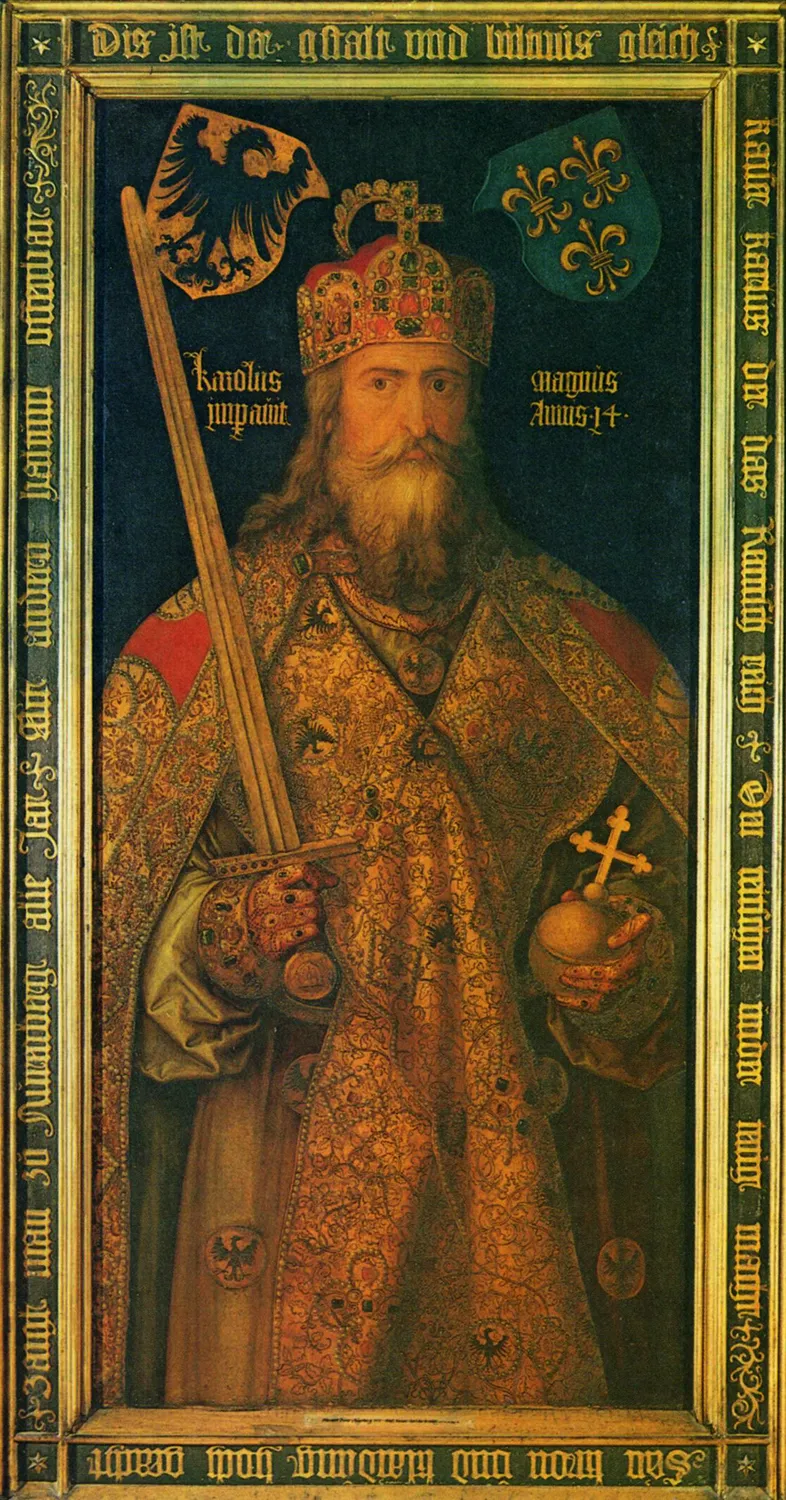
"Albrecht Dürer - Emperor Charlemagne" / Wikimedia Commons.
Charlemagne was one of the most influential rulers of the Middle Ages, earning the title "Father of Europe." He became the King of the Franks in 768 CE and later Emperor of the Carolingian Empire. Charlemagne's reign shaped much of Western Europe by expanding his territory, supporting education, and strengthening the role of Christianity.
Charlemagne’s military campaigns were central to his power. He led a series of conquests that united much of Western and Central Europe under his rule. In 774 CE, he conquered the Lombards in Italy and became their king. He also campaigned against the Saxons, who lived in what is now Germany, for over 30 years. Charlemagne demanded their conversion to Christianity, and after years of resistance, most Saxons accepted his rule and religion. A primary source, the Royal Frankish Annals, records the large assembly at Paderborn in 777 CE, where Saxon leaders swore loyalty to Charlemagne. His empire eventually stretched from the Pyrenees in the west to the Danube River in the east, covering much of present-day France, Germany, and northern Italy.
Charlemagne understood that ruling a vast empire required more than military strength. He worked to revive learning and culture, often called the "Carolingian Renaissance." He invited scholars from across Europe to his court at Aachen, which became a center for education and the copying of ancient texts. Alcuin of York, a famous English scholar, helped Charlemagne develop a curriculum for palace schools. Illuminated manuscripts and religious texts were produced, preserving knowledge for future generations. An archaeological discovery, the Palatine Chapel at Aachen, still stands today as evidence of the artistic and religious achievements of his reign.
Religion was central to Charlemagne’s rule. He worked closely with the Pope, and in 800 CE, he was crowned "Emperor of the Romans" by Pope Leo III in Rome. This event symbolized the connection between the Christian Church and European kingship. Charlemagne encouraged the building of churches and monasteries, and he required his subjects to follow Christian teachings. His empire had a clear social hierarchy, with nobles and church leaders holding much power, while peasants and serfs worked the land.
Charlemagne’s reign had lasting effects on European history. By uniting so many regions, supporting education, and connecting royal power with Christianity, he laid the foundation for the rise of modern European nations. Many historians see his efforts as a turning point in the history of the Middle Ages.
This study of Charlemagne connects to broader themes of leadership, cultural change, and the shaping of societies in world history.
Interesting Fact: Charlemagne reportedly could not write, although he greatly valued education and learning for others.
Who was crowned Emperor in 800 CE?
CharlemagneAlcuin of YorkPope Leo IIIA Lombard king
Which group did Charlemagne defeat in 774 CE?
SaxonsLombardsVikingsRomans
Where was Charlemagne’s main court located?
RomeParisAachenLondon
Why did Charlemagne invite scholars to his court?
To build an armyTo support educationTo mine goldTo fight the Pope
What effect did Charlemagne’s conquests have?
United Western EuropeWeakened ChristianityDestroyed schoolsReduced learning
How did Charlemagne use religion in his rule?
Ignored the PopeConnected with ChristianityBanned churchesFought against monks
Charlemagne’s empire had a social hierarchy. True or false?
TrueFalse
What is a 'primary source'?
A modern textbookA document from the timeA legendA drawing
Perfect For:
👩🏫 Teachers
• Reading comprehension practice
• Auto-graded assessments
• Literacy skill development
👨👩👧👦 Parents
• Reading practice at home
• Comprehension improvement
• Educational reading time
🏠 Homeschoolers
• Reading curriculum support
• Independent reading practice
• Progress monitoring
Reading Features:
📖
Reading Passage
Engaging fiction or nonfiction text
❓
Comprehension Quiz
Auto-graded questions
📊
Instant Feedback
Immediate results and scoring
📄
Printable Version
Download for offline reading
🔊
Read Aloud
Voice-over with word highlighting
Reviews & Ratings
No reviews yet. Be the first to share your experience!
Related Content
Middle Ages Legacy
This history reading passage examines the lasting legacy of the Middle Ages, including the development of universities, ...
Early Middle Ages
This comprehensive reading passage explores the Early Middle Ages (500-1000 CE), a transformative period in European his...
High Middle Ages
This detailed world history reading passage explores the High Middle Ages (1000-1300 CE), a transformative era in Europe...
What Were the Middle Ages?
This engaging world history reading passage introduces students to the Middle Ages, the period in European history betwe...
Late Middle Ages
This rigorous world history reading passage explores the Late Middle Ages (1300-1500 CE), a time marked by the devastati...
Dark Ages
This passage offers a rigorous, engaging examination of why the early Middle Ages are often called the 'Dark Ages.' Stud...
Life in Middle Ages
This rigorous history reading passage explores life in Europe during the Middle Ages, focusing on the structure of feuda...
Medieval Islamic World
This rigorous reading passage delves into the Medieval Islamic World's golden age, when a vast civilization stretched fr...
Islamic Golden Age
This history reading passage explores the Islamic Golden Age, a period from the 8th to 14th centuries marked by outstand...
Medieval to Modern Transition
This engaging world history reading passage explores the dramatic transformation from the Middle Ages to the modern era,...
Medieval Words in English
This engaging history reading passage examines the evolution of the English language during the Middle Ages, focusing on...
Age of Exploration Begins
This engaging history reading passage explores the Age of Exploration, a turning point in world history when European po...
Italian City-States
This passage explores the rise and significance of the Italian city-states—Venice, Florence, and Genoa—during the Middle...
Attila the Hun
This engaging world history reading passage examines Attila the Hun, a powerful and feared ruler during the Middle Ages....
Medieval Guilds
This engaging world history reading passage explores the important role of guilds—worker groups that shaped the economy ...
Medieval Christian Worship
This detailed passage examines how people worshiped during the Middle Ages, focusing on essential religious practices su...
Power of the Pope
This history reading passage examines the power of the pope during the Middle Ages, focusing on his role as spiritual le...
Carolingian Renaissance
This engaging world history passage explores how Charlemagne, ruler of the Franks, transformed education and learning in...
Islamic Golden Age Inventions
This world history reading passage explores the remarkable inventions and scientific advances made in the medieval Islam...
Medieval Agricultural Innovations
This history reading passage explores how farming inventions like the heavy plow, three-field system, and horse collar r...