This learning resource is available in interactive and printable formats. The interactive worksheet can be played online and assigned to students. The Printable PDF version can be downloaded and printed for completion by hand.
Delve into the pivotal role of Charles 'The Hammer' Martel in medieval European history through this informative passage. Students will explore Martel's rise as Mayor of the Palace, his influential leadership, and the decisive Battle of Tours in 732 CE, where his forces halted the advance of Muslim armies into Western Europe. The text aligns with CA HSS 7.1.1 and CCSS RH.6-8.1, supporting historical analysis, cause-and-effect understanding, and engagement with primary evidence. Included are a glossary, differentiated reading levels, Spanish translation, assessment activities, and graphic organizers to deepen comprehension. This resource is ideal for supporting world history instruction with read aloud audio and Spanish translation, and offers a well-rounded exploration of Charles Martel's lasting impact on European society and the development of feudalism.
CONTENT PREVIEW
Expand content preview
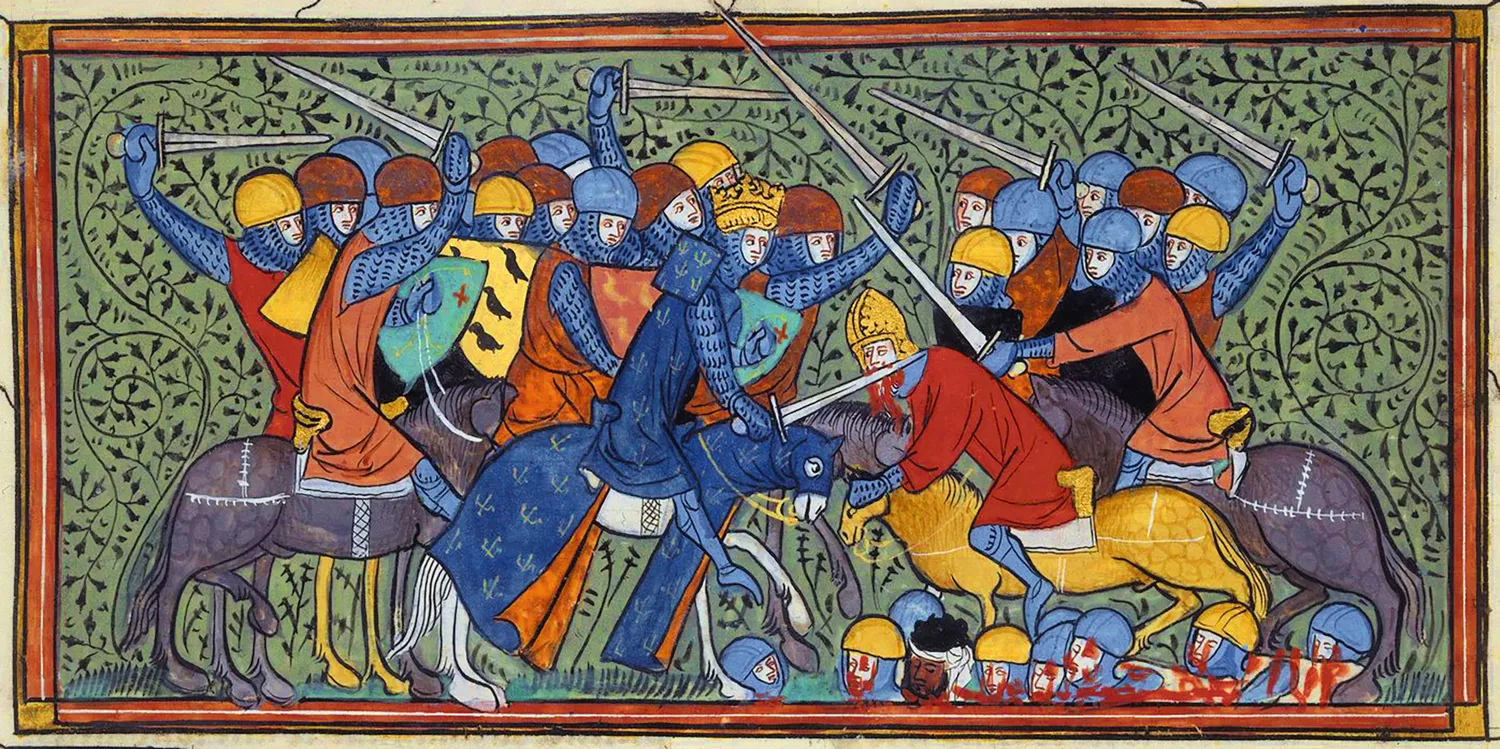
"Charles Martel at Battle of Tours, Great Chronicles of France" by Levan Ramishvili from Tbilisi, Georgia / Wikimedia Commons.
Charles Martel, known as “The Hammer,” was a powerful leader of the Franks in the early Middle Ages. As Mayor of the Palace of the Frankish kingdom, he held the real power behind the throne. Around 732 CE, Charles Martel led his people during a critical moment in European history—the Battle of Tours. His leadership and military strategy changed the future of Western Europe.
Martel’s rise to power began in the early 8th century, a time when the Frankish kings were weak and local noblemen competed for control. The Frankish kingdom covered much of modern-day France and parts of Germany. As Mayor of the Palace, Martel managed royal lands, led the army, and made important decisions for the kingdom. According to the “Continuations of Fredegar,” a key primary source, Martel strengthened his army by granting land to his followers in exchange for military service—a practice that would later shape European feudalism.
In 711 CE, Muslim armies from North Africa crossed into Spain and created the Umayyad state of Al-Andalus. By 732, these forces advanced north into Gaul (now France), threatening Christian kingdoms. At Tours, near the Loire River, Martel’s heavily armed infantry met the invading army led by Abdul Rahman Al Ghafiqi. The “Chronicle of Moissac,” an early medieval source, describes how Martel’s disciplined troops formed a defensive wall, stopping the cavalry charges of their opponents. After a day of fierce fighting, the Muslim army retreated, and Abdul Rahman was killed.
The Battle of Tours had lasting consequences. Many historians believe Martel’s victory prevented further Muslim expansion into Western Europe, allowing Christianity and Frankish culture to flourish. This battle also increased Martel’s reputation and laid the groundwork for the later Carolingian dynasty, including his grandson Charlemagne. The outcome influenced the social hierarchy of medieval Europe, as land-owning nobles and armored knights became more important in society.
Charles Martel’s actions at Tours shaped the political and religious landscape of Europe. His use of land grants for military service was a turning point, leading to the rise of feudalism. Historians continue to debate the size of the armies and the full impact of the battle, but Martel’s leadership remains a key example of how individuals can change history.
Charles Martel’s story connects to broader themes of power, religion, and cultural change in world history.
Interesting Fact: Charles Martel never became king himself, but his descendants, including Charlemagne, would later rule a vast European empire.
Who was Charles Martel?
Leader of the FranksRoman emperorMuslim generalKing of England
In what year did the Battle of Tours occur?
732 CE1066 CE711 CE800 CE
Who led the invading army at Tours?
Abdul Rahman Al GhafiqiCharlemagneJulius CaesarWilliam the Conqueror
Why was the Battle of Tours important?
Stopped Muslim expansionEnded feudalismStarted Roman EmpireFormed Al-Andalus
How did Martel reward his followers?
By granting landWith gold coinsWith titles onlyWith ships
What was one effect of Martel's victory?
Rise of feudalismDecline of ChristianityEnd of the Frankish kingdomCreation of the Roman Republic
Charles Martel was a king. True or false?
TrueFalse
What does 'dynasty' mean?
Family of rulersBattle formationGroup of soldiersType of weapon
Perfect For:
👩🏫 Teachers
• Reading comprehension practice
• Auto-graded assessments
• Literacy skill development
👨👩👧👦 Parents
• Reading practice at home
• Comprehension improvement
• Educational reading time
🏠 Homeschoolers
• Reading curriculum support
• Independent reading practice
• Progress monitoring
Reading Features:
📖
Reading Passage
Engaging fiction or nonfiction text
❓
Comprehension Quiz
Auto-graded questions
📊
Instant Feedback
Immediate results and scoring
📄
Printable Version
Download for offline reading
🔊
Read Aloud
Voice-over with word highlighting
Reviews & Ratings
No reviews yet. Be the first to share your experience!
Related Content
Middle Ages Legacy
This history reading passage examines the lasting legacy of the Middle Ages, including the development of universities, ...
Early Middle Ages
This comprehensive reading passage explores the Early Middle Ages (500-1000 CE), a transformative period in European his...
High Middle Ages
This detailed world history reading passage explores the High Middle Ages (1000-1300 CE), a transformative era in Europe...
What Were the Middle Ages?
This engaging world history reading passage introduces students to the Middle Ages, the period in European history betwe...
Late Middle Ages
This rigorous world history reading passage explores the Late Middle Ages (1300-1500 CE), a time marked by the devastati...
Dark Ages
This passage offers a rigorous, engaging examination of why the early Middle Ages are often called the 'Dark Ages.' Stud...
Life in Middle Ages
This rigorous history reading passage explores life in Europe during the Middle Ages, focusing on the structure of feuda...
Medieval Islamic World
This rigorous reading passage delves into the Medieval Islamic World's golden age, when a vast civilization stretched fr...
Islamic Golden Age
This history reading passage explores the Islamic Golden Age, a period from the 8th to 14th centuries marked by outstand...
Medieval to Modern Transition
This engaging world history reading passage explores the dramatic transformation from the Middle Ages to the modern era,...
Medieval Words in English
This engaging history reading passage examines the evolution of the English language during the Middle Ages, focusing on...
Age of Exploration Begins
This engaging history reading passage explores the Age of Exploration, a turning point in world history when European po...
Italian City-States
This passage explores the rise and significance of the Italian city-states—Venice, Florence, and Genoa—during the Middle...
Attila the Hun
This engaging world history reading passage examines Attila the Hun, a powerful and feared ruler during the Middle Ages....
Medieval Guilds
This engaging world history reading passage explores the important role of guilds—worker groups that shaped the economy ...
Medieval Christian Worship
This detailed passage examines how people worshiped during the Middle Ages, focusing on essential religious practices su...
Power of the Pope
This history reading passage examines the power of the pope during the Middle Ages, focusing on his role as spiritual le...
Carolingian Renaissance
This engaging world history passage explores how Charlemagne, ruler of the Franks, transformed education and learning in...
Islamic Golden Age Inventions
This world history reading passage explores the remarkable inventions and scientific advances made in the medieval Islam...
Medieval Agricultural Innovations
This history reading passage explores how farming inventions like the heavy plow, three-field system, and horse collar r...