Clovis and the Franks
Interactive passage with audio narration, comprehension questions, and printable PDF.
By completing this purchase you agree to our Terms of Use and Privacy Policy. Your subscription renews automatically until you cancel. You can cancel anytime from your account settings. All sales are final and non-refundable. Digital content is available for download in your account immediately upon purchase.
What's included
Clovis and the Franks preview and details
About this printable Clovis and the Franks reading passage (Grades 5-8)
Sample passage and quiz from Clovis and the Franks
Reading passage and comprehension quiz preview
Clovis and the Franks
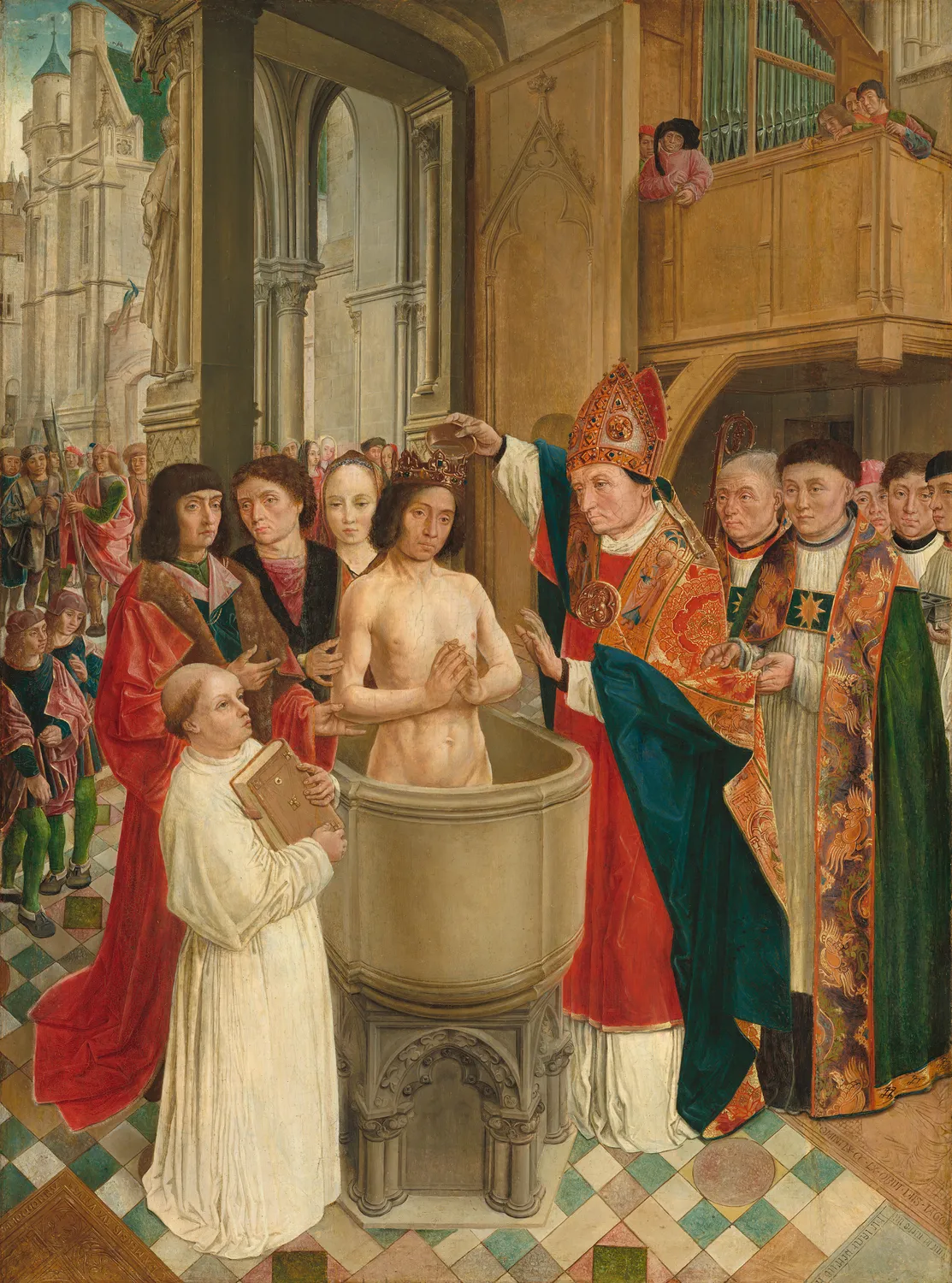
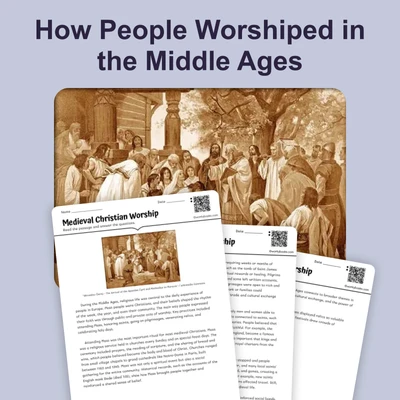
Master Of Saint Gilles - The Baptism of Clovis / Wikimedia Commons.
Clovis was the first king to unite all the Frankish tribes under one ruler, creating the foundation for the kingdom of France. In the years after the fall of the Western Roman Empire, Europe was divided into many small kingdoms and tribes. The Franks, a Germanic people, lived in what is now France and western Germany. Clovis became king of the Salian Franks in 481 CE at the age of 15. His leadership, military skill, and religious choices would change the course of European history.
Clovis began his reign by expanding his territory through warfare. He defeated the Roman governor Syagrius at the Battle of Soissons in 486 CE, ending Roman control in northern Gaul. This victory gave him control over valuable land and resources. Clovis then fought against other tribes, including the Alemanni, whom he defeated at the Battle of Tolbiac around 496 CE. According to the historian Gregory of Tours, Clovis prayed to the Christian God for victory during this battle, promising to convert to Christianity if he won. After his victory, Clovis and 3,000 of his warriors were baptized by Bishop Remigius in Reims. This event, described in detail by Gregory, was a turning point for both the Franks and the spread of Christianity in Western Europe.
Clovis’s conversion to Christianity had significant effects. Before his baptism, most Franks followed traditional pagan beliefs, while many of their neighbors were already Christian. By adopting Christianity, Clovis gained the support of the powerful Roman Church and its leaders, especially the pope. This alliance strengthened his authority and helped unite his people. The Church provided education, record-keeping, and a sense of shared identity. Archaeological evidence, such as the richly decorated tombs found at sites like Tournai, shows the blending of Frankish and Christian traditions during Clovis’s reign.
As king, Clovis established the Merovingian dynasty, named after his legendary ancestor Merovech. He created new laws, called the Salic Law, which organized society and established order. Under Clovis, Frankish society became more structured, with a clear hierarchy of nobles, warriors, and common people. The capital was set at Paris, which grew in importance. Clovis’s kingdom covered much of modern France and parts of Germany, shaping the map of Europe for centuries.
Clovis’s achievements marked the beginning of the Middle Ages in Western Europe. By uniting the Franks and converting to Christianity, he set a pattern for future European rulers. His actions helped create the close connection between kings and the Church that would define medieval society. The legacy of Clovis can still be seen in the traditions, laws, and cultures of Europe today.
This story about Clovis connects to the broader themes of how leaders use war, religion, and alliances to build powerful states, and how geography shapes the rise of civilizations.
Interesting Fact: The baptism of Clovis is often considered the birth of France as a Christian nation and is still celebrated in French history today.
Comprehension quiz (8 questions)
1. Who united the Frankish tribes?
2. Where did Clovis defeat Syagrius?
3. What law did Clovis create?
4. Why did Clovis convert to Christianity?
5. How did Clovis’s conversion help him?
6. What did the Church provide to Clovis?
7. Clovis was baptized with 3,000 warriors. True or false?
8. What is a dynasty?
Perfect for the way you teach
- Build comprehension skills
- Auto-graded quiz
- Differentiated reading
- Read together at home
- Improve fluency
- Quiet reading time
- Reading curriculum support
- Independent practice
- Track Lexile growth