Reading PassagePremium

Comparing Energy Sources

Interactive passage with audio narration, comprehension questions, and printable PDF.

No ratings yet
Grades 5–8ScienceReadingElaEnglish · SpanishInteractive · Printable
Aligned toMS-PS3-4MS-ESS3-3MS-ESS3-4
Just this resource
$1.50
One-time purchase
Best value
Unlock everything
$49.99$29.99/yr
40% off until Aug 1 — 10,000+ resources
Renews at $49.99/year.
Unlock above to use these actions

What's included

Reading passage
Audio narration
Comprehension quiz
Writing activity
Glossary & flashcards
Differentiated version
Spanish translation

Comparing Energy Sources preview and details

About this printable Comparing Energy Sources science reading passage, NGSS-aligned (Grades 5-8)

This passage provides a comprehensive overview for middle school students on how scientists and societies compare various energy sources. Focusing on criteria such as availability, cost, environmental impact, reliability, and efficiency, the passage demonstrates why no single energy source is perfect and highlights the importance of a balanced energy mix. Quantitative concepts like Energy Return on Investment (EROI) are introduced at an accessible level, and the text addresses regional considerations in energy choices. Aligned to NGSS standards MS-PS3-4, MS-ESS3-3, and MS-ESS3-4, the passage encourages critical thinking about the trade-offs involved in energy decisions. Activities include a multiple-choice quiz, writing prompts, and graphic organizers to deepen student understanding. Audio support is integrated for all learners. This resource is ideal for supporting science instruction and literacy in grades 6-8 classrooms.
Written by Workybooks TeamPublished by Workybooks
Preview

Sample passage and quiz from Comparing Energy Sources

Reading passage and comprehension quiz preview

Comparing Energy Sources
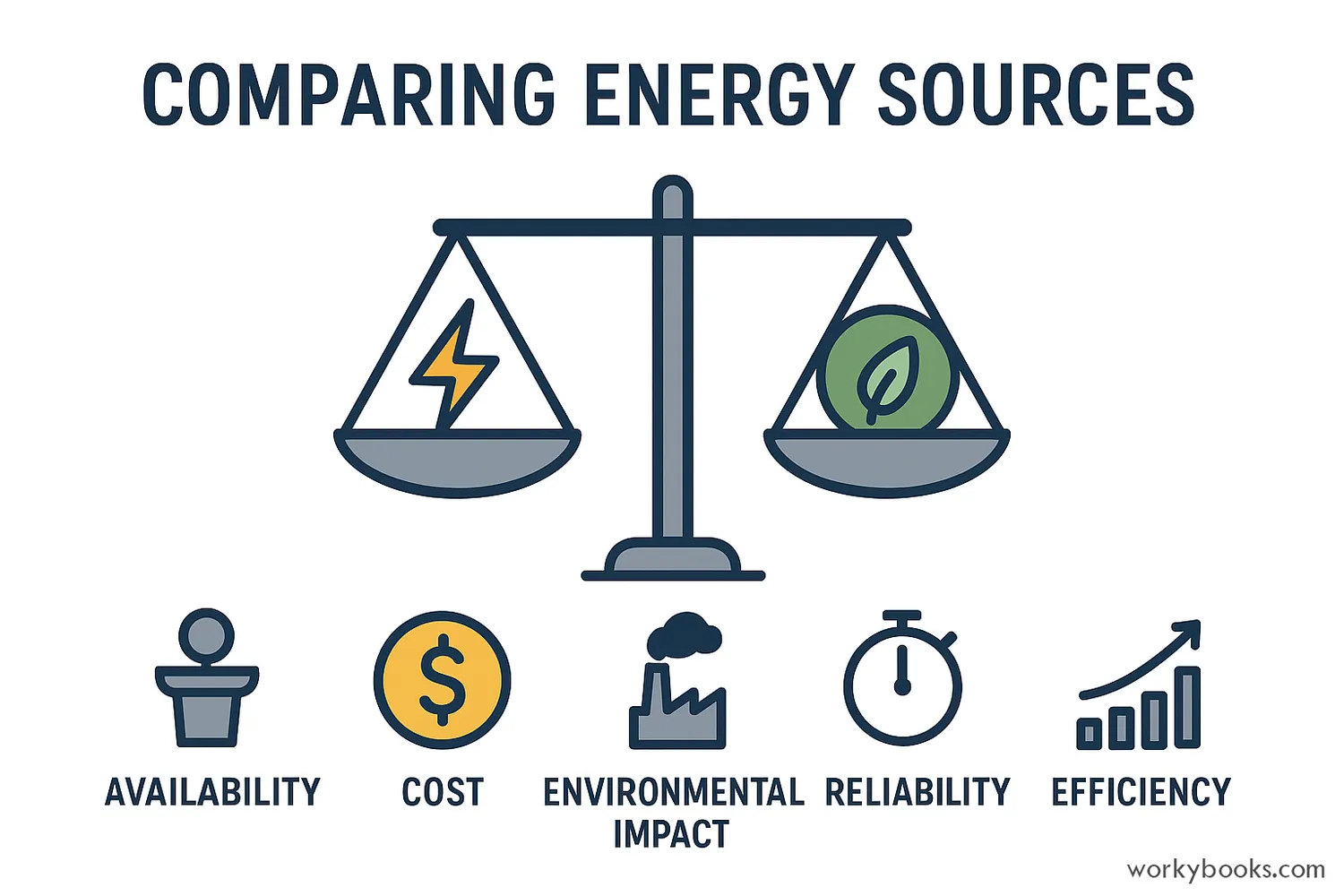
Icons comparing energy sources by key criteria on white background.
Energy sources compared by availability, cost, impact, reliability, efficiency, EROI.

Many countries must decide how to meet their energy needs while protecting the environment and keeping costs low. Choosing the right energy source is complex because each type has advantages and disadvantages. Energy sources like coal, oil, wind, solar, and nuclear are compared using a framework that includes availability, cost, environmental impact, reliability, efficiency, and scalability. No single energy source is perfect, so societies often choose a balanced mix to meet their needs.

How Energy Sources Are Evaluated

Scientists and engineers use several criteria to evaluate energy sources. Availability refers to how much of a resource is present and how easily it can be accessed. For example, solar energy is available during sunny days, while wind energy depends on weather patterns. Cost includes how much money is needed to build, maintain, and operate power plants. Environmental impact examines how each source affects air, water, land, and living things. Coal and oil release greenhouse gases, while solar and wind produce electricity without pollution. Reliability is the ability of an energy source to supply power when it is needed. Nuclear power is very reliable, but solar and wind can be less consistent due to weather. Efficiency measures how much usable energy is obtained from a source compared to the energy put in. Scalability asks whether a source can be expanded to meet growing demand. Hydroelectric dams, for example, require specific landscapes and cannot be built everywhere.

Energy Return on Investment (EROI) and Real-World Examples

A key concept in comparing energy sources is Energy Return on Investment (EROI), which is the ratio of energy produced to the energy needed to obtain it. Higher EROI values mean more net energy is available for society. For example, traditional oil extraction once had EROI values over 30:1, but as resources become harder to access, the EROI drops. Wind and solar have EROI values ranging from 10:1 to 30:1, depending on technology and location. These values help scientists determine which sources are most practical for large-scale use.

Balanced Energy Mix and Regional Factors

Because each energy source has strengths and weaknesses, countries often use a mix to provide stable and affordable power. Regions with strong sunlight, like the American Southwest, invest more in solar energy. Areas with steady winds, such as northern Europe, use more wind power. Other regions rely on fossil fuels due to existing infrastructure. As technology improves, the efficiency and EROI of renewables are increasing, making them more competitive. However, no single source meets all needs everywhere, so a balanced approach is necessary.

Energy choices have major impacts on the environment, economy, and society. Understanding the trade-offs helps people and governments make informed decisions about which energy sources to use.

Interesting Fact: The world’s largest solar farm, located in India, can generate enough electricity to power over 150,000 homes at once!

Comprehension quiz (10 questions)

1. Which of the following is NOT a factor used to compare energy sources in the passage?

Taste
Cost
Reliability
Efficiency

2. What does 'availability' mean when talking about energy sources?

How much of a resource exists and can be used
How expensive the energy is
How much pollution is created
How hard it is to store energy

3. Which energy sources are described as producing electricity without pollution?

Solar and wind
Coal and oil
Nuclear and coal
Oil and gas

4. What does EROI stand for?

Energy Return on Investment
Environmental Rate of Impact
Energy Range of Input
Economic Resource Output Index

5. What is meant by 'scalability' in the passage?

How easily a source can grow to meet more demand
How much pollution is created
The color of the energy source
How long an energy source lasts

6. Which energy source is described as very reliable?

Nuclear
Solar
Wind
Oil

7. If a country has a lot of sunlight, which energy source might it use more?

Solar
Coal
Wind
Oil

8. True or False: All energy sources are equally reliable everywhere.

True
False

9. True or False: Using a balanced mix of energy sources can help meet energy needs and reduce problems.

True
False

10. What is the main reason societies use different energy sources instead of just one?

No single energy source is perfect for all needs or regions
It is more expensive to use only one source
Governments want to try every technology
People like to change things often
Who it's for

Perfect for the way you teach

Teachers
  • Build comprehension skills
  • Auto-graded quiz
  • Differentiated reading
Parents
  • Read together at home
  • Improve fluency
  • Quiet reading time
Homeschoolers
  • Reading curriculum support
  • Independent practice
  • Track Lexile growth
Topics

Reviews & Ratings

No reviews yet. Be the first to share your experience!

More reading you might love

20 more
Passage
Natural Disaster: Volcanic Eruptions - reading educational content
Grades 4–5

Natural Disaster: Volcanic Eruptions

weather and climate · RI.3.1

Free
Passage
Great Pacific Garbage Patch - reading educational content
Grades 5–8

Great Pacific Garbage Patch

science · MS-ESS3-3

$1.50
Passage
How Rainforests Help the Planet - reading educational content
Grades 5–8

How Rainforests Help the Planet

science · MS-LS2-3

$1.50
Passage
Human Impacts: Pollution - reading educational content
Grades 5–8

Human Impacts: Pollution

life science · MS-LS2-4

$1.50
Passage
Human Impacts: Habitat Destruction - reading educational content
Grades 5–8

Human Impacts: Habitat Destruction

life science · MS-LS2-4

$1.50
Passage
Ecosystem Services - reading educational content
Grades 5–8

Ecosystem Services

life science · MS-LS2-5

Free
Passage
Environmental Problems and Solutions - reading educational content
Grades 5–8

Environmental Problems and Solutions

life science · MS-LS2-4

$1.50
Passage
Remote Sensing - reading educational content
Grades 5–8

Remote Sensing

science · MS-ESS3-3

$1.50
Passage
Geographic Information Systems (GIS) - reading educational content
Grades 5–8

Geographic Information Systems (GIS)

science · MS-ESS3-3

$1.50
Passage
Renewable vs. Nonrenewable Energy - reading educational content
Grades 5–8

Renewable vs. Nonrenewable Energy

physical science · MS-PS3-4

$1.50
Passage
Fossil Fuels: Coal - reading educational content
Grades 5–8

Fossil Fuels: Coal

physical science · MS-PS3-4

$1.50
Passage
Solar Energy - reading educational content
Grades 5–8

Solar Energy

physical science · MS-PS3-4

$1.50
Passage
Wind Energy - reading educational content
Grades 5–8

Wind Energy

physical science · MS-PS3-4

$1.50
Passage
Hydroelectric Energy - reading educational content
Grades 5–8

Hydroelectric Energy

physical science · MS-PS3-4

$1.50
Passage
Geothermal Energy - reading educational content
Grades 5–8

Geothermal Energy

physical science · MS-PS3-4

$1.50
Passage
Biomass and Biofuels - reading educational content
Grades 5–8

Biomass and Biofuels

physical science · MS-PS3-4

$1.50
Passage
Nuclear Energy as a Resource - reading educational content
Grades 5–8

Nuclear Energy as a Resource

physical science · MS-PS3-4

$1.50
Passage
Water Quality - reading educational content
Grades 5–8

Water Quality

science · MS-ESS3-1

$1.50
Passage
Florida Everglades - reading educational content
Grades 5–8

Florida Everglades

weather and climate · MS-LS2-1

$1.50
Passage
Congo Rainforest - reading educational content
Grades 5–8

Congo Rainforest

weather and climate · MS-LS2-1

$1.50
Copyright © 2026 Workybooks. Made with ♥ in California.