Comparing the Planets
Interactive passage with audio narration, comprehension questions, and printable PDF.
By completing this purchase you agree to our Terms of Use and Privacy Policy. Your subscription renews automatically until you cancel. You can cancel anytime from your account settings. All sales are final and non-refundable. Digital content is available for download in your account immediately upon purchase.
What's included
Comparing the Planets preview and details
About this printable Comparing the Planets science reading passage, NGSS-aligned (Grades 5-8)
Sample passage and quiz from Comparing the Planets
Reading passage and comprehension quiz preview
Comparing the Planets
Source: Wikimedia Commons (Public domain).
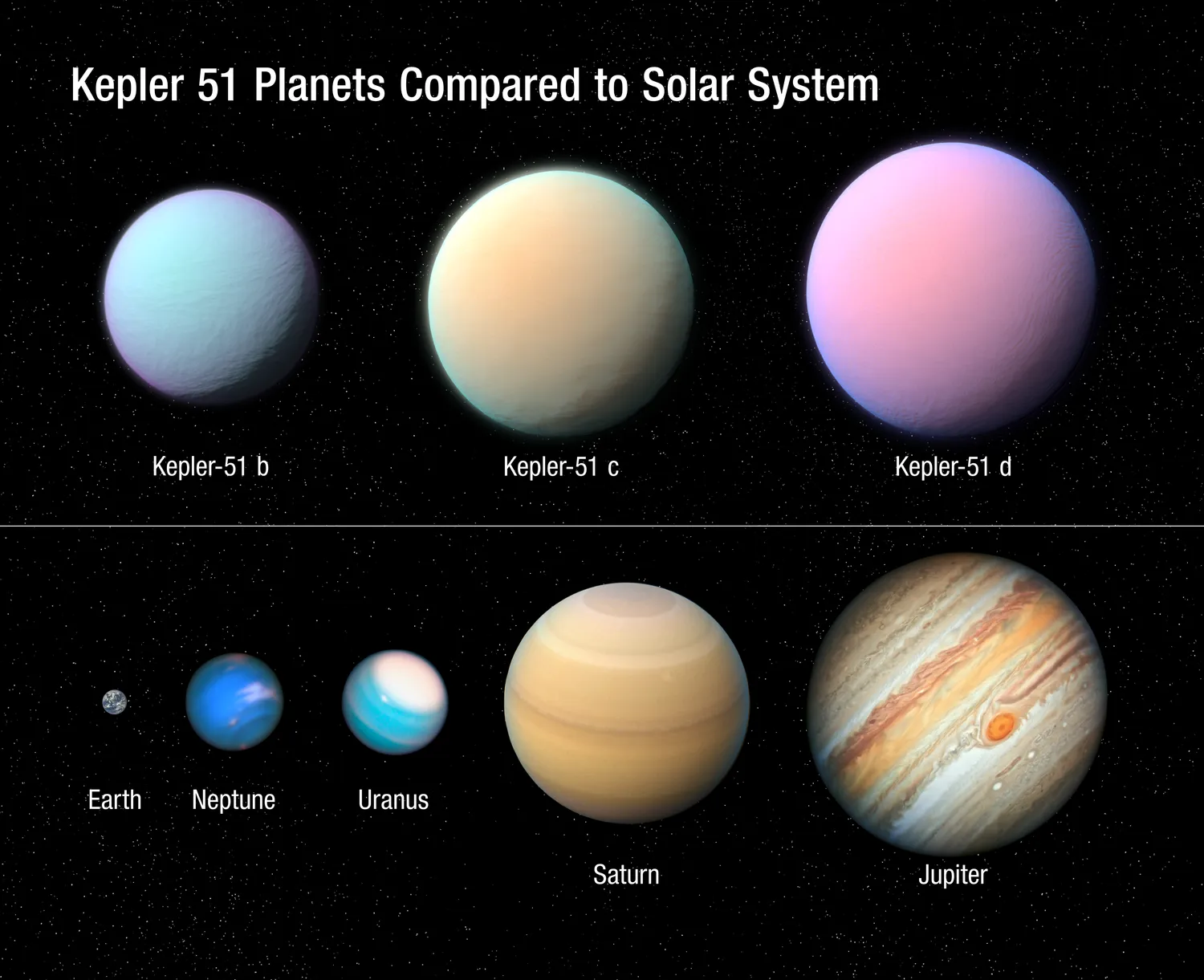
Planetary science allows us to organize the planets of our solar system into groups based on their physical characteristics. When scientists observe the night sky, they notice that not all planets are alike. Some are small, rocky, and dense, while others are enormous and made mostly of gases. Understanding these differences helps reveal how planets form and interact as systems.
Types of Planets and Their Features
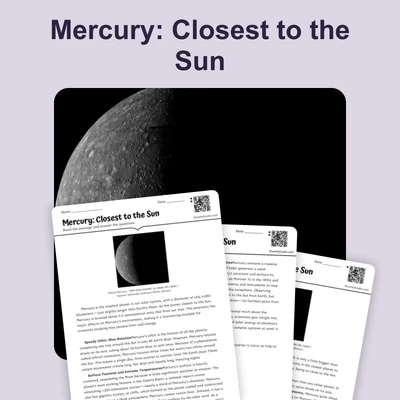
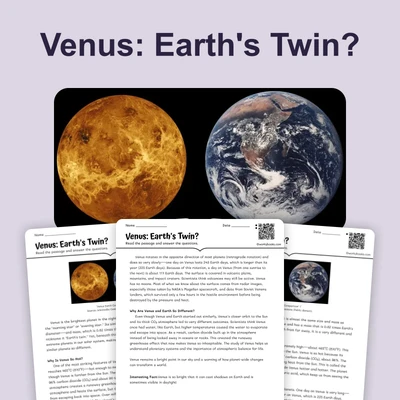
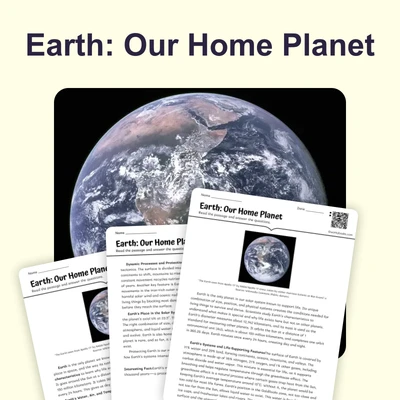
The four terrestrial planets—Mercury, Venus, Earth, and Mars—share several characteristics. They are all rocky, have solid surfaces, and are relatively small and dense (about 5 grams per cubic centimeter). These planets have few or no moons, and their atmospheres vary: Venus has a thick, toxic atmosphere, Mars has a thin one, and Mercury has almost none at all. Earth's atmosphere supports life and regulates temperature. Surface conditions among terrestrial planets are influenced by atmosphere; for example, Mercury's lack of atmosphere causes extreme temperature swings from 430°C during the day to -180°C at night.
Gas Giants and Ice Giants
Jupiter and Saturn are known as gas giants. They are much larger than terrestrial planets, mostly composed of hydrogen and helium, and have no solid surface. Their low densities, especially Saturn’s (which would float in water), result from their gaseous composition. Both have many moons and ring systems. Uranus and Neptune are ice giants, somewhat smaller than gas giants but with significant differences. Their atmospheres contain more ices like water, ammonia, and methane, which gives Neptune and Uranus their blue color. Methane absorbs red light and reflects blue, making these planets stand out. Ice giants also have many moons and faint rings.
Comparing Size, Density, and Motion
The solar system’s planets show dramatic variety in size and mass. Jupiter is the most massive, about 318 times Earth’s mass, while Mercury is the smallest at only 0.055 times Earth’s mass. Densities also vary: Earth is the densest planet, while Saturn is the least dense. Day lengths differ, too. Venus rotates very slowly, taking 243 Earth days for one rotation, while Jupiter spins quickly in about 10 hours. A planet’s orbital period, or year, is also different: Mercury takes just 88 Earth days, but Neptune’s year lasts 165 Earth years. These variations are measured using telescopes and space probes, which collect data about each planet’s movement, size, and composition.
Studying planetary differences helps scientists understand the processes that shape planet formation and evolution. It also guides future space missions and the search for life beyond Earth by focusing on planets with conditions that might support life.
Interesting Fact: Saturn is so light for its size that it would float in water—if you could find a bathtub big enough!
Comprehension quiz (10 questions)
1. Which group of planets is known for having rocky surfaces and high density?
2. What causes the blue color of Uranus and Neptune?
3. Which planet would float in water because of its low density?
4. How do scientists measure the differences between the planets?
5. What does the term "orbital period" mean in the passage?
6. Why do terrestrial planets have more extreme temperature changes compared to gas giants?
7. Which is true about gas giants and ice giants?
8. If a new planet is discovered with a thick methane atmosphere and many moons, which group would it likely belong to?
9. Jupiter is more massive than Earth.
10. Mercury has a very thick atmosphere.
Perfect for the way you teach
- Build comprehension skills
- Auto-graded quiz
- Differentiated reading
- Read together at home
- Improve fluency
- Quiet reading time
- Reading curriculum support
- Independent practice
- Track Lexile growth