Crusader States
Interactive passage with audio narration, comprehension questions, and printable PDF.
By completing this purchase you agree to our Terms of Use and Privacy Policy. Your subscription renews automatically until you cancel. You can cancel anytime from your account settings. All sales are final and non-refundable. Digital content is available for download in your account immediately upon purchase.
What's included
Crusader States preview and details
About this printable Crusader States reading passage (Grades 5-8)
Sample passage and quiz from Crusader States
Reading passage and comprehension quiz preview
Crusader States
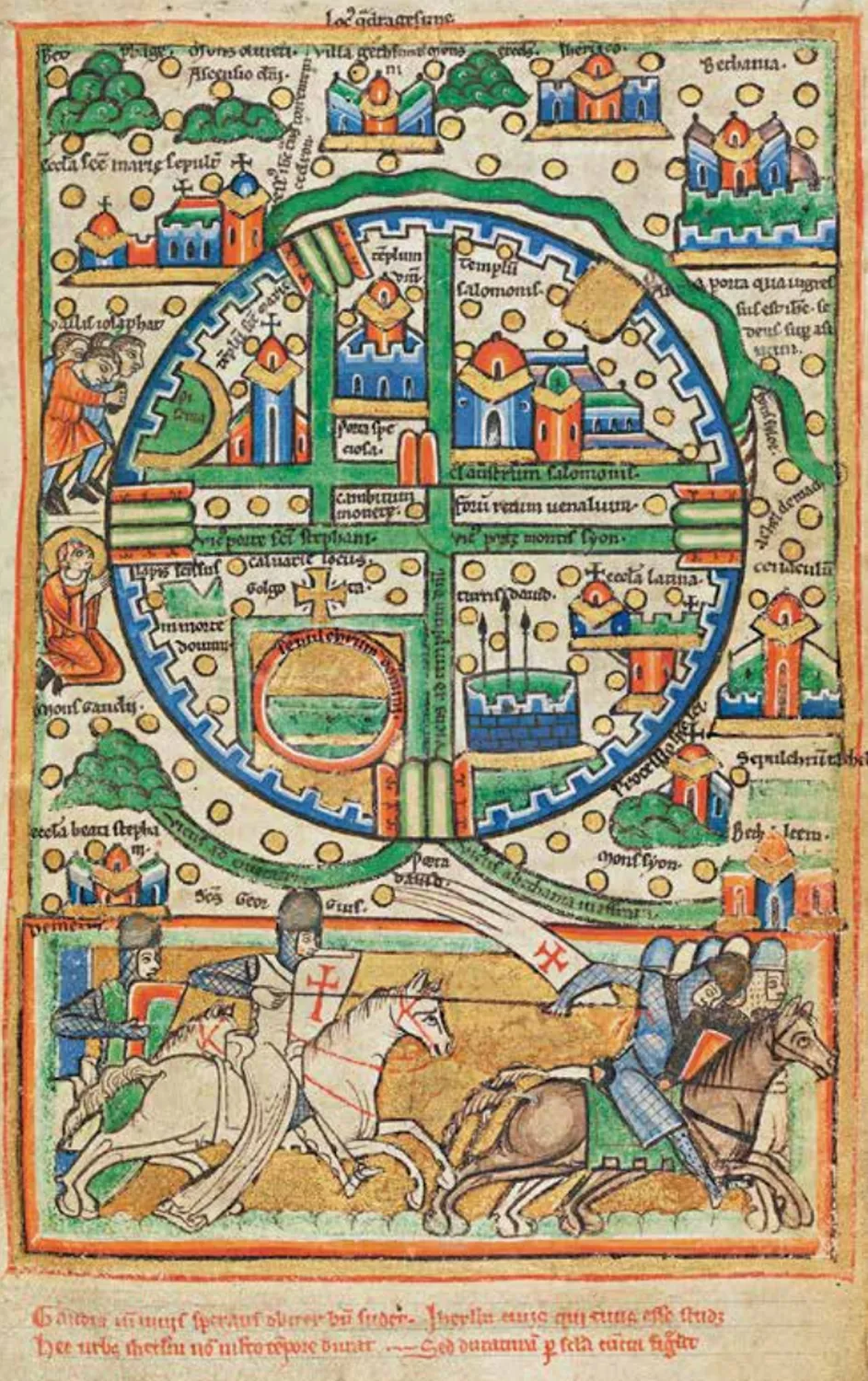
"Map of Crusader Jerusalem, late 12th century" by End of 12th century artist / Wikimedia Commons.
The Crusader States were four Christian kingdoms created by European knights in the eastern Mediterranean during the early Middle Ages. After the First Crusade captured Jerusalem in 1099, the victors established the Kingdom of Jerusalem, the County of Edessa, the Principality of Antioch, and the County of Tripoli. These new states were located in lands that included parts of modern-day Israel, Lebanon, Syria, and Turkey. Their rulers aimed to maintain control over sacred Christian sites while defending against local Muslim powers.
The largest and most important of the Crusader States was the Kingdom of Jerusalem. It included the city of Jerusalem, which was a spiritual center for Christians, Jews, and Muslims. The kingdom was ruled by European nobles who brought their own laws and customs but had to cooperate with local populations. The other three states were also governed by European leaders, but each faced unique challenges. For example, the County of Edessa was especially vulnerable due to its location far from the sea and was the first to fall when Muslim forces under Zengi captured it in 1144. The Principality of Antioch and the County of Tripoli were established by noble families, such as the Bohemonds and the Saint-Gilles, and often relied on alliances with neighboring powers for survival.
All four Crusader States faced constant military threats from Muslim dynasties, especially the Seljuks and later the Ayyubids under Saladin. The crusaders built massive fortresses, like Krak des Chevaliers, to defend their territories. These fortresses were advanced for their time, with thick walls and towers. Archaeologists have found coins, pottery, and castle remains that show both European and Middle Eastern influences, proving that crusaders adapted to the region's geography and culture. Some primary sources, such as letters from leaders like King Baldwin IV, describe the difficulties of holding onto the land and the importance of local alliances.
Life in the Crusader States was shaped by a mix of European and Middle Eastern cultures. There were social hierarchies, with European nobles at the top, but many local Christians, Muslims, and Jews lived and worked in the cities and countryside. Trade flourished, and local products such as spices and textiles were exported to Europe. However, the constant warfare and need for reinforcements from Europe made the states unstable. By 1291, all four states had been conquered by Muslim armies, but their legacy remained in the form of castles, cultural exchanges, and historical records.
The story of the Crusader States helps us understand how geography, culture, and conflict shaped medieval societies. Studying their rise and fall connects to broader themes of cultural interaction, religious change, and the lasting impact of the Middle Ages on world history.
Interesting Fact: Some crusader castles, like Krak des Chevaliers, are still standing today and are UNESCO World Heritage Sites.
Comprehension quiz (8 questions)
1. Which city was the center of the Kingdom of Jerusalem?
2. Who captured Edessa in 1144?
3. What was the main purpose of Crusader fortresses?
4. What led to the downfall of the Crusader States?
5. Why was Edessa vulnerable?
6. What evidence shows cultural exchange in the Crusader States?
7. The Crusader States ended in 1291. True or false?
8. What is a 'fortress'?
Perfect for the way you teach
- Build comprehension skills
- Auto-graded quiz
- Differentiated reading
- Read together at home
- Improve fluency
- Quiet reading time
- Reading curriculum support
- Independent practice
- Track Lexile growth