This learning resource is available in interactive and printable formats. The interactive worksheet can be played online and assigned to students. The Printable PDF version can be downloaded and printed for completion by hand.
This passage explores the historical division of England in the late 9th century, when Viking invaders and King Alfred the Great of Wessex agreed to split the land into two regions: Wessex, ruled by the Anglo-Saxons, and the Danelaw, controlled by the Vikings. Students will learn about the causes and effects of Viking invasions, the significance of the Treaty of Wedmore, and the ways in which this division influenced law, culture, and daily life in medieval England. Using evidence from archaeological finds and primary sources, the text addresses continuity and change, human impact, and the importance of geography. The passage is aligned with CA HSS 6.7.3 and CCSS RH.6-8.2, and includes read aloud audio, a Spanish translation, multiple activities, and graphic organizers to support student learning.
CONTENT PREVIEW
Expand content preview
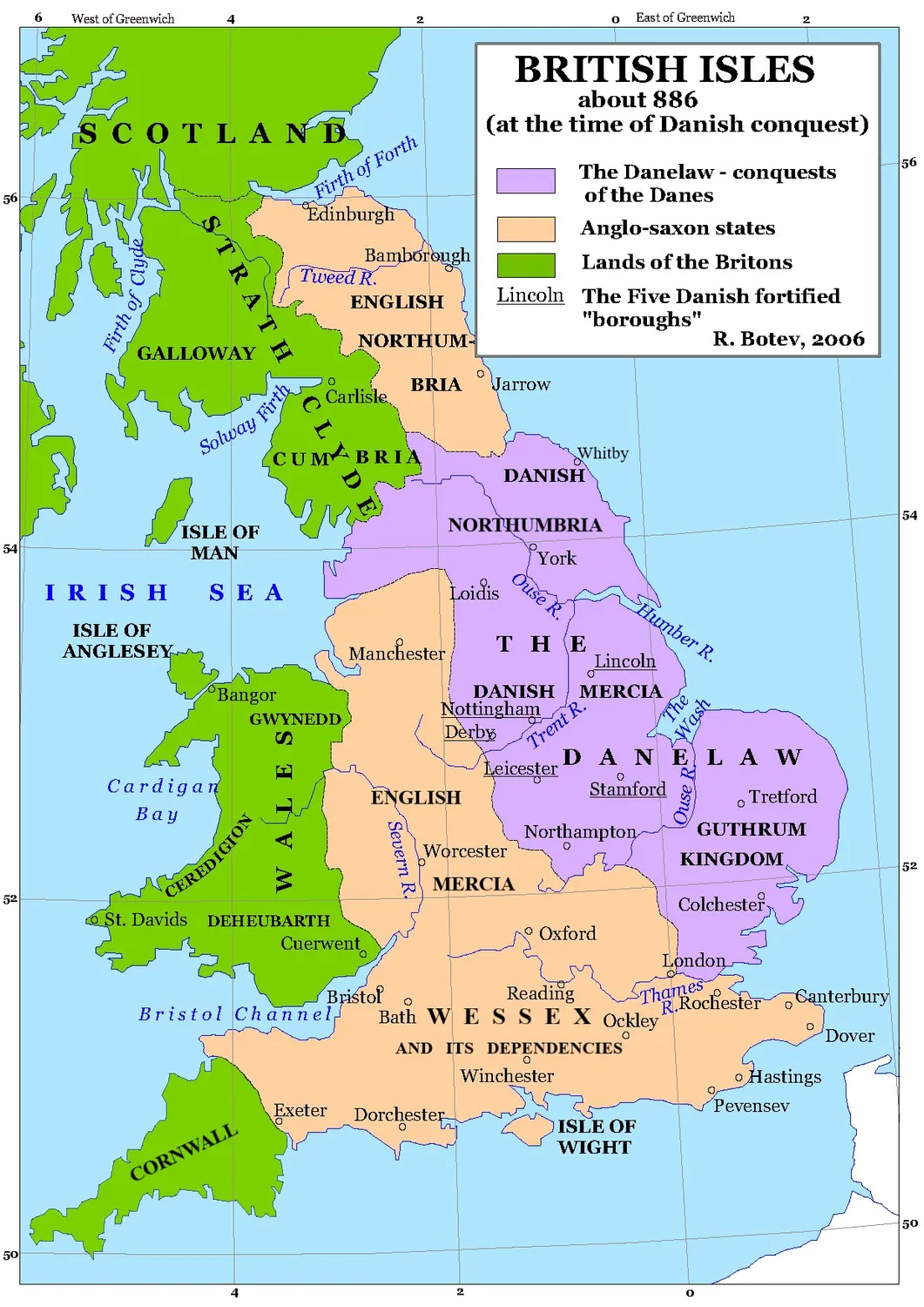
"England was divided into powerful groups" / Wikimedia Commons.
In the late 9th century, England was divided between two powerful groups: the Anglo-Saxons, led by King Alfred the Great of Wessex, and the Vikings, who controlled the region called the Danelaw. This split changed the future of England, leaving a mark on its laws, culture, and society.
During the 800s, Viking raiders from Scandinavia attacked and settled large parts of England. By 865 CE, the so-called Great Heathen Army landed and quickly captured northern and eastern regions. Many local Anglo-Saxon rulers were defeated or killed. According to the Anglo-Saxon Chronicle, entire towns such as York (Jorvik) came under Viking rule. The Vikings introduced their own customs and laws, often living side by side with the English but maintaining control over taxation and land ownership.
King Alfred of Wessex fought many battles against the Vikings. After a major victory at the Battle of Edington in 878 CE, Alfred and the Viking leader Guthrum agreed to the Treaty of Wedmore. This treaty set a border running roughly from London to Chester, dividing England into two regions: Wessex and the Danelaw. The Danelaw covered much of northern and eastern England, including cities like York, Lincoln, and Nottingham. Archaeological evidence, such as Viking burial sites at Repton and hoards of silver coins, shows the strong presence of Norse settlers in these areas.
The Danelaw was governed by unique laws and customs, blending Viking and local traditions. For example, land was measured using the Viking 'hundred' system instead of the Anglo-Saxon 'hide'. Towns in the Danelaw often had names ending in –by or –thorpe, reflecting Norse language. Social life in the Danelaw was shaped by a mix of cultures, and people traded goods across the border. However, the border was not always peaceful. Raids and conflicts continued, and over time, the two regions grew closer as rulers intermarried and exchanged ideas.
The division of England affected its future development. The Danelaw introduced new words, laws, and farming techniques. Over the next century, the two regions gradually unified, especially after King Athelstan's rule in the early 900s. Today, the legacy of the Danelaw can still be seen in English place names and legal traditions.
This episode in English history connects to broader themes of cultural interaction, migration, and the impact of treaties on societies. It shows how borders can shape language, law, and identity for generations.
Interesting Fact: Some English words, like "law" and "window," come from Old Norse, the language of the Vikings.
Who led Wessex against the Vikings?
King Alfred the GreatKing AthelstanGuthrumHarold Godwinson
What year did the Great Heathen Army invade?
1066 CE878 CE865 CE900 CE
Which city was known as Jorvik under Vikings?
LondonYorkLincolnNottingham
What was a major effect of the treaty?
England united under one rulerEngland split into two regionsVikings left England foreverThe Romans returned
How did the Danelaw influence English language?
No influence at allAdded Norse words to EnglishChanged English to LatinMade English illegal
Why did Vikings settle in England?
To escape cold climateFor new land and powerThey were invited by AlfredTo build castles
The Danelaw covered southern England. True or false?
TrueFalse
What does 'archaeological' mean?
About ancient remainsAbout building housesAbout farmingAbout laws
Perfect For:
👩🏫 Teachers
• Reading comprehension practice
• Auto-graded assessments
• Literacy skill development
👨👩👧👦 Parents
• Reading practice at home
• Comprehension improvement
• Educational reading time
🏠 Homeschoolers
• Reading curriculum support
• Independent reading practice
• Progress monitoring
Reading Features:
📖
Reading Passage
Engaging fiction or nonfiction text
❓
Comprehension Quiz
Auto-graded questions
📊
Instant Feedback
Immediate results and scoring
📄
Printable Version
Download for offline reading
🔊
Read Aloud
Voice-over with word highlighting
Reviews & Ratings
No reviews yet. Be the first to share your experience!
Related Content
Middle Ages Legacy
This history reading passage examines the lasting legacy of the Middle Ages, including the development of universities, ...
Early Middle Ages
This comprehensive reading passage explores the Early Middle Ages (500-1000 CE), a transformative period in European his...
High Middle Ages
This detailed world history reading passage explores the High Middle Ages (1000-1300 CE), a transformative era in Europe...
What Were the Middle Ages?
This engaging world history reading passage introduces students to the Middle Ages, the period in European history betwe...
Late Middle Ages
This rigorous world history reading passage explores the Late Middle Ages (1300-1500 CE), a time marked by the devastati...
Dark Ages
This passage offers a rigorous, engaging examination of why the early Middle Ages are often called the 'Dark Ages.' Stud...
Life in Middle Ages
This rigorous history reading passage explores life in Europe during the Middle Ages, focusing on the structure of feuda...
Medieval Islamic World
This rigorous reading passage delves into the Medieval Islamic World's golden age, when a vast civilization stretched fr...
Islamic Golden Age
This history reading passage explores the Islamic Golden Age, a period from the 8th to 14th centuries marked by outstand...
Medieval to Modern Transition
This engaging world history reading passage explores the dramatic transformation from the Middle Ages to the modern era,...
Medieval Words in English
This engaging history reading passage examines the evolution of the English language during the Middle Ages, focusing on...
Age of Exploration Begins
This engaging history reading passage explores the Age of Exploration, a turning point in world history when European po...
Italian City-States
This passage explores the rise and significance of the Italian city-states—Venice, Florence, and Genoa—during the Middle...
Attila the Hun
This engaging world history reading passage examines Attila the Hun, a powerful and feared ruler during the Middle Ages....
Medieval Guilds
This engaging world history reading passage explores the important role of guilds—worker groups that shaped the economy ...
Medieval Christian Worship
This detailed passage examines how people worshiped during the Middle Ages, focusing on essential religious practices su...
Power of the Pope
This history reading passage examines the power of the pope during the Middle Ages, focusing on his role as spiritual le...
Carolingian Renaissance
This engaging world history passage explores how Charlemagne, ruler of the Franks, transformed education and learning in...
Islamic Golden Age Inventions
This world history reading passage explores the remarkable inventions and scientific advances made in the medieval Islam...
Medieval Agricultural Innovations
This history reading passage explores how farming inventions like the heavy plow, three-field system, and horse collar r...