Eastern Roman Empire
Interactive passage with audio narration, comprehension questions, and printable PDF.
By completing this purchase you agree to our Terms of Use and Privacy Policy. Your subscription renews automatically until you cancel. You can cancel anytime from your account settings. All sales are final and non-refundable. Digital content is available for download in your account immediately upon purchase.
What's included
Eastern Roman Empire preview and details
About this printable Eastern Roman Empire reading passage (Grades 5-8)
Sample passage and quiz from Eastern Roman Empire
Reading passage and comprehension quiz preview
Eastern Roman Empire
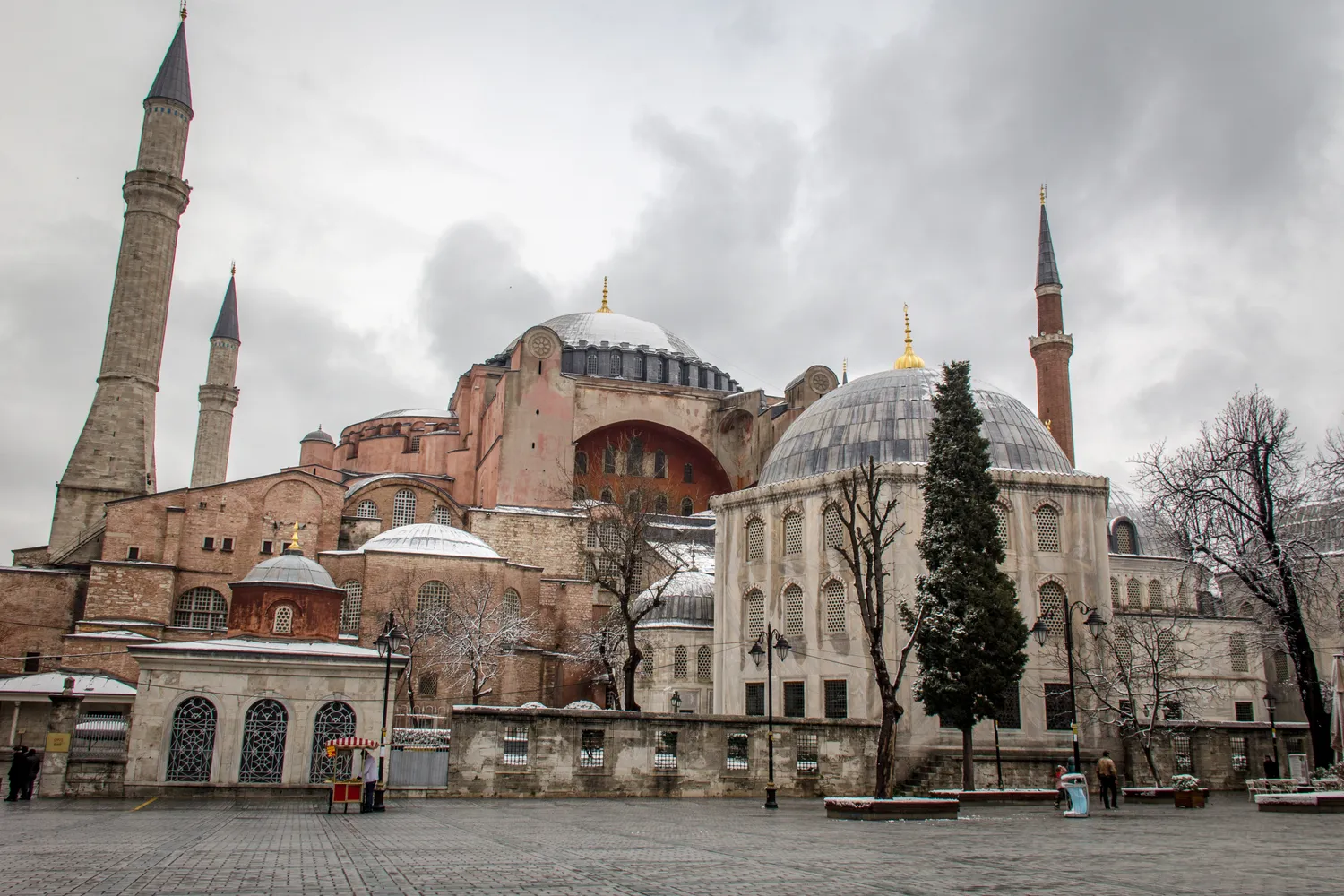
Hagia Sophia, Istanbul, Turkey" by Leandro Centomo / Wikimedia Commons.
The Byzantine Empire was the eastern half of the ancient Roman Empire, centered around the city of Constantinople (modern-day Istanbul). After the Western Roman Empire fell in 476 CE, the East continued for more than 1,000 years, preserving Roman traditions and developing its own unique culture. This long-lasting civilization played a major role in shaping the Middle Ages, especially in Europe and the eastern Mediterranean.
Constantinople, founded by Emperor Constantine in 330 CE, became the new capital of the Roman Empire. Its location on the Bosporus Strait made it a perfect spot for trade between Europe and Asia. The city was famous for its strong fortifications, including huge walls and a chain across its harbor. These defenses helped the city survive many attacks, like the Arab sieges in the 7th and 8th centuries. The people of Constantinople also used a secret weapon called Greek fire, a flammable liquid sprayed at enemy ships, which was impossible to put out with water.
One of the most important emperors was Justinian I (ruled 527-565 CE). He tried to rebuild the old Roman Empire by conquering lands in North Africa, Italy, and Spain. Justinian is also famous for creating the Justinian Code, a collection of Roman laws that became the basis for many legal systems in Europe. During his reign, the beautiful church of Hagia Sophia was built. Its huge dome and mosaics amazed visitors and showed the empire’s wealth and skill in architecture.
Life in the Byzantine Empire was shaped by its social hierarchy. The emperor sat at the top, followed by nobles, soldiers, merchants, craftsmen, and farmers. Most people spoke Greek and practiced Christianity, but the style of worship and church organization was different from the West. The Patriarch of Constantinople led the church in the East. Art, education, and science flourished, especially during peaceful times. The city’s markets bustled with goods from as far as China and Africa, showing its influence as a center of trade.
The Byzantine Empire faced many challenges, such as invasions by Persians, Arabs, and later Turks. Over time, it lost much of its territory, but Constantinople remained powerful until it finally fell to the Ottoman Turks in 1453 CE. Despite its end, the Byzantine Empire left a lasting legacy in law, art, religion, and government. Its culture influenced Russia and Eastern Europe, and its preservation of ancient Greek and Roman knowledge helped shape the Renaissance in Western Europe.
The story of the Byzantine Empire connects world history themes of cultural exchange, resilience, and the spread of ideas across continents.
Interesting Fact: The mosaics in Hagia Sophia contain some of the world’s oldest surviving images of Byzantine emperors and empresses.
Comprehension quiz (8 questions)
1. What was the capital of the Byzantine Empire?
2. Who was the famous emperor who created the Justinian Code?
3. Which weapon helped defend Constantinople?
4. Why was Constantinople’s location important?
5. What effect did the Justinian Code have?
6. How did Hagia Sophia show the empire’s wealth?
7. The Byzantine Empire lasted over 1,000 years. True or false?
8. What does 'fortifications' mean?
Perfect for the way you teach
- Build comprehension skills
- Auto-graded quiz
- Differentiated reading
- Read together at home
- Improve fluency
- Quiet reading time
- Reading curriculum support
- Independent practice
- Track Lexile growth