This learning resource is available in interactive and printable formats. The interactive worksheet can be played online and assigned to students. The Printable PDF version can be downloaded and printed for completion by hand.
This middle school science passage explores the science of transformers—devices that change the voltage of electricity using electromagnetic induction. Aligned to NGSS MS-PS2-3, the passage introduces students to the structure and function of transformers, including step-up and step-down types. It explains the importance of high-voltage transmission for reducing energy loss and highlights everyday examples like phone chargers. The passage also provides a glossary, simplified and Spanish-translated versions, quizzes, writing prompts, and graphic organizers for classroom use. Audio integration is available for all content, supporting diverse learning needs. This resource builds foundational knowledge about how large-scale electrical systems work and encourages scientific thinking about cause-and-effect relationships within energy systems.
CONTENT PREVIEW
Expand content preview
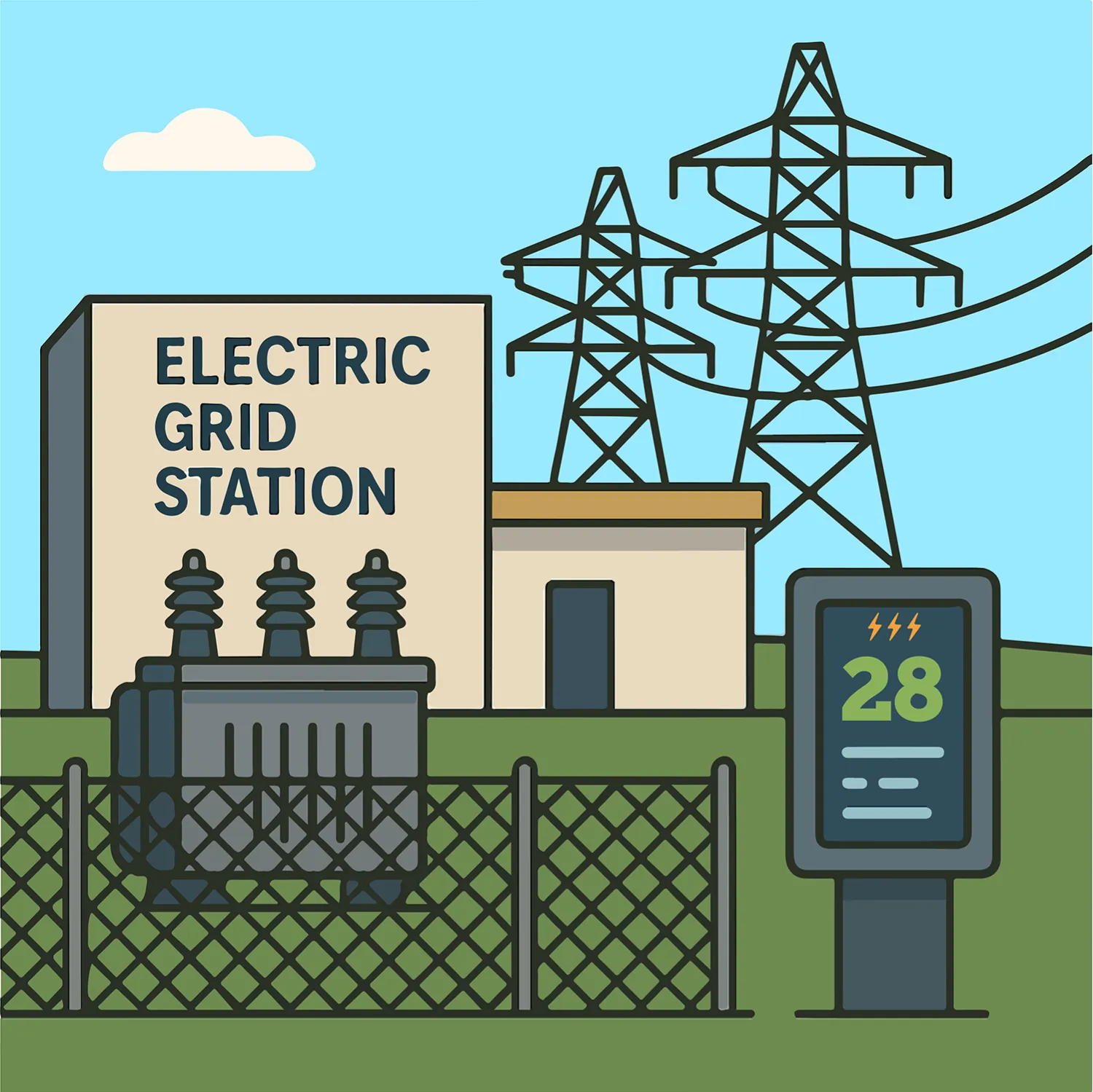
Electric grid sation daily voltage reading
Electrical power is a vital part of modern life, allowing us to use lights, computers, and appliances. However, the electricity generated in power plants must travel long distances through power lines before reaching our homes. To make this possible and efficient, special devices called transformers are used to change the voltage—the force that pushes electric current—up or down, depending on the need.
How Transformers Work
A transformer uses a principle called electromagnetic induction to change the voltage of electricity. Its basic structure includes two coils of wire, called the primary coil and secondary coil, wrapped around an iron core. When electric current flows through the primary coil, it creates a changing magnetic field in the iron core. This changing magnetic field induces, or creates, a current in the secondary coil. The voltage in the secondary coil is determined by the number of turns (loops) of wire compared to the primary coil. If the secondary coil has more turns than the primary, the transformer increases the voltage (step-up transformer). If it has fewer turns, the voltage decreases (step-down transformer). This process allows energy to be transferred efficiently and safely over long distances.
Applications and Importance of Transformers
Transformers are essential for sending electricity over power lines. Power plants use step-up transformers to raise the voltage to hundreds of thousands of volts for transmission. This is important because high-voltage electricity loses less energy as heat—only about 5 to 10% of the energy is lost during transmission, compared to much higher losses at low voltage. When the electricity gets closer to homes or businesses, step-down transformers lower the voltage to safer levels for everyday use (like 120 or 240 volts). Without transformers, much more energy would be wasted, and delivering electricity safely would be much harder and more expensive. Even everyday devices, such as phone chargers, use small transformers to reduce voltage for safe charging.
Broader Implications and Scientific Connections
Transformers demonstrate how scientific principles like electromagnetic induction can be applied to solve real-world problems. Their role in reducing energy loss during transmission is a key reason why large electrical grids work. The efficiency gained by using transformers supports our society’s need for reliable, affordable energy. Scientists continue to develop new materials and designs to make transformers even more efficient and environmentally friendly. Understanding transformers also helps explain many other technologies, such as electric trains and renewable energy systems.
Together, transformers, power lines, and generators form a system that delivers electricity to billions of people worldwide. This system relies on the careful management of voltage and current to keep energy flowing safely and efficiently.
Interesting Fact: The world’s largest transformer, used in high-voltage power networks, can weigh over 800 tons and handle enough electricity to power a city!
What is the main purpose of a transformer in an electrical system?
To increase or decrease voltage for efficient transmissionTo generate electricity from sunlightTo store electrical energy for later useTo change alternating current to direct current
What is electromagnetic induction?
The process of creating an electric current with a changing magnetic fieldThe flow of current through a resistorThe transfer of heat from one object to anotherThe storage of energy in batteries
What are the two main parts of a transformer called?
Primary coil and secondary coilAnode and cathodeRotor and statorSolar cell and battery
What does a step-up transformer do?
Increases the voltageDecreases the voltageStores energyChanges current to voltage
Why do power companies use high voltages to transmit electricity over long distances?
To reduce energy loss as heatTo make electricity travel faster than lightTo change electricity into magnetismTo increase the resistance in wires
What is the role of a step-down transformer near homes?
It lowers the voltage to a safe level for home useIt increases the voltage to power factoriesIt generates electricity from windIt stores backup power for emergencies
In the passage, what is an example of a transformer used in everyday life?
A phone chargerA solar panelA refrigerator motorA wind turbine
Which of the following best describes the relationship between the number of wire turns and voltage in a transformer?
More turns in the secondary coil mean higher voltageFewer turns in the secondary coil mean higher voltageNumber of turns does not affect voltageVoltage only depends on the iron core
True or False: Without transformers, much more energy would be wasted transmitting electricity.
TrueFalse
True or False: Transformers can only be used in large power plants.
FalseTrue
Perfect For:
👩🏫 Teachers
• Reading comprehension practice
• Auto-graded assessments
• Literacy skill development
👨👩👧👦 Parents
• Reading practice at home
• Comprehension improvement
• Educational reading time
🏠 Homeschoolers
• Reading curriculum support
• Independent reading practice
• Progress monitoring
Reading Features:
📖
Reading Passage
Engaging fiction or nonfiction text
❓
Comprehension Quiz
Auto-graded questions
📊
Instant Feedback
Immediate results and scoring
📄
Printable Version
Download for offline reading
🔊
Read Aloud
Voice-over with word highlighting
Reviews & Ratings
No reviews yet. Be the first to share your experience!
Related Content
Types of Magnets
This science passage for grades 6-8 explains the types of magnets—permanent, temporary, natural, and briefly electromagn...
MS-PS2-3
Magnetic Materials
This passage, aligned to NGSS standard MS-PS2-3, explores the science behind magnetic materials and their importance in ...
MS-PS2-3
What Is Electricity?
This middle school science passage introduces the concept of electricity, aligned with NGSS standard MS-PS2-3. Students ...
MS-PS2-3
Electric Charge
This comprehensive middle school science passage introduces the concept of electric charge as a fundamental property of ...
MS-PS2-3
How Charges Interact
This standards-aligned passage for grades 6-8 introduces students to how electric charges interact, focusing on the fund...
MS-PS2-3MS-PS2-5
Electric Current
This comprehensive middle school science passage, aligned with NGSS standard MS-PS2-3, introduces students to the concep...
MS-PS2-3
Electric Circuits
This middle school science passage explores electric circuits in depth, aligning with NGSS standard MS-PS2-3. Students w...
MS-PS2-3
Series and Parallel Circuits
This informative passage for grades 6-8 explains the scientific mechanisms behind series and parallel electrical circuit...
MS-PS2-3
Electrical Safety
This comprehensive informational passage for grades 6-8 explores the science behind electrical safety, focusing on the m...
MS-PS2-3
Voltage
This comprehensive passage for grades 6-8 explores the concept of voltage, defined as the electrical potential differenc...
MS-PS2-3
Resistance
This engaging middle school science passage explores the concept of resistance, a fundamental idea in the study of elect...
MS-PS2-3
Static Electricity
This passage provides a comprehensive exploration of static electricity, aimed at students in grades 6-8 and aligned wit...
MS-PS2-3MS-PS2-5
Electricity and Magnetism Connection
This comprehensive science passage for grades 6-8 explores the deep connection between electricity and magnetism, beginn...
MS-PS2-3MS-PS2-5
Electromagnets
This middle school science passage introduces students to electromagnets, aligning with NGSS standard MS-PS2-3. It cover...
MS-PS2-3
Uses of Electromagnets
This engaging middle school science passage explores the uses of electromagnets, aligned with NGSS standard MS-PS2-3. St...
MS-PS2-3
Electromagnetic Induction
This middle school science reading passage explores the concept of electromagnetic induction, focusing on Faraday's grou...
MS-PS2-3MS-PS3-5
Electric Motor
This comprehensive middle school science passage explores the science of electric motors, aligning with NGSS standards M...
MS-PS2-3MS-PS3-5
Strength of Electromagnets
This middle school science passage explores the factors that affect the strength of electromagnets, including the number...
MS-PS2-3
Magnetic Force
This comprehensive science passage for grades 6-8 explores the mechanisms behind magnetic force, including how magnet st...