Exoplanets That Could Support Life — Reading Comprehension
Rate this
Premium Resource
Present
Present in classroom. No work saved
Assign
Classroom with student accounts, Track progress
Quick Play
No student accounts, assign with a link
Grades
5
6
7
8
Standards
MS-ESS1-2
PRINT+DIGITAL RESOURCE
This learning resource is available in interactive and printable formats. The interactive worksheet can be played online and assigned to students. The Printable PDF version can be downloaded and printed for completion by hand.
This informational science reading passage introduces middle school students to the search for potentially habitable exoplanets. Aligned with NGSS MS-ESS1-2, it explains the criteria scientists use to identify Earth-like worlds: rocky composition, location within the habitable zone, suitable size, and the presence of an atmosphere. Using real examples like Proxima Centauri b, the TRAPPIST-1 system, Kepler-452b, and LHS 1140 b, students learn how astronomers use telescopes such as James Webb to analyze planetary conditions. The passage explores complex concepts such as tidal locking, flare radiation, and biosignatures, showing how these factors interact to determine habitability. The resource includes a glossary, Spanish translations, a differentiated version for struggling readers, comprehension quizzes, writing prompts, and graphic organizers. Audio integration supports diverse learners. This passage helps students connect astronomical discoveries to broader scientific principles and the ongoing search for life beyond our solar system.
CONTENT PREVIEW
Expand content preview
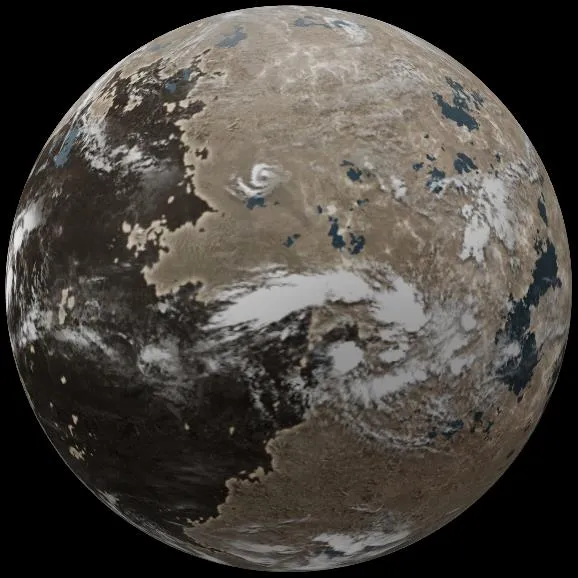
Proxima Centauri b by NASA / Wikimedia Commons
Exoplanets are planets that orbit stars outside our solar system. The search for potentially habitable exoplanets is one of the most exciting areas of modern astronomy. Scientists want to find worlds that might have the right conditions for life as we know it. To do this, researchers look for planets that are rocky, similar in size to Earth, and located in a region called the habitable zone. This zone is the area around a star where temperatures could allow liquid water to exist on a planet’s surface. The presence of liquid water is an important clue because life on Earth depends on water.
How Scientists Identify Habitable Worlds To determine if an exoplanet could be habitable, astronomers use telescopes to observe the planet’s size, composition, and distance from its star. A planet that is too close to its star may be too hot, while a planet too far away could be too cold. The habitable zone is sometimes called the “Goldilocks zone” because the conditions must be just right—not too hot and not too cold. Scientists also look for planets that are the right size—usually between 0.5 and 2 times the size of Earth—because very large planets may be gas giants like Jupiter, which cannot support life as we know it. Another important factor is whether the planet has an atmosphere. An atmosphere can protect a planet from harmful radiation and help keep temperatures stable.
Examples of Potentially Habitable Exoplanets The closest potentially habitable exoplanet is Proxima Centauri b, located just 4.2 light-years away. This rocky planet is slightly larger than Earth and orbits a red dwarf star in the habitable zone. However, red dwarf stars can be very active and produce strong flares that send dangerous radiation toward the planet. This could make it difficult for life to survive. The TRAPPIST-1 system is another important discovery. It contains seven Earth-sized planets orbiting a red dwarf star about 40 light-years away. Three or four of these planets are in the habitable zone, making this system a prime target for further study. Kepler-452b is often called “Earth’s cousin” because it is similar in size to Earth and orbits a Sun-like star in the habitable zone, though it is much farther away at 1,400 light-years. LHS 1140 b is a rocky super-Earth that may have an atmosphere and is also in its star’s habitable zone.
Challenges and the Search for Biosignatures Although these exoplanets meet many requirements, there are still challenges. We do not yet know if any of these planets truly have atmospheres, liquid water, or the right conditions for life. Many planets around red dwarf stars are tidally locked, which means one side always faces the star while the other side is in darkness. This could create extreme temperature differences. Also, frequent stellar flares might strip away atmospheres or make the surface dangerous for life. To learn more, scientists use powerful telescopes like the James Webb Space Telescope to study exoplanet atmospheres. They search for biosignatures—chemicals like oxygen, methane, or water vapor that could indicate life processes.
Discovering potentially habitable exoplanets helps us understand our place in the universe. It connects to larger scientific questions about how planets form and what makes a world suitable for life. As technology improves, astronomers hope to find planets that are even more Earth-like. The search for life beyond our solar system continues to inspire new scientific discoveries.
Interesting Fact: There are over 5,000 confirmed exoplanets, but only a small fraction are considered potentially habitable!
What is an exoplanet?
A planet that orbits a star outside our solar systemA large moon orbiting JupiterA comet in our solar systemA type of asteroid
Why do scientists look for planets in the habitable zone?
Because these planets are always close to their starsBecause the temperatures allow liquid water to existBecause they are the biggest planetsBecause they have no atmosphere
Which exoplanet is the closest potentially habitable one to Earth?
Kepler-452bTRAPPIST-1eLHS 1140 bProxima Centauri b
What is one challenge for life on planets around red dwarf stars?
They are always gas giantsThey receive strong flares and radiationThey have too much waterThey are too far from their stars
What does 'atmosphere' mean as used in the passage?
An area of strong gravityA layer of gases surrounding a planetA type of rocky surfaceA distant star
What is a biosignature?
A region where planets can't existA sign of a planet's sizeA chemical clue that may suggest lifeA type of telescope
Why do scientists use telescopes like James Webb to study exoplanets?
To look for biosignatures in their atmospheresTo measure the planets' speedTo make the planets brighterTo find asteroids
Which is TRUE about the TRAPPIST-1 system?
It has only one planetAll its planets are gas giantsIt contains several Earth-sized planets in the habitable zoneIt orbits a star like our Sun
Exoplanets in the habitable zone always have atmospheres. (True/False)
TrueFalse
Strong flares from red dwarf stars could make it hard for life to survive. (True/False)
TrueFalse
Perfect For:
👩🏫 Teachers
• Reading comprehension practice
• Auto-graded assessments
• Literacy skill development
👨👩👧👦 Parents
• Reading practice at home
• Comprehension improvement
• Educational reading time
🏠 Homeschoolers
• Reading curriculum support
• Independent reading practice
• Progress monitoring
Reading Features:
📖
Reading Passage
Engaging fiction or nonfiction text
❓
Comprehension Quiz
Auto-graded questions
📊
Instant Feedback
Immediate results and scoring
📄
Printable Version
Download for offline reading
🔊
Read Aloud
Voice-over with word highlighting
Reviews & Ratings
No reviews yet. Be the first to share your experience!
Related Content
Comets
This middle school science passage explores the fascinating world of comets, commonly known as 'dirty snowballs.' Studen...
MS-ESS1-2
Mercury: Closest to the Sun
This comprehensive, standards-aligned passage explores Mercury—the smallest and closest planet to the Sun. Students in g...
MS-ESS1-2MS-ESS1-3
Venus: Earth's Twin?
This comprehensive science passage for grades 6-8 examines Venus—often called Earth's twin—by exploring its similarities...
MS-ESS1-2MS-ESS1-3
Earth: Our Home Planet
This comprehensive science passage for grades 6-8 explores Earth’s unique characteristics and the interconnected systems...
MS-ESS1-2
Mars: The Red Planet
This middle school science passage explores Mars, the Red Planet, providing students in grades 6-8 with a comprehensive ...
MS-ESS1-2MS-ESS1-3
What Is Gravity?
This comprehensive middle school science reading passage explores the concept of gravity, aligning with NGSS standards M...
MS-ESS1-2MS-PS2-4
Kepler's Laws of Planetary Motion
This comprehensive middle school science passage explores Kepler's Laws of Planetary Motion, meeting NGSS Standard MS-ES...
MS-ESS1-2
Tides and Tidal Forces
This middle school science passage explores the mechanisms of tides and tidal forces, aligning with NGSS standards MS-ES...
MS-ESS1-1MS-ESS1-2
Escape Velocity and Space Travel
This middle school science passage introduces students to the concept of escape velocity—the minimum speed required to b...
MS-ESS1-2MS-PS2-4
Weightlessness and Microgravity
This science reading passage for middle school students explores the phenomenon of weightlessness and microgravity. Alig...
MS-PS2-4MS-ESS1-2
Orbits and Orbital Motion
This middle school science passage, aligned with NGSS MS-ESS1-2 and MS-PS2-4, explores the science of orbits and orbital...
MS-ESS1-2MS-PS2-4
What Is the Solar System?
This passage provides a comprehensive overview of the solar system for grades 6-8, aligned with NGSS standards MS-ESS1-2...
MS-ESS1-2MS-ESS1-3
Structure of the Solar System
This comprehensive science reading passage introduces middle school students (grades 6-8) to the structure of the solar ...
MS-ESS1-2MS-ESS1-3
Moons of the Solar System
This comprehensive passage, designed for grades 6-8 and aligned to NGSS standard MS-ESS1-2, delves into the fascinating ...
MS-ESS1-2
Defining Life: What Are We Looking For?
This informational science passage for middle school students explores the question: What is life, and how do we define ...
MS-LS1-1MS-ESS1-2
Astronomy
This comprehensive reading passage introduces middle school students to the science of astronomy, which is the study of ...
MS-ESS1-2MS-ESS1-3MS-PS4-2MS-ETS1-1
The Solar System
This middle school science passage introduces students to the solar system, aligning with NGSS standards MS-ESS1-2 and M...
MS-ESS1-2MS-ESS1-3
Gravity and Orbits
This comprehensive passage for grades 6-8 explains the science of gravity and orbits, aligning with NGSS standard MS-ESS...
MS-ESS1-2
The Inner Planets
This comprehensive science passage for grades 6-8 explores the inner (terrestrial) planets of our solar system—Mercury, ...
MS-ESS1-2MS-ESS1-3
The Outer Planets
This engaging science passage for grades 6-8 introduces students to the outer planets—Jupiter, Saturn, Uranus, and Neptu...