Fall of Constantinople
Interactive passage with audio narration, comprehension questions, and printable PDF.
By completing this purchase you agree to our Terms of Use and Privacy Policy. Your subscription renews automatically until you cancel. You can cancel anytime from your account settings. All sales are final and non-refundable. Digital content is available for download in your account immediately upon purchase.
What's included
Fall of Constantinople preview and details
About this printable Fall of Constantinople reading passage (Grades 5-8)
Sample passage and quiz from Fall of Constantinople
Reading passage and comprehension quiz preview
Fall of Constantinople
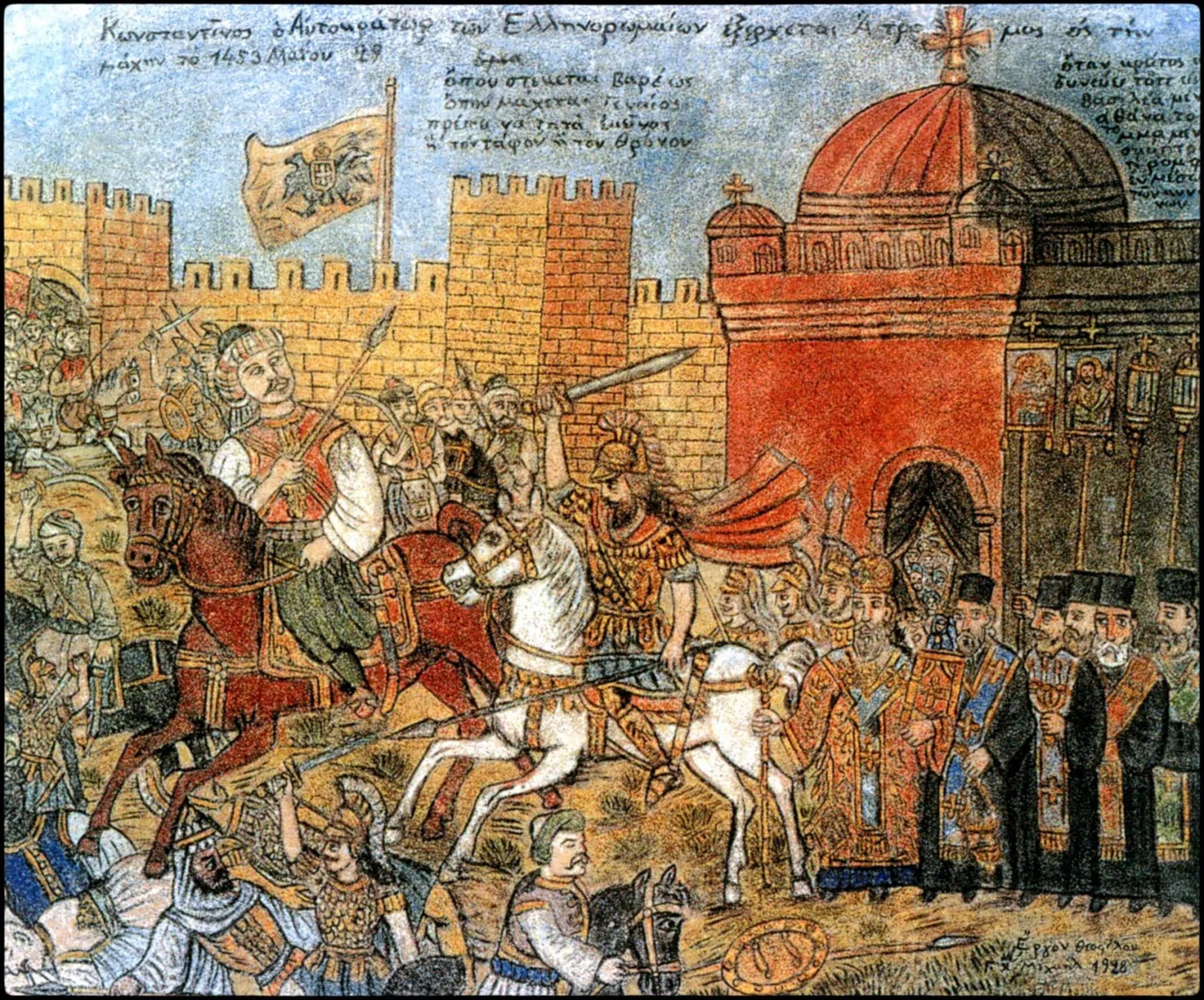
"Fall of constantinople" by Theophilos Hatzimihail / Wikimedia Commons.
In 1453, the city of Constantinople fell to the Ottoman Empire, ending the Byzantine Empire after more than one thousand years. This event is one of the most important turning points in world history, marking the end of the Middle Ages and the beginning of new connections between Europe and Asia.
Constantinople was the capital of the Byzantine Empire and a center of trade, culture, and religion. Its location on the narrow Bosporus Strait connected Europe and Asia, making the city wealthy and powerful. The famous city walls, built by Emperor Theodosius II in the fifth century, protected the city for centuries. Many travelers and ambassadors described the city’s markets, churches, and palaces in their writings. For example, the Spanish ambassador Ruy González de Clavijo wrote about the city’s strong defenses in 1403.
By the mid-1400s, the city was weakened by years of war and loss of territory. The Ottomans, led by Sultan Mehmet II, wanted to expand their empire and control the important trade routes. In April 1453, Mehmet II surrounded Constantinople with an army of about 80,000 soldiers. The Ottomans used advanced technology, including a giant cannon called the Basilica, which could break through the thick city walls. The defenders, led by Emperor Constantine XI, had only about 7,000 soldiers, including some foreign allies from Venice and Genoa. Despite their courage, the defenders faced overwhelming odds.
After a siege lasting 53 days, the Ottomans finally broke through on May 29, 1453. Historical records, such as eyewitness accounts by the Venetian Nicolo Barbaro, describe the chaos as Ottoman soldiers poured into the city. Emperor Constantine XI died fighting on the walls. The Ottomans captured the Hagia Sophia, the city’s most famous church, and turned it into a mosque. The city’s fall led to major changes: the Ottoman Empire became one of the world’s most powerful states, and many Greek scholars fled to Western Europe, bringing ancient manuscripts that helped spark the Renaissance.
The fall of Constantinople changed world history. It ended the last part of the Roman Empire and shifted trade routes, pushing Europeans to explore new sea routes to Asia. The city, now called Istanbul, became a center of Islamic culture and trade under Ottoman rule. This event shows how geography, technology, and human choices shape history.
This topic connects to broader themes of empire, cultural exchange, and the impact of geography on civilization.
Interesting Fact: The Ottomans used massive cannons, some over 27 feet long, to break through the famous walls of Constantinople. These were among the largest weapons of their time.
Comprehension quiz (8 questions)
1. Who led the Ottoman army in 1453?
2. What protected Constantinople for centuries?
3. What was the Hagia Sophia?
4. Why did the Ottomans want Constantinople?
5. What happened after the city fell?
6. How did the Ottomans break the walls?
7. The Byzantine Empire ended in 1453. (True/False)
8. What is a 'siege'?
Perfect for the way you teach
- Build comprehension skills
- Auto-graded quiz
- Differentiated reading
- Read together at home
- Improve fluency
- Quiet reading time
- Reading curriculum support
- Independent practice
- Track Lexile growth