Reading PassagePremium

Formation of the Solar System

Interactive passage with audio narration, comprehension questions, and printable PDF.

No ratings yet
Grades 5–8ScienceReadingElaEnglish · SpanishInteractive · Printable
Aligned toMS-ESS1-2
Just this resource
$1.50
One-time purchase
Best value
Unlock everything
$49.99$29.99/yr
40% off until Aug 1 — 10,000+ resources
Renews at $49.99/year.
Unlock above to use these actions

What's included

Reading passage
Audio narration
Comprehension quiz
Writing activity
Glossary & flashcards
Differentiated version
Spanish translation

Formation of the Solar System preview and details

About this printable Formation of the Solar System science reading passage, NGSS-aligned (Grades 5-8)

This comprehensive middle school science passage explores the formation of the solar system, aligned to NGSS standard MS-ESS1-2. Students learn how the solar nebula theory explains the transformation of a giant cloud of gas and dust into our Sun, planets, asteroids, and comets. The text highlights cause-and-effect chains, such as gravity's role in the collapse and spinning of the nebula and how temperature differences led to rocky and gas planets. Students examine real scientific evidence, including the direction of planetary orbits and observations of other star systems. The passage features an academic vocabulary glossary, Spanish translation, a simplified version, multiple choice quiz, writing prompts, and interactive graphic organizers. Audio integration supports diverse learners. This resource is ideal for middle school classrooms seeking standards-based, engaging science content about planetary system formation.
Written by Workybooks TeamPublished by Workybooks
Preview

Sample passage and quiz from Formation of the Solar System

Reading passage and comprehension quiz preview

Formation of the Solar System
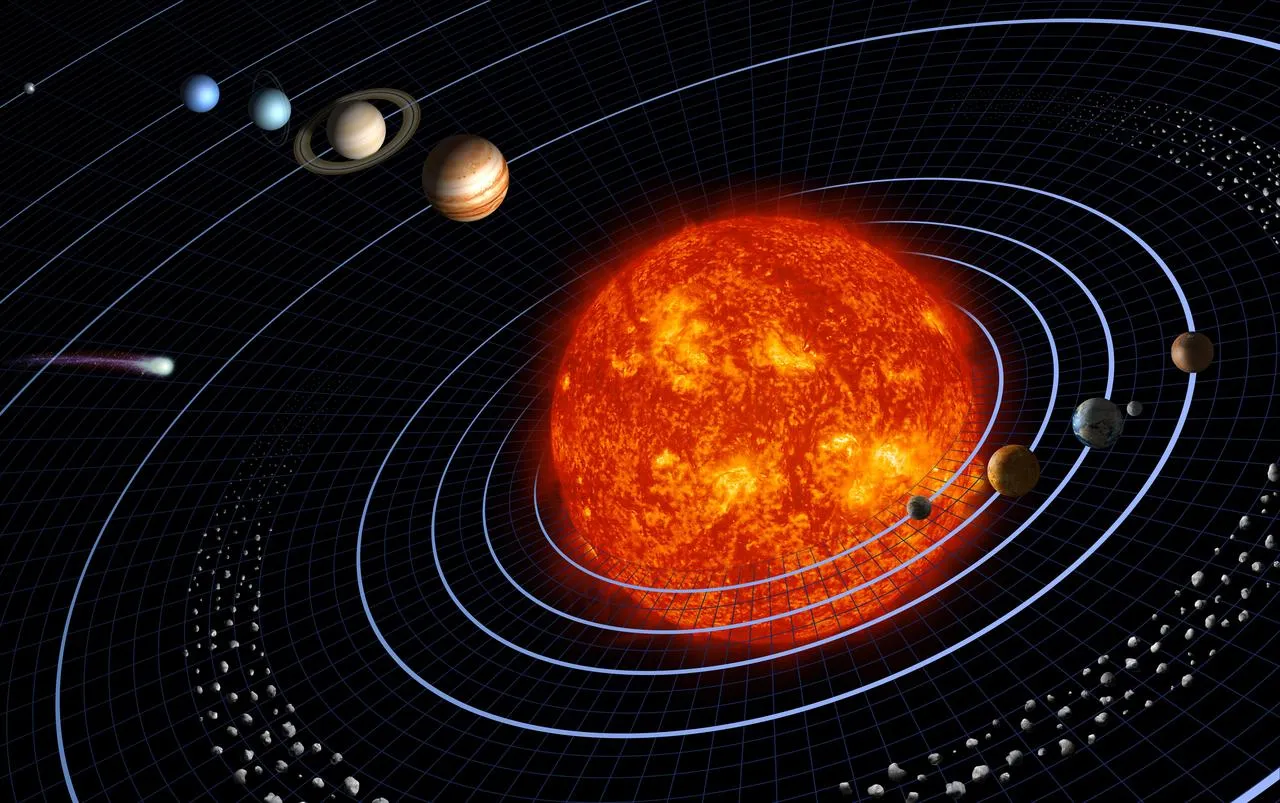
Our Solar System Features Eight Planets
"Our Solar System Features Eight Planets" / NASA (Public domain).

The solar system is a complex system of planets, moons, asteroids, and comets orbiting our Sun. All these objects formed about 4.6 billion years ago, but how did this incredible transformation occur? Scientific evidence supports the solar nebula theory, which explains the step-by-step process that shaped our planetary neighborhood. Understanding this process helps us see how natural forces, like gravity and energy, create organized systems from chaotic beginnings.

From Cloud to Spinning Disk
According to the solar nebula theory, the solar system began as a massive, cold cloud of gas and dust called the solar nebula. This cloud may have started collapsing under its own gravity after a shockwave from a nearby supernova—an exploding star—disturbed it. As gravity pulled the particles closer, the cloud shrank and began spinning faster, a result of the conservation of angular momentum. This process is similar to how a figure skater spins faster when pulling their arms in. The spinning nebula flattened into a disk, with most material concentrating at the center. As the core grew dense and hot, it became a protostar: our young Sun.

Building Planets and Moons
In the disk around the protostar, tiny dust grains collided and stuck together, gradually forming larger objects called planetesimals. Over time, planetesimals grew by attracting more material through gravity. In the hot, inner part of the disk, only metals and rocks could survive, so small, rocky planets like Mercury, Venus, Earth, and Mars formed there. In the colder, outer regions, ices could remain solid, allowing giant planets like Jupiter and Saturn to develop thick layers of gas and ice. The leftover material became asteroids and comets, which still orbit the Sun.

Evidence and Scientific Understanding
Scientists support the solar nebula theory with several lines of evidence. Nearly all planets revolve around the Sun in the same direction and in a flat plane, matching the predicted shape of the original disk. The age of meteorites—about 4.6 billion years—matches the estimated age of the solar system. Modern telescopes have also observed young stars with spinning disks and forming planets, providing real-time examples of similar processes elsewhere in the universe.

The formation of the solar system is an example of how systems can organize from disorder through natural laws. This understanding connects to the broader scientific principle that the universe follows predictable patterns, from the orbits of planets to the cycles of stars. As astronomers continue to study other star systems, they gain new insights into how common planets like ours may be in the universe.

Interesting Fact: Some meteorites found on Earth contain grains older than the Sun itself, offering clues about the materials that built our solar system!

Comprehension quiz (10 questions)

1. What is the solar nebula theory?

The idea that the solar system formed from a collapsing cloud of gas and dust
The belief that planets were always separate from the Sun
The theory that Earth is the center of the universe
The explanation for why comets appear in the sky

2. Approximately how old is the solar system?

About 4.6 billion years
About 1 million years
About 100,000 years
About 13.8 billion years

3. What caused the solar nebula to start collapsing?

A shockwave from a nearby supernova
Earth's gravity
The Sun's heat
A comet impact

4. What is a protostar?

A young star forming at the center of a spinning disk
A planet made of rock
A type of asteroid
A frozen comet

5. What are planetesimals?

Small solid objects that combine to form planets
Rings of Saturn
Solar flares
Comet tails

6. What does 'conservation of angular momentum' mean as used in the passage?

Spinning things go faster as they get smaller
Objects always move in straight lines
Gravity pulls everything together
Rocks form in the inner solar system

7. Why are the inner planets rocky and the outer planets mostly gas and ice?

It was too hot for ice near the Sun, but cold enough farther away
Gravity was stronger in the outer solar system
The Sun pushed gas outward
Planetesimals only formed close to the Sun

8. Which observation supports the solar nebula theory?

All planets orbit the Sun in the same direction and in a flat plane
Comets only appear at night
Planets are different sizes
The Sun is very hot

9. True or False: Meteorites found on Earth are about the same age as the solar system.

True
False

10. True or False: Scientists have seen young stars with spinning disks and forming planets in space.

True
False
Who it's for

Perfect for the way you teach

Teachers
  • Build comprehension skills
  • Auto-graded quiz
  • Differentiated reading
Parents
  • Read together at home
  • Improve fluency
  • Quiet reading time
Homeschoolers
  • Reading curriculum support
  • Independent practice
  • Track Lexile growth
Topics

Reviews & Ratings

No reviews yet. Be the first to share your experience!

More reading you might love

20 more
Passage
Comets - reading educational content
Grades 5–8

Comets

science · MS-ESS1-2

$1.50
Passage
Mercury: Closest to the Sun - reading educational content
Grades 5–8

Mercury: Closest to the Sun

science · MS-ESS1-2

$1.50
Passage
Venus: Earth's Twin? - reading educational content
Grades 5–8

Venus: Earth's Twin?

science · MS-ESS1-2

$1.50
Passage
Earth: Our Home Planet - reading educational content
Grades 5–8

Earth: Our Home Planet

science · MS-ESS1-2

Free
Passage
Mars: The Red Planet - reading educational content
Grades 5–8

Mars: The Red Planet

science · MS-ESS1-2

$1.50
Passage
Kepler's Laws of Planetary Motion - reading educational content
Grades 5–8

Kepler's Laws of Planetary Motion

science · MS-ESS1-2

$1.50
Passage
Tides and Tidal Forces - reading educational content
Grades 5–8

Tides and Tidal Forces

science · MS-ESS1-1

$1.50
Passage
Escape Velocity and Space Travel - reading educational content
Grades 5–8

Escape Velocity and Space Travel

science · MS-ESS1-2

$1.50
Passage
Weightlessness and Microgravity - reading educational content
Grades 5–8

Weightlessness and Microgravity

science · MS-PS2-4

$1.50
Passage
Orbits and Orbital Motion - reading educational content
Grades 5–8

Orbits and Orbital Motion

science · MS-ESS1-2

$1.50
Passage
What Is the Solar System? - reading educational content
Grades 5–8

What Is the Solar System?

science · MS-ESS1-2

$1.50
Passage
Structure of the Solar System - reading educational content
Grades 5–8

Structure of the Solar System

science · MS-ESS1-2

$1.50
Passage
Moons of the Solar System - reading educational content
Grades 5–8

Moons of the Solar System

science · MS-ESS1-2

Free
Passage
Defining Life: What Are We Looking For? - reading educational content
Grades 5–8

Defining Life: What Are We Looking For?

science · MS-LS1-1

$1.50
Passage
 Astronomy - reading educational content
Grades 5–8

Astronomy

earth science · MS-ESS1-2

$1.50
Passage
The Solar System - reading educational content
Grades 5–8

The Solar System

science · MS-ESS1-2

$1.50
Passage
Gravity and Orbits - reading educational content
Grades 5–8

Gravity and Orbits

science · MS-ESS1-2

$1.50
Passage
The Inner Planets - reading educational content
Grades 5–8

The Inner Planets

science · MS-ESS1-2

$1.50
Passage
The Outer Planets - reading educational content
Grades 5–8

The Outer Planets

science · MS-ESS1-2

$1.50
Passage
The Moon's Characteristics - reading educational content
Grades 5–8

The Moon's Characteristics

science · MS-ESS1-1

$1.50
Copyright © 2026 Workybooks. Made with ♥ in California.