Gothic Cathedrals: Building for God — Reading Comprehension
Rate this
Premium Resource
Present
Present in classroom. No work saved
Assign
Classroom with student accounts, Track progress
Quick Play
No student accounts, assign with a link
Grades
5
6
7
8
PRINT+DIGITAL RESOURCE
This learning resource is available in interactive and printable formats. The interactive worksheet can be played online and assigned to students. The Printable PDF version can be downloaded and printed for completion by hand.
This detailed history reading passage examines the rise of Gothic cathedrals in medieval Europe, focusing on their architectural features, religious significance, and the human effort involved in their construction. Students will discover how these massive stone churches, with their pointed arches and stained glass windows, became symbols of Christian devotion and community pride. The passage highlights specific examples such as Notre-Dame de Paris, describes the roles of craftsmen and laborers, and explores the impact of geography and social hierarchy on cathedral building. Activities include comprehension questions, writing prompts, and graphic organizers, with a glossary to support academic vocabulary. The passage is aligned with CA HSS 7.6.6 and CCSS RI.6.3, RI.7.3, RI.8.3, and includes a Spanish translation and read aloud audio for accessibility.
CONTENT PREVIEW
Expand content preview
During the Middle Ages, the construction of Gothic cathedrals was one of the most remarkable achievements in European history. These massive stone churches, built between the 12th and 16th centuries, were designed to inspire awe and reflect the medieval devotion to Christianity. With their towering spires, stained glass windows, and intricate sculptures, Gothic cathedrals became centers of religious and community life.
Gothic architecture first appeared in northern France around 1140, with the
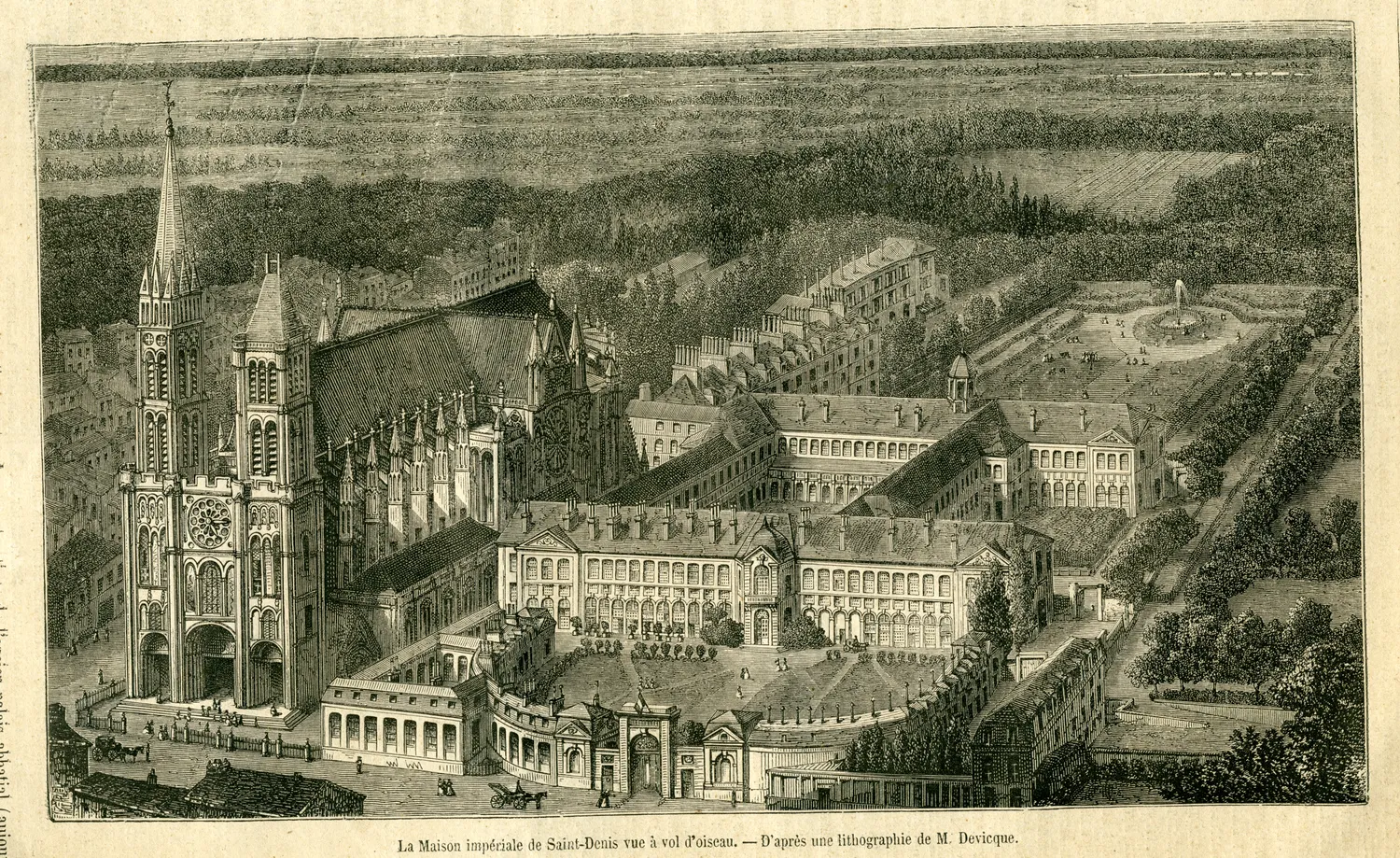
"Basilica of Saint Denis (16120270060)" by Julien Hippolyte Devicque (1821) / Wikimedia Commons
near Paris. Architect Abbot Suger wanted to create a church filled with light, so he used new building techniques. The pointed arch and flying buttress allowed builders to create taller walls and larger windows than ever before. These innovations spread quickly across Europe. The famous Notre-Dame de Paris, begun in 1163, is a prime example. Its wide nave, vaulted ceilings, and colorful stained glass told stories from the Bible to people who could not read.
Building a cathedral required enormous resources and teamwork. Skilled craftsmen like stonemasons, carpenters, and glassmakers worked alongside unskilled laborers. Construction could take decades or even centuries; for example, Cologne Cathedral in Germany began in 1248 but was not finished until 1880. Townspeople often donated money, food, or labor, believing their contributions would help them gain favor in the afterlife. Cathedrals were usually built near rivers or quarries, making it easier to transport heavy stones. Archaeological evidence, including the discovery of medieval tools and builders' marks on stones, provides insight into their construction.
Gothic cathedrals were more than just places for worship. They served as meeting halls, schools, and symbols of a city’s wealth and power. The tall spires could be seen for miles, reminding everyone of the church’s importance. The social hierarchy was visible in the way people gathered: important citizens sat near the altar, while peasants stood in the back. Despite the passage of time, many Gothic cathedrals still stand today, connecting us to the beliefs and skills of the medieval world.
The construction of Gothic cathedrals changed over time, as new techniques and styles developed. However, the continuity of their purpose—to honor God and bring communities together—remained strong. Studying these cathedrals helps us understand the creativity, faith, and teamwork that shaped medieval Europe.
Interesting Fact: The stained glass windows in Chartres Cathedral, created around 1220, are so bright and colorful because the glassmakers used special minerals and techniques that are still not fully understood by scientists today.
Gothic cathedrals show how people’s beliefs, geography, and social structure influenced art and architecture during the Middle Ages, a theme seen across world history.
When did Gothic cathedrals start in France?
Around 1140Around 1040Around 1240Around 1340
Which cathedral started in 1163?
Notre-Dame de ParisChartres CathedralCologne CathedralSaint-Denis
What is a flying buttress?
Stone support outside a wallColorful windowTall ceilingStone carving
Why did townspeople help build cathedrals?
To gain favor after deathTo become kingTo get free foodTo leave town
How did building techniques change cathedrals?
Allowed taller walls and larger windowsMade them smallerUsed only woodNo decorations
What do stained glass windows show?
Bible storiesOnly kingsFamous battlesFood recipes
Gothic cathedrals were only for worship. True or false?
TrueFalse
What is a vaulted ceiling?
Curved or arched ceilingFlat wooden roofUnderground tunnelPainted wall
Perfect For:
👩🏫 Teachers
• Reading comprehension practice
• Auto-graded assessments
• Literacy skill development
👨👩👧👦 Parents
• Reading practice at home
• Comprehension improvement
• Educational reading time
🏠 Homeschoolers
• Reading curriculum support
• Independent reading practice
• Progress monitoring
Reading Features:
📖
Reading Passage
Engaging fiction or nonfiction text
❓
Comprehension Quiz
Auto-graded questions
📊
Instant Feedback
Immediate results and scoring
📄
Printable Version
Download for offline reading
🔊
Read Aloud
Voice-over with word highlighting
Reviews & Ratings
No reviews yet. Be the first to share your experience!
Related Content
Middle Ages Legacy
This history reading passage examines the lasting legacy of the Middle Ages, including the development of universities, ...
Early Middle Ages
This comprehensive reading passage explores the Early Middle Ages (500-1000 CE), a transformative period in European his...
High Middle Ages
This detailed world history reading passage explores the High Middle Ages (1000-1300 CE), a transformative era in Europe...
What Were the Middle Ages?
This engaging world history reading passage introduces students to the Middle Ages, the period in European history betwe...
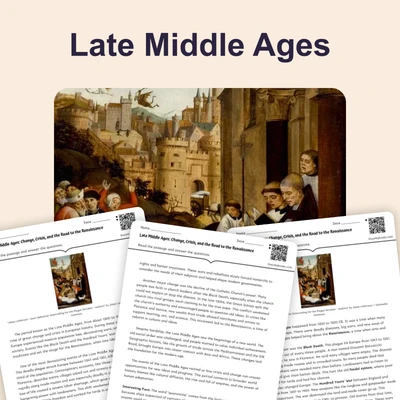
Late Middle Ages
This rigorous world history reading passage explores the Late Middle Ages (1300-1500 CE), a time marked by the devastati...
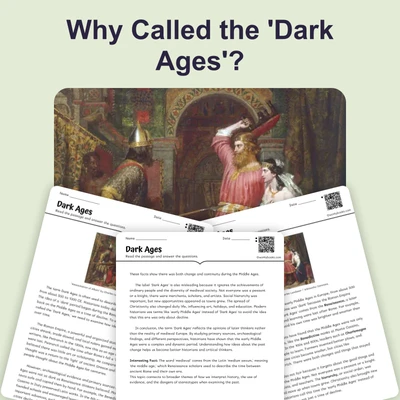
Dark Ages
This passage offers a rigorous, engaging examination of why the early Middle Ages are often called the 'Dark Ages.' Stud...
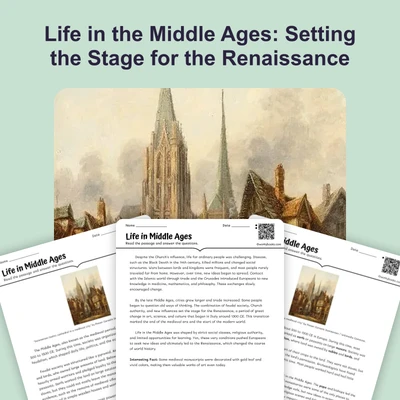
Life in Middle Ages
This rigorous history reading passage explores life in Europe during the Middle Ages, focusing on the structure of feuda...
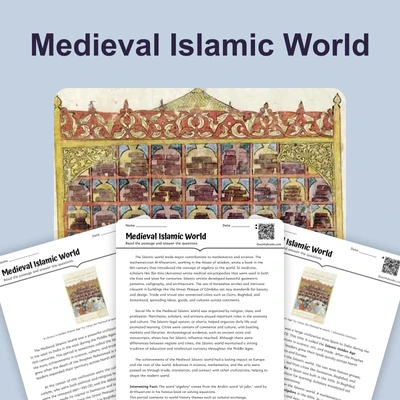
Medieval Islamic World
This rigorous reading passage delves into the Medieval Islamic World's golden age, when a vast civilization stretched fr...
Islamic Golden Age
This history reading passage explores the Islamic Golden Age, a period from the 8th to 14th centuries marked by outstand...
Medieval to Modern Transition
This engaging world history reading passage explores the dramatic transformation from the Middle Ages to the modern era,...
Medieval Words in English
This engaging history reading passage examines the evolution of the English language during the Middle Ages, focusing on...
Age of Exploration Begins
This engaging history reading passage explores the Age of Exploration, a turning point in world history when European po...
Italian City-States
This passage explores the rise and significance of the Italian city-states—Venice, Florence, and Genoa—during the Middle...
Attila the Hun
This engaging world history reading passage examines Attila the Hun, a powerful and feared ruler during the Middle Ages....
Medieval Guilds
This engaging world history reading passage explores the important role of guilds—worker groups that shaped the economy ...
Medieval Christian Worship
This detailed passage examines how people worshiped during the Middle Ages, focusing on essential religious practices su...
Power of the Pope
This history reading passage examines the power of the pope during the Middle Ages, focusing on his role as spiritual le...
Carolingian Renaissance
This engaging world history passage explores how Charlemagne, ruler of the Franks, transformed education and learning in...
Islamic Golden Age Inventions
This world history reading passage explores the remarkable inventions and scientific advances made in the medieval Islam...
Medieval Agricultural Innovations
This history reading passage explores how farming inventions like the heavy plow, three-field system, and horse collar r...