Great Heathen Army
Interactive passage with audio narration, comprehension questions, and printable PDF.
By completing this purchase you agree to our Terms of Use and Privacy Policy. Your subscription renews automatically until you cancel. You can cancel anytime from your account settings. All sales are final and non-refundable. Digital content is available for download in your account immediately upon purchase.
What's included
Great Heathen Army preview and details
About this printable Great Heathen Army reading passage (Grades 5-8)
Sample passage and quiz from Great Heathen Army
Reading passage and comprehension quiz preview
Great Heathen Army
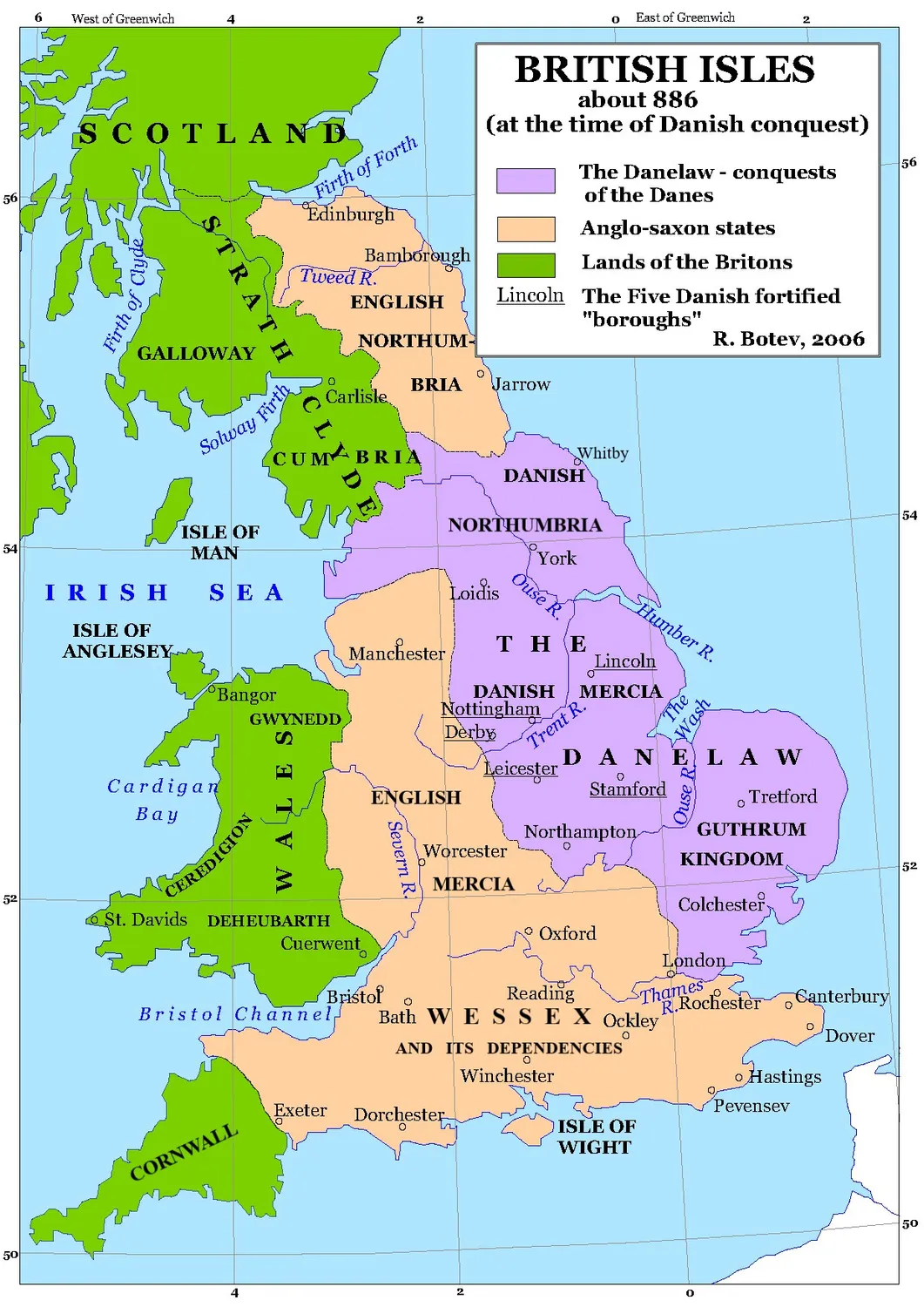
Britain 886 / Wikimedia Commons
The Great Heathen Army was a large Viking force that invaded England in 865 CE. The Vikings, who came from Scandinavia, had raided England’s coasts for decades, but this invasion was different. Instead of small raiding parties, the Great Heathen Army was a united group of warriors who aimed to conquer and settle land. According to the Anglo-Saxon Chronicle, an important historical record, this army landed in East Anglia and quickly began to threaten the Anglo-Saxon kingdoms.
The Vikings were led by several famous commanders, including Ivar the Boneless, Halfdan Ragnarsson, and Ubba. They used their advanced military tactics and swift longships to move rapidly along rivers and coasts. Their first major target was the kingdom of Northumbria, where they captured the city of York in 866 CE. Archaeological evidence, such as Viking weapons and coins found in York, confirms the importance of this city to the invaders. The Vikings then moved south, defeating the kingdoms of East Anglia and Mercia over the next few years. Many Anglo-Saxon leaders were killed, including King Edmund of East Anglia, who, according to legend, was executed after refusing to give up his Christian faith.
Life during the time of the Great Heathen Army changed for both the Vikings and the English. Some Vikings established permanent settlements and farmed the land, while others continued to fight. The English responded by building fortified towns called burhs to defend against attacks. The creation of the Danelaw—a region under Viking control—changed the social and legal systems in parts of England. Viking laws, language, and customs blended with local traditions. This period also saw new alliances and betrayals among kings and nobles, as everyone tried to survive the conflict.
The invasion of the Great Heathen Army had lasting effects on England. Although the Vikings did not conquer all of England, they controlled large areas for many years. Over time, some Vikings converted to Christianity and became part of English society. The struggles between Vikings and Anglo-Saxons eventually led to the rise of powerful leaders like Alfred the Great, who defended Wessex and began to unify England. Today, place names, archaeological finds, and written records all show the influence of the Great Heathen Army on English history.
The story of the Great Heathen Army demonstrates how migration, warfare, and cultural exchange shaped the Middle Ages in Europe. It connects to broader themes of conflict, adaptation, and the blending of societies throughout world history.
Interesting Fact: Some Viking warriors believed that dying in battle would earn them a place in Valhalla, the hall of the gods, which helped inspire their fearlessness during invasions.
Comprehension quiz (8 questions)
1. When did the Great Heathen Army invade England?
2. Who was one leader of the Viking army?
3. Which city did Vikings capture first?
4. Why did Vikings build settlements?
5. What was the Danelaw?
6. How did the Anglo-Saxons respond to the invasion?
7. Some Vikings became part of English society. True or false?
8. What does 'archaeological' mean?
Perfect for the way you teach
- Build comprehension skills
- Auto-graded quiz
- Differentiated reading
- Read together at home
- Improve fluency
- Quiet reading time
- Reading curriculum support
- Independent practice
- Track Lexile growth