This learning resource is available in interactive and printable formats. The interactive worksheet can be played online and assigned to students. The Printable PDF version can be downloaded and printed for completion by hand.
This comprehensive passage introduces middle school students (grades 6-8) to the concept of the habitable zone, also known as the 'Goldilocks zone.' Aligned to NGSS MS-ESS1-2, it explains the scientific reasoning behind where life might exist in the universe. Students will learn how star brightness, planetary atmosphere, and other factors determine whether a planet can support liquid water, a key ingredient for life. The passage also discusses how planets like Earth, Venus, and Mars compare, and explores the potential for life on moons outside the traditional habitable zone, like Europa and Enceladus. Glossary terms, a simplified differentiated version, Spanish translations, quizzes, writing prompts, and graphic organizers support diverse learners. Audio integration is available for all content. This resource is ideal for teachers seeking to deepen student understanding of planetary systems, habitability, and astrobiology.
CONTENT PREVIEW
Expand content preview
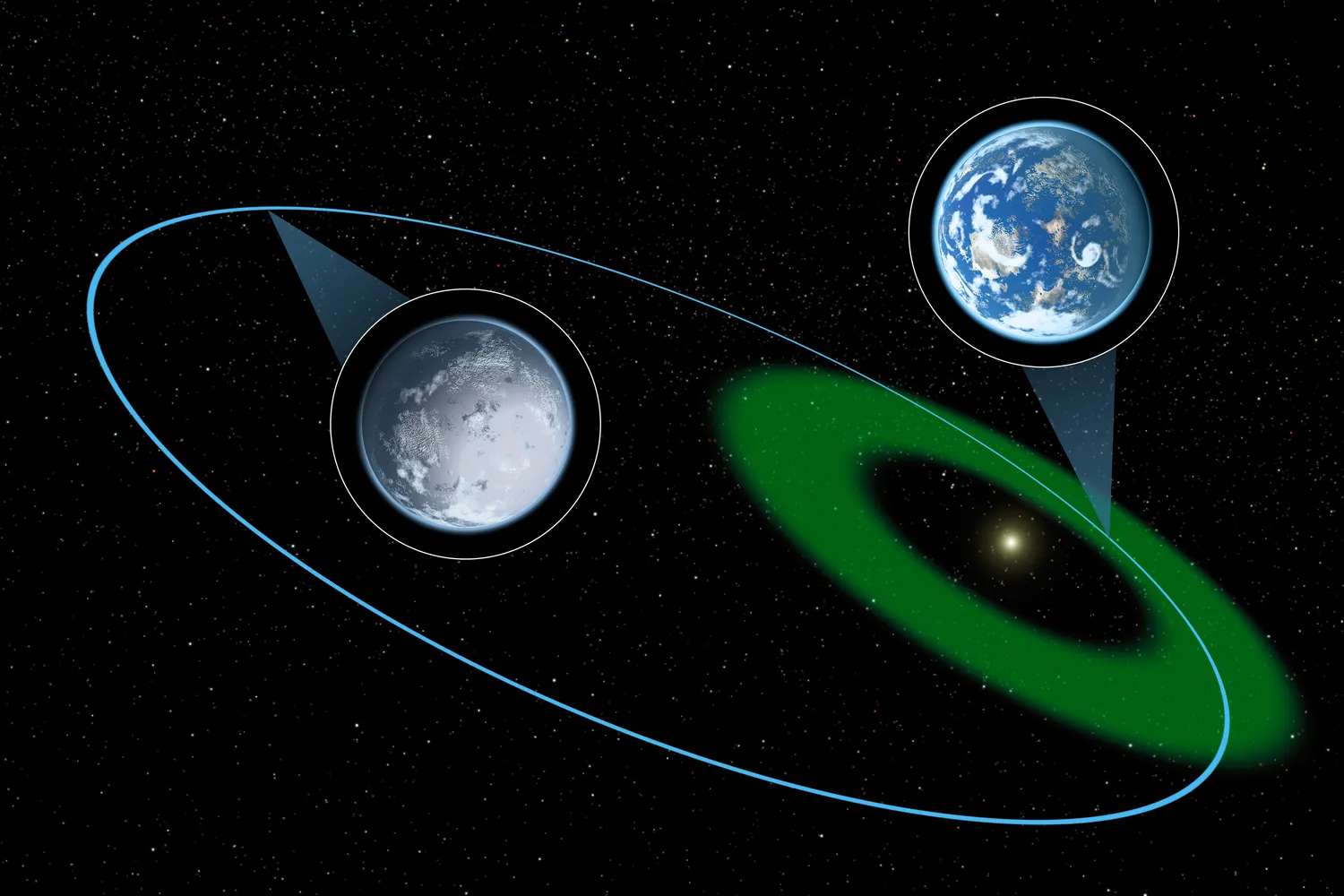
"Eccentric Habitable Zones" by NASA/JPL-Caltech / Source: Wikimedia Commons
The habitable zone is a key concept in the search for life beyond Earth. Scientists define it as the region around a star where conditions might allow liquid water to exist on a planet’s surface. Liquid water is essential for life as we know it, so understanding the habitable zone helps guide the search for planets that could support living organisms. This region is often called the Goldilocks zone because it is not too hot and not too cold—temperatures must be just right for water to remain liquid.
The Science Behind the Habitable Zone
The boundaries of the habitable zone depend on several factors. First, the brightness and energy output of the star play a major role. Brighter stars give off more energy, pushing their habitable zones farther out. Dimmer stars have habitable zones much closer to them. For example, around our Sun, the habitable zone is estimated to be between 0.95 and 1.37 astronomical units (AU), where 1 AU is the average distance from Earth to the Sun (about 150 million kilometers). Earth sits comfortably in the middle of this zone. Venus, closer to the Sun, lies at the inner edge—making it too hot for stable liquid water. Mars, on the other hand, is at the outer edge, where it’s generally too cold. Mars lost much of its atmosphere over time, so it cannot keep water in liquid form today.
Atmospheres and Other Requirements
Being in the habitable zone does not guarantee that a planet is actually habitable. The planet’s atmosphere is crucial. A thick atmosphere can trap heat, making a planet warmer, while a thin one can let heat escape. Earth’s atmosphere keeps temperatures stable and protects life from harmful radiation. A strong magnetic field also helps by deflecting radiation from the star. Geological activity is another factor, as it recycles important chemicals and helps maintain a stable climate. Scientists also consider how stable the star is, since frequent stellar flares can be harmful to life.
Expanding the Search for Life
Some scientists use a “conservative” definition of the habitable zone, only including planets very likely to have liquid water. Others are more “optimistic” and include planets that could have water under special conditions, such as a dense atmosphere. Importantly, being in the habitable zone does not mean a planet is inhabited—it only means life could be possible. There are also exceptions. For example, some moons outside the habitable zone may have subsurface oceans kept warm by tidal forces, not just the star. Moons like Europa, Enceladus, and Titan show that the search for life extends beyond traditional boundaries.
The study of habitable zones connects to larger scientific principles about planetary systems and the conditions needed for life. As technology advances, scientists continue to discover new exoplanets and moons, expanding our understanding of where life might exist throughout the universe.
Interesting Fact: There are now thousands of known exoplanets, and some are located right in their star’s habitable zone!
What is the habitable zone?
The region around a star where liquid water could exist on a planet's surface.The area inside a planet's core.The space where planets are always too hot for life.The distance between two stars in a galaxy.
Why is the habitable zone also called the Goldilocks zone?
Because all planets here are made of gold.Because it is not too hot and not too cold for water.Because it is the oldest area in a solar system.Because it is the smallest part of a solar system.
Which planet in our solar system is in the middle of the Sun’s habitable zone?
VenusMarsEarthJupiter
How does a planet’s atmosphere affect its ability to support life?
A thick atmosphere traps heat and protects from radiation.A thin atmosphere makes a planet always warmer.Atmosphere has no effect on life.A planet needs no atmosphere to support life.
What does 'astronomical unit' mean in the passage?
The average distance from Earth to the Sun.A small moon around Mars.A type of planet.A measure of brightness.
What is the main reason Mars cannot keep liquid water today?
It is too close to the Sun.It lost much of its atmosphere.It is too large.It is always covered in ice.
Why do scientists look for planets in the habitable zone?
Because it is the only place with stars.Because life as we know it needs liquid water.Because it is the farthest from the Sun.Because all planets there are the same size as Earth.
True or False: All planets in the habitable zone are inhabited.
TrueFalse
True or False: Some moons outside the traditional habitable zone might have liquid water beneath their surfaces.
TrueFalse
If a planet orbits a dim star, where would its habitable zone likely be?
Farther from the star.Closer to the star.Nowhere in the system.Exactly at 1 AU.
Perfect For:
👩🏫 Teachers
• Reading comprehension practice
• Auto-graded assessments
• Literacy skill development
👨👩👧👦 Parents
• Reading practice at home
• Comprehension improvement
• Educational reading time
🏠 Homeschoolers
• Reading curriculum support
• Independent reading practice
• Progress monitoring
Reading Features:
📖
Reading Passage
Engaging fiction or nonfiction text
❓
Comprehension Quiz
Auto-graded questions
📊
Instant Feedback
Immediate results and scoring
📄
Printable Version
Download for offline reading
🔊
Read Aloud
Voice-over with word highlighting
Reviews & Ratings
No reviews yet. Be the first to share your experience!
Related Content
Comets
This middle school science passage explores the fascinating world of comets, commonly known as 'dirty snowballs.' Studen...
MS-ESS1-2
Mercury: Closest to the Sun
This comprehensive, standards-aligned passage explores Mercury—the smallest and closest planet to the Sun. Students in g...
MS-ESS1-2MS-ESS1-3
Venus: Earth's Twin?
This comprehensive science passage for grades 6-8 examines Venus—often called Earth's twin—by exploring its similarities...
MS-ESS1-2MS-ESS1-3
Earth: Our Home Planet
This comprehensive science passage for grades 6-8 explores Earth’s unique characteristics and the interconnected systems...
MS-ESS1-2
Mars: The Red Planet
This middle school science passage explores Mars, the Red Planet, providing students in grades 6-8 with a comprehensive ...
MS-ESS1-2MS-ESS1-3
What Is Gravity?
This comprehensive middle school science reading passage explores the concept of gravity, aligning with NGSS standards M...
MS-ESS1-2MS-PS2-4
Kepler's Laws of Planetary Motion
This comprehensive middle school science passage explores Kepler's Laws of Planetary Motion, meeting NGSS Standard MS-ES...
MS-ESS1-2
Tides and Tidal Forces
This middle school science passage explores the mechanisms of tides and tidal forces, aligning with NGSS standards MS-ES...
MS-ESS1-1MS-ESS1-2
Escape Velocity and Space Travel
This middle school science passage introduces students to the concept of escape velocity—the minimum speed required to b...
MS-ESS1-2MS-PS2-4
Weightlessness and Microgravity
This science reading passage for middle school students explores the phenomenon of weightlessness and microgravity. Alig...
MS-PS2-4MS-ESS1-2
Orbits and Orbital Motion
This middle school science passage, aligned with NGSS MS-ESS1-2 and MS-PS2-4, explores the science of orbits and orbital...
MS-ESS1-2MS-PS2-4
What Is the Solar System?
This passage provides a comprehensive overview of the solar system for grades 6-8, aligned with NGSS standards MS-ESS1-2...
MS-ESS1-2MS-ESS1-3
Structure of the Solar System
This comprehensive science reading passage introduces middle school students (grades 6-8) to the structure of the solar ...
MS-ESS1-2MS-ESS1-3
Moons of the Solar System
This comprehensive passage, designed for grades 6-8 and aligned to NGSS standard MS-ESS1-2, delves into the fascinating ...
MS-ESS1-2
Defining Life: What Are We Looking For?
This informational science passage for middle school students explores the question: What is life, and how do we define ...
MS-LS1-1MS-ESS1-2
Astronomy
This comprehensive reading passage introduces middle school students to the science of astronomy, which is the study of ...
MS-ESS1-2MS-ESS1-3MS-PS4-2MS-ETS1-1
The Solar System
This middle school science passage introduces students to the solar system, aligning with NGSS standards MS-ESS1-2 and M...
MS-ESS1-2MS-ESS1-3
Gravity and Orbits
This comprehensive passage for grades 6-8 explains the science of gravity and orbits, aligning with NGSS standard MS-ESS...
MS-ESS1-2
The Inner Planets
This comprehensive science passage for grades 6-8 explores the inner (terrestrial) planets of our solar system—Mercury, ...
MS-ESS1-2MS-ESS1-3
The Outer Planets
This engaging science passage for grades 6-8 introduces students to the outer planets—Jupiter, Saturn, Uranus, and Neptu...