Hagia Sophia
Interactive passage with audio narration, comprehension questions, and printable PDF.
By completing this purchase you agree to our Terms of Use and Privacy Policy. Your subscription renews automatically until you cancel. You can cancel anytime from your account settings. All sales are final and non-refundable. Digital content is available for download in your account immediately upon purchase.
What's included
Hagia Sophia preview and details
About this printable Hagia Sophia reading passage (Grades 5-8)
Sample passage and quiz from Hagia Sophia
Reading passage and comprehension quiz preview
Hagia Sophia: Engineering Marvel
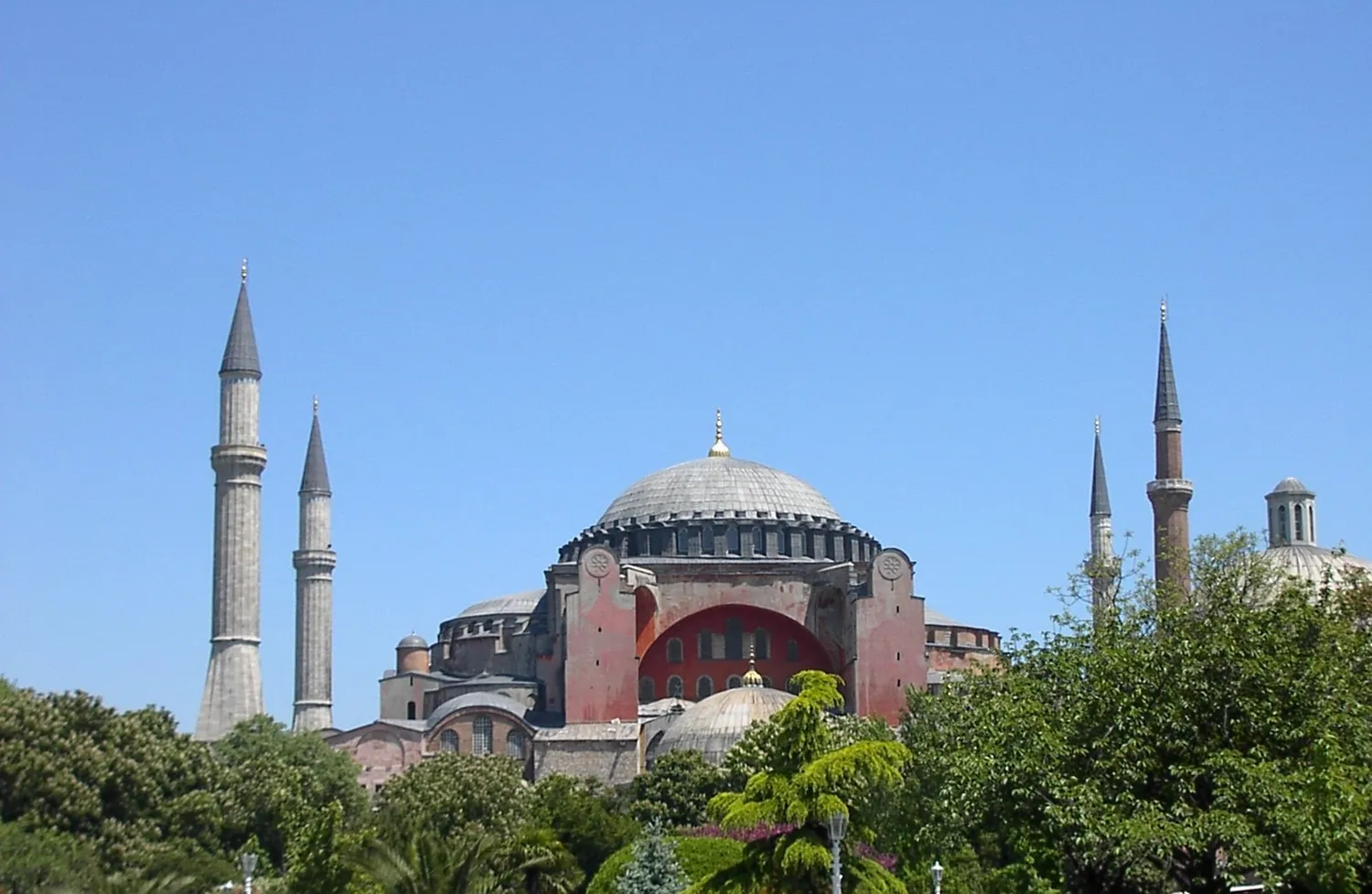
"Hagia Sophia, Istanbul, Turkey" / Wikimedia Commons.
The Hagia Sophia stands as one of the greatest architectural achievements of the Middle Ages. Located in present-day Istanbul, Turkey, it was built between 532 and 537 CE during the reign of the Byzantine Emperor Justinian I. The Hagia Sophia is famous for its enormous central dome, brilliant mosaics, and its changing role as a place of worship for both Christians and Muslims.
The construction of the Hagia Sophia began after a previous church on the site was destroyed during riots in 532 CE, known as the Nika Riots. Emperor Justinian I ordered two architects, Anthemius of Tralles and Isidore of Miletus, to design a new and spectacular church. They combined Roman engineering with new techniques to create a vast interior space. The central dome, measuring about 31 meters (102 feet) in diameter, was supported by pendentives—curved triangular sections that allow the circular dome to rest on a square base. This was an innovative solution that had rarely been used before. Ancient historian Procopius, in his book 'On Buildings,' described the dome as seeming to hang from heaven, demonstrating the awe it inspired even in its own time.
Artistic achievement was as important as engineering in the Hagia Sophia. The interior was decorated with golden mosaics depicting Christian figures such as Jesus, Mary, and several emperors and patriarchs. Marble from across the empire was brought to cover the walls and floors, showing the wealth and reach of the Byzantine Empire. Archaeological discoveries have revealed inscriptions in Greek, and some original floor mosaics remain visible today. Over centuries, the Hagia Sophia underwent changes. When the Ottoman Empire conquered Constantinople in 1453, it was converted into a mosque. Islamic features such as minarets, a mihrab (prayer niche), and calligraphic panels were added, blending Christian and Islamic artistic traditions.
The Hagia Sophia has always been a symbol of religious and political power. For nearly 1,000 years, it was the main cathedral of the Eastern Orthodox Church and the site of imperial ceremonies, including the crowning of emperors. Under Ottoman rule, it became one of the most important mosques in the Islamic world. In 1935, after the founding of modern Turkey, the building was made a museum. Today, it is recognized as a UNESCO World Heritage site and continues to attract visitors from around the world, showing the lasting influence of both Byzantine and Ottoman civilizations.
The Hagia Sophia connects to broader themes in world history, such as the spread of religions, the development of new technologies, and the blending of cultures. Its story shows how architecture can reflect changes in society and belief over time.
Interesting Fact: For nearly 1,000 years, the Hagia Sophia was the largest cathedral in the world until the completion of the Seville Cathedral in Spain in 1520.
Comprehension quiz (8 questions)
1. Who ordered the Hagia Sophia built?
2. In which city is the Hagia Sophia?
3. What year did the Ottomans capture Constantinople?
4. What made the Hagia Sophia's dome unique?
5. Why did Hagia Sophia become a mosque?
6. How did art change after 1453?
7. Hagia Sophia is now a museum. True or false?
8. What is a 'mihrab'?
Perfect for the way you teach
- Build comprehension skills
- Auto-graded quiz
- Differentiated reading
- Read together at home
- Improve fluency
- Quiet reading time
- Reading curriculum support
- Independent practice
- Track Lexile growth