Hanseatic League
Interactive passage with audio narration, comprehension questions, and printable PDF.
What's included
Hanseatic League preview and details
About this printable Hanseatic League reading passage (Grades 5-8)
Sample passage and quiz from Hanseatic League
Reading passage and comprehension quiz preview
Hanseatic League
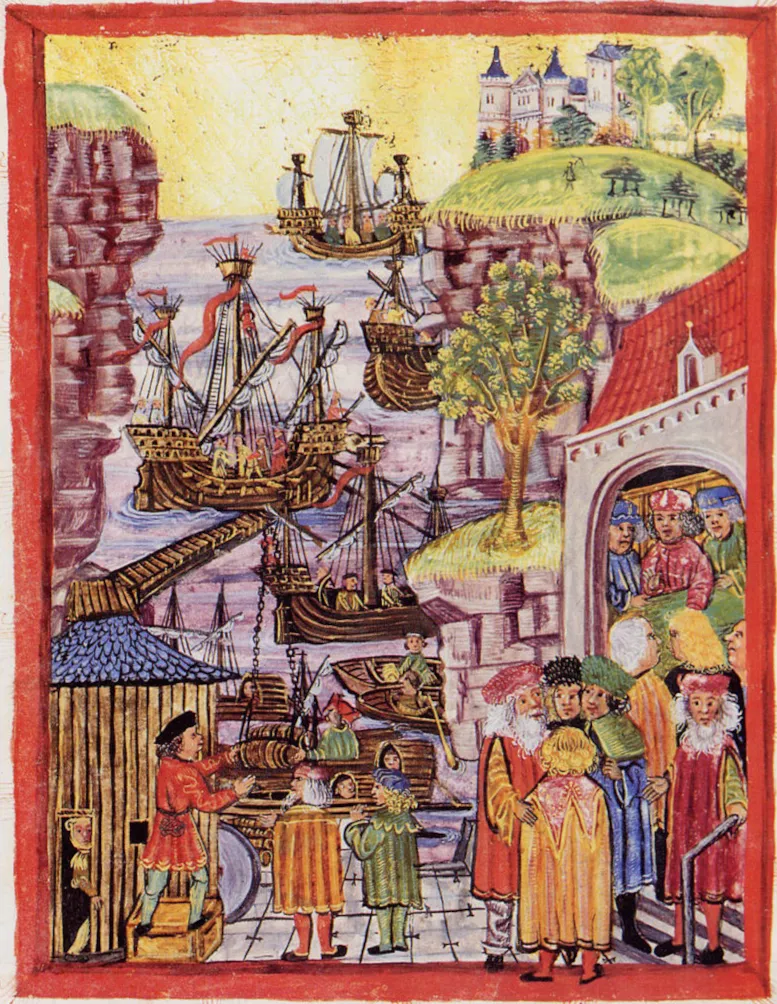
Hanseatic league by Sebastian Sonntag, Orginalkünster vermutlich Absolon Stumme: http://de.wikipedia.org/wiki/Absolon_Stumme / Wikimedia Commons
The Hanseatic League was a powerful network of trading cities in northern Europe that rose to prominence during the Middle Ages, especially from the 1200s to the 1600s. This alliance included major ports and merchant towns along the Baltic and North Seas, such as Lübeck, Hamburg, Bremen, and Riga. These cities united to protect their economic interests, control vital trade routes, and defend against pirates and rival powers.
The League began in the late 1100s, when merchants from Lübeck and Hamburg agreed to cooperate for safer and more profitable trade. By the 13th century, their alliance expanded as more cities joined, forming a confederation. The Hanseatic League grew to include over 200 cities at its peak. Members shared legal agreements, trading privileges, and even mutual defense, making the League a significant economic and political force in the region.
One of the League's main goals was to control the trade of goods like grain, timber, salt, furs, and fish. The League established monopolies over certain products, meaning only their merchants could legally trade these items in some areas. For example, a 14th-century agreement found in Lübeck's city records shows that Hanseatic merchants were granted exclusive rights to sell herring in Scania (now Sweden). The League also built secure warehouses called kontors in major cities like London and Novgorod, which became important centers for storing and trading goods.
Geography played a crucial role in the League's success. The Baltic Sea connected many cities and made shipping faster and safer compared to long overland routes. This allowed Hanseatic merchants to transport large amounts of goods efficiently. To protect their ships from pirates and storms, the League organized armed convoys and established rules for navigation. According to a letter written in 1370 by a Hamburg merchant, convoys helped reduce attacks and made trade more reliable.
The Hanseatic League shaped daily life and social order in its member cities. Merchants became part of an influential social class, while skilled workers and shipbuilders supported economic growth. The League also influenced laws and city governments, helping to create a sense of shared identity among its members. However, not everyone benefited equally; peasants and non-member towns had less power and fewer opportunities.
Over time, the League faced new challenges. The rise of strong nation-states, changes in trade routes, and competition from other merchants weakened the League by the 1500s. By the mid-1600s, the Hanseatic League had lost most of its influence, though some member cities continued to cooperate for many years.
Despite its decline, the Hanseatic League left a lasting legacy. It set standards for trade, encouraged cooperation between cities, and shaped the development of modern European commerce. Today, the League is remembered as one of the earliest and most successful examples of regional economic collaboration.
The story of the Hanseatic League connects to broader themes in world history, such as the rise of trade networks, the impact of geography on human societies, and the development of urban centers.
Interesting Fact: The word "Hanse" comes from an old German word meaning "guild" or "association." The League's legacy lives on, as several modern cities still celebrate their Hanseatic heritage with annual festivals.
Comprehension quiz (8 questions)
1. When did the Hanseatic League begin?
2. Which city was a key member?
3. What product did the League control in Scania?
4. Why did the League form convoys?
5. What was a main effect of geography?
6. What happened as nation-states grew stronger?
7. The League ended in the 1700s. True or false?
8. What is a 'kontor'?
Perfect for the way you teach
- Build comprehension skills
- Auto-graded quiz
- Differentiated reading
- Read together at home
- Improve fluency
- Quiet reading time
- Reading curriculum support
- Independent practice
- Track Lexile growth