Holy Roman Empire
Interactive passage with audio narration, comprehension questions, and printable PDF.
By completing this purchase you agree to our Terms of Use and Privacy Policy. Your subscription renews automatically until you cancel. You can cancel anytime from your account settings. All sales are final and non-refundable. Digital content is available for download in your account immediately upon purchase.
What's included
Holy Roman Empire preview and details
About this printable Holy Roman Empire reading passage (Grades 5-8)
Sample passage and quiz from Holy Roman Empire
Reading passage and comprehension quiz preview
The Holy Roman Empire
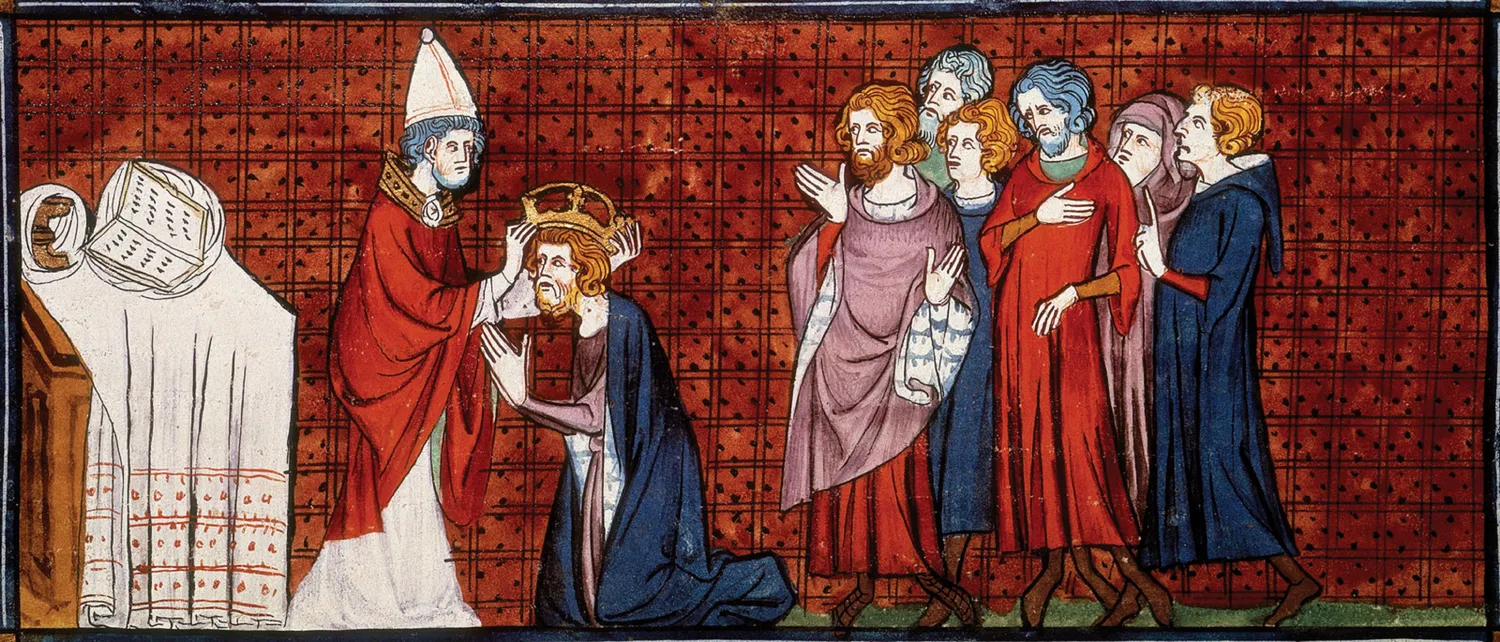
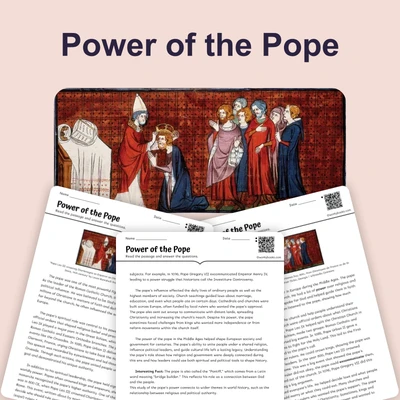
"Pope Leo III crowning Charlemagne as Emperor on Christmas Day, 800;, from Chroniques de France ou de St Denis, 14th century" by Levan Ramishvili from Tbilisi, Georgia / Wikimedia Commons.
The Holy Roman Empire was a powerful and complex state that existed in Central Europe from the year 962 until 1806. Despite its name, the Holy Roman Empire was neither truly holy, nor Roman, nor a single empire in the way we might expect. Instead, it was a collection of territories—mainly in present-day Germany and northern Italy—ruled by hundreds of local princes, bishops, and nobles. The emperor was supposed to unite these lands, but in reality, his power was often limited.
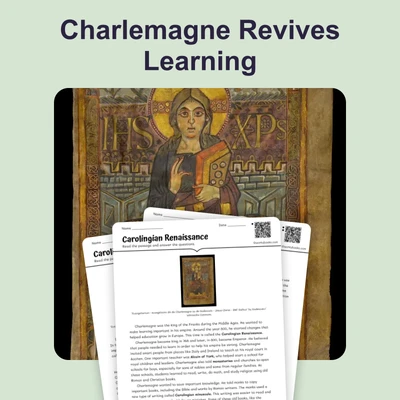
One of the most important moments in its history came in 800 CE, when Pope Leo III crowned Charlemagne as "Emperor of the Romans" in Rome. This act linked the idea of empire to the legacy of ancient Rome and to the authority of the Church. However, it was not until 962 that Otto I, a German king, became the first official Holy Roman Emperor. Otto worked to strengthen his control by appointing loyal bishops and fighting off external enemies, such as the Magyars. Yet, even Otto struggled to control the many independent rulers within his vast realm.
The name Holy Roman Empire reflected its leaders' desire for religious and ancient prestige. The word "Holy" showed their close connection to the Catholic Church, while "Roman" suggested they were heirs to the old Roman Emperors. But the reality was much messier. The empire had no single capital, no common language, and often no clear laws for all its people. Local rulers, known as princes or electors, had so much independence that they sometimes ignored the emperor’s orders. A famous primary source, the Golden Bull of 1356, set rules for electing the emperor but also admitted the power of these princes.
The Holy Roman Emperors often clashed with the popes over who had more authority. This conflict, known as the Investiture Controversy, peaked in the 11th century when Emperor Henry IV and Pope Gregory VII argued over who could appoint church officials. Henry was even excommunicated—a punishment that cut him off from the Church. After dramatic events, including Henry standing barefoot in the snow at Canossa in 1077 to beg forgiveness, the pope's power was mostly upheld. These disputes weakened the emperor’s control and allowed local rulers to grow even stronger.
Despite its weaknesses, the Holy Roman Empire played a major role in European history. It acted as a buffer between Western Europe and eastern invaders, and its decentralized system allowed for the growth of unique cities and cultures. Over time, the empire’s power faded, especially as new nation-states like France and Spain became stronger. In 1806, after being defeated by Napoleon, the last emperor dissolved the empire, ending more than 800 years of history.
The story of the Holy Roman Empire shows how geography, religion, and politics shaped the lives of millions. Its struggle between central and local power, as well as its ongoing disputes with the Church, reflect themes found throughout world history.
Interesting Fact: The famous writer Voltaire once joked, “The Holy Roman Empire was neither holy, nor Roman, nor an empire.”
Comprehension quiz (8 questions)
1. When did the Holy Roman Empire begin?
2. Who crowned Charlemagne emperor?
3. What did the Golden Bull of 1356 do?
4. Why was the empire's name misleading?
5. What was the Investiture Controversy about?
6. What did the emperor often struggle with?
7. The empire ended in 1806. (True/False)
8. What is a 'prince' in the passage?
Perfect for the way you teach
- Build comprehension skills
- Auto-graded quiz
- Differentiated reading
- Read together at home
- Improve fluency
- Quiet reading time
- Reading curriculum support
- Independent practice
- Track Lexile growth