Reading PassagePremium

How Do Weather Apps Work

Interactive passage with audio narration, comprehension questions, and printable PDF.

No ratings yet
Grades 5–8ScienceElaEnglish · SpanishInteractive · Printable
Aligned toMS-ESS2-5
Just this resource
$1.50
One-time purchase
Best value
Unlock everything
$49.99$29.99/yr
40% off until Aug 1 — 10,000+ resources
Renews at $49.99/year.
Unlock above to use these actions

What's included

Reading passage
Audio narration
Comprehension quiz
Writing activity
Glossary & flashcards
Differentiated version
Spanish translation

How Do Weather Apps Work preview and details

About this printable How Do Weather Apps Work science reading passage, NGSS-aligned (Grades 5-8)

This engaging 400-500 word informational science passage explains how weather apps work for middle school students in grades 6-8. Students learn how weather apps pull data from government sources like the National Weather Service and ECMWF, use proprietary algorithms and models, and incorporate crowd-sourced data from phones and home weather stations. The passage explores why different weather apps sometimes disagree and discusses app reliability for daily decisions versus severe weather situations. Aligned to NGSS standard MS-ESS2-5 and the Disciplinary Core Idea MS-ESS2.D: Weather and Climate, this passage includes cause-and-effect reasoning to help students understand the relationship between data sources, forecasting models, and prediction accuracy. The content is audio-integrated and includes a complete glossary, Spanish translation, differentiated version for struggling readers, comprehension questions, writing activities, and graphic organizers to support diverse learners in understanding weather prediction technology.
Written by Workybooks TeamPublished by Workybooks
Preview

Sample passage and quiz from How Do Weather Apps Work

Reading passage and comprehension quiz preview

How Do Weather Apps Work
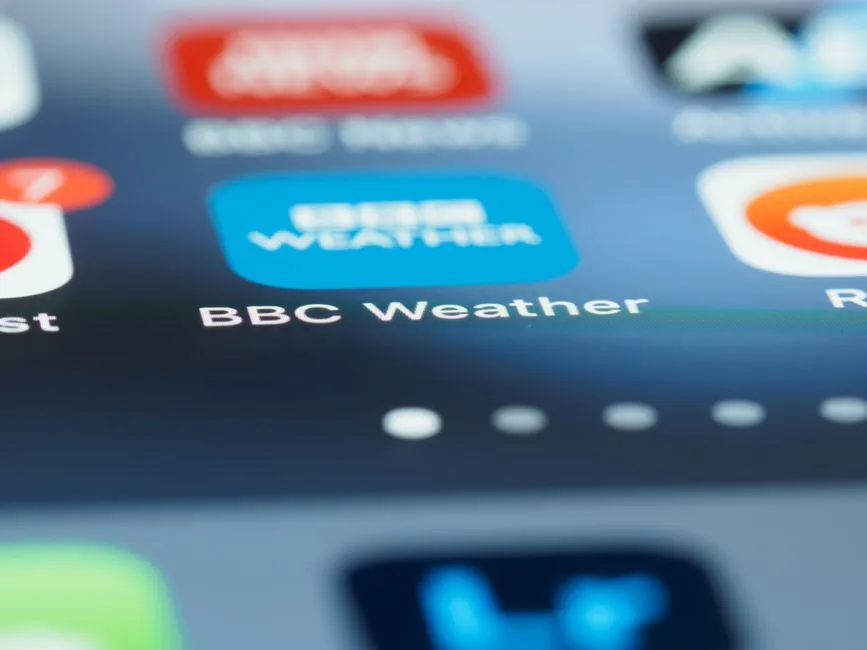
Detailed view of BBC Weather application icon on a smartphone screen.

"Detailed view of BBC Weather application icon on a smartphone screen." by Brett Jordan / Pexels.

When you check your phone to see if you need an umbrella, you rely on a weather app. But how does that app know what the weather will be? Weather apps gather information from multiple sources and use computer models to predict conditions for your specific location.

Most weather apps pull data from government weather services like the National Weather Service (NWS) in the United States or the European Centre for Medium-Range Weather Forecasts (ECMWF). These organizations collect data from thousands of weather stations, satellites, weather balloons, and ocean buoys around the world. The data includes temperature, air pressure, humidity, wind speed, and precipitation. Scientists feed this information into powerful computers that run forecast models—mathematical programs that simulate how the atmosphere behaves. Different models use different equations and assumptions, which can lead to different predictions.

Weather apps also use their own proprietary algorithms to interpret the data. An algorithm is a set of rules that tells a computer how to solve a problem. Some apps combine data from several models and calculate an average. Others give more weight to models that have been more accurate in the past. This is why two apps on your phone might show different forecasts for the same location. They may be using different models or processing the same data in different ways.

Increasingly, weather apps also use crowd-sourced data from everyday devices. Your smartphone can report local conditions like temperature and barometric pressure. Home weather stations send real-time data about rainfall and wind. This helps apps provide more precise hyperlocal forecasts for neighborhoods rather than entire cities. Apps also send push notifications to alert users about severe weather like thunderstorms, tornadoes, or flash floods.

For example, during Hurricane Ida in 2021, weather apps provided early warnings that helped millions of people prepare. However, for life-threatening weather events, the National Weather Service remains the most reliable source. Evidence shows that most weather apps are accurate enough for daily decisions like choosing what to wear. But for severe weather, official government forecasts undergo more review and quality control.

Understanding how weather apps work helps you make better decisions. Check multiple apps when planning important outdoor activities. Pay attention to which features matter most: radar maps show current precipitation, hourly forecasts help with short-term plans, and severe weather alerts can keep you safe. The technology behind weather prediction continues to improve as scientists develop better models and gather more data.

Interesting Fact: Weather forecast accuracy has doubled in the past 30 years. A modern five-day forecast is as accurate as a two-day forecast was in the 1990s, thanks to better satellites and computer models.

Comprehension quiz (10 questions)

1. Where do most weather apps get their data?

From social media posts about weather
From government weather services like the National Weather Service
From individual weather reporters
From television weather channels only

2. What is a forecast model?

A person who predicts the weather
A type of weather station
A mathematical computer program that simulates atmospheric behavior
A smartphone application

3. Why might two different weather apps show different forecasts for the same location?

They may use different models or process data in different ways
One app is always wrong
They measure different types of weather
They are designed for different countries

4. What does the term 'crowd-sourced data' mean in the passage?

Data collected only by scientists
Information gathered from large groups of people
Weather information from everyday devices like smartphones and home weather stations
Data that comes from weather balloons

5. According to the passage, what type of weather information is best obtained from the National Weather Service rather than weather apps?

Daily temperature readings
Information about what to wear
Life-threatening severe weather forecasts
Hourly precipitation amounts

6. What is an algorithm?

A weather measurement tool
A set of rules that tells a computer how to solve a problem
A type of satellite
A severe weather alert

7. Based on the passage, what can cause weather forecast models to produce different predictions?

Using different mathematical equations and assumptions
Measuring temperature in different units
Collecting data at different times of day
Having different app designers

8. How has weather forecast accuracy changed over the past 30 years?

It has stayed the same
It has gotten worse due to climate change
It has doubled, with five-day forecasts now as accurate as two-day forecasts from the 1990s
It has improved slightly but not significantly

9. Weather apps are always 100% accurate for all types of weather predictions.

True
False

10. Smartphones can contribute data about local temperature and barometric pressure to weather apps.

True
False
Who it's for

Perfect for the way you teach

Teachers
  • Build comprehension skills
  • Auto-graded quiz
  • Differentiated reading
Parents
  • Read together at home
  • Improve fluency
  • Quiet reading time
Homeschoolers
  • Reading curriculum support
  • Independent practice
  • Track Lexile growth
Topics

Reviews & Ratings

No reviews yet. Be the first to share your experience!

More reading you might love

20 more
Passage
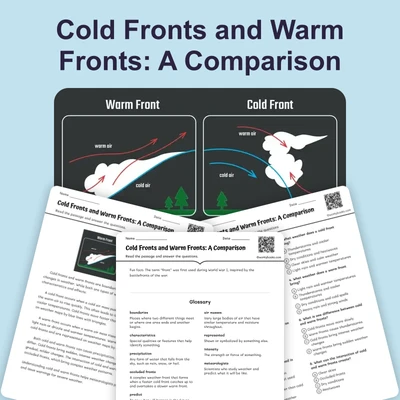
Cold Fronts and Warm Fronts - reading educational content
Grades 5–8

Cold Fronts and Warm Fronts

science · MS-ESS2-5

$1.50
Passage
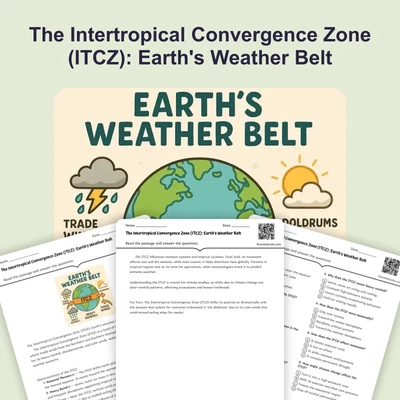
The Intertropical Convergence Zone (ITCZ): Earth's Weather Belt - reading educational content
Grades 5–8

The Intertropical Convergence Zone (ITCZ): Earth's Weather Belt

science · MS-ESS2-5

Free
Passage
What Is the Antarctic Polar Vortex? - reading educational content
Grades 3–7

What Is the Antarctic Polar Vortex?

science · MS-ESS2-5

Free
Passage
What Causes the Temperature to Decrease with Height in the Troposphere? - reading educational content
Grades 3–7

What Causes the Temperature to Decrease with Height in the Troposphere?

weather and climate · MS-ESS2-5

Free
Passage
Raining Frogs - reading educational content
Grades 5–8

Raining Frogs

science · MS-ESS2-5

Free
Passage
How Adiabatic Cooling Makes Clouds - reading educational content
Grade 6

How Adiabatic Cooling Makes Clouds

weather and climate · MS-ESS2-5

$1.50
Passage
Hurricanes and Tropical Cyclones - reading educational content
Grades 5–8

Hurricanes and Tropical Cyclones

weather and climate · MS-ESS3-2

$1.50
Passage
Tornadoes - reading educational content
Grades 5–8

Tornadoes

weather and climate · MS-ESS3-2

$1.50
Passage
Weather Factors - reading educational content
Grades 5–8

Weather Factors

weather and climate · MS-ESS2-5

$1.50
Passage
Air Pressure - reading educational content
Grades 5–8

Air Pressure

science · MS-ESS2-5

$1.50
Passage
Wind - reading educational content
Grades 5–8

Wind

science · MS-ESS2-5

$1.50
Passage
Clouds and Precipitation - reading educational content
Grades 5–8

Clouds and Precipitation

science · MS-ESS2-5

$1.50
Passage
Air Masses - reading educational content
Grades 5–8

Air Masses

science · MS-ESS2-5

$1.50
Passage
Weather Maps and Forecasting - reading educational content
Grades 5–8

Weather Maps and Forecasting

weather and climate · MS-ESS2-5

$1.50
Passage
Weather Fronts - reading educational content
Grades 5–8

Weather Fronts

science · MS-ESS2-5

$1.50
Passage
What Is Meteorology - reading educational content
Grades 6–8

What Is Meteorology

earth science · MS-ESS2-5

$1.50
Passage
Do Trees Cause Wind - reading educational content
Grades 5–8

Do Trees Cause Wind

science · MS-ESS2-5

Free
Passage
Why San Francisco Is Foggy - reading educational content
Grades 5–8

Why San Francisco Is Foggy

weather and climate · MS-ESS2-5

$1.50
Passage
How Do Scientists Measure Weather - reading educational content
Grades 5–8

How Do Scientists Measure Weather

weather and climate · MS-ESS2-5

$1.50
Passage
How Do Weather Satellites Work - reading educational content
Grades 5–8

How Do Weather Satellites Work

weather and climate · MS-ESS2-5

$1.50
Copyright © 2026 Workybooks. Made with ♥ in California.