How Does Condensation Form Clouds
Interactive passage with audio narration, comprehension questions, and printable PDF.
By completing this purchase you agree to our Terms of Use and Privacy Policy. Your subscription renews automatically until you cancel. You can cancel anytime from your account settings. All sales are final and non-refundable. Digital content is available for download in your account immediately upon purchase.
What's included
How Does Condensation Form Clouds preview and details
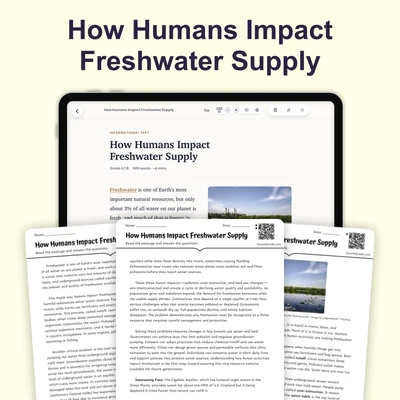
About this printable How Does Condensation Form Clouds science reading passage, NGSS-aligned (Grades 5-8)
Sample passage and quiz from How Does Condensation Form Clouds
Reading passage and comprehension quiz preview
How Does Condensation Form Clouds

Clouds form when water vapor in rising air cools and changes into tiny liquid droplets. Image by Diana / Pexels.
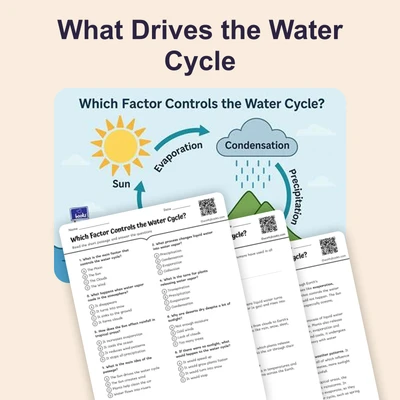
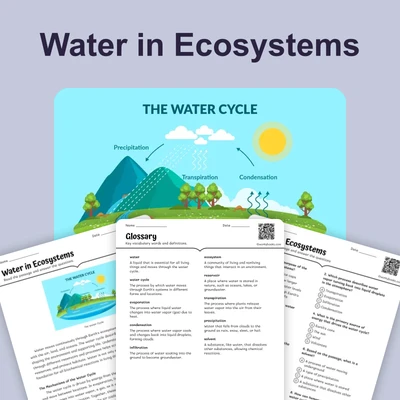
Clouds form when water vapor in rising air cools and changes into tiny liquid droplets. This process, called condensation, happens when warm air rises into the atmosphere and encounters cooler temperatures at higher altitudes. As the air cools below a specific temperature called the dew point, water vapor can no longer remain as an invisible gas. Scientists observe that this temperature threshold causes water molecules to cluster together and form visible droplets.
The condensation process requires more than just cool air. Water vapor needs a surface on which to condense. In the atmosphere, tiny particles provide these surfaces. Dust grains, salt crystals from ocean spray, and pollution particles all serve as condensation nuclei. Evidence shows that without these microscopic particles, water vapor would have difficulty forming droplets. Each droplet measures about 20 microns across, which is roughly 1/50th the width of a human hair. These droplets are so small that air currents can easily keep them suspended in the sky.
Trillions of these tiny droplets together create what we see as a cloud. Think of it like this: a single drop of water is invisible from far away, but billions of drops together form a visible ocean. Similarly, individual cloud droplets are nearly invisible, but massive numbers of them scatter sunlight and appear as white or gray clouds. The color depends on how thick the cloud is and how much sunlight can pass through it. Scientists explain that thicker clouds with more droplets appear darker because less light reaches our eyes.
Fog provides a familiar example of this same process happening at ground level. When air near the Earth's surface cools to its dew point, water vapor condenses just like it does high in the sky. San Francisco experiences dense fog regularly because cool ocean air moves over the warmer land. The temperature difference causes the air to reach its dew point quickly. This creates the thick fog that can reduce visibility to just a few meters.
Understanding cloud formation matters because clouds play important roles in Earth's weather and climate systems. Clouds can bring rain or snow when droplets combine and grow heavy enough to fall. They also reflect sunlight back into space, which helps cool the planet. Scientists study clouds to better predict weather patterns and understand how Earth's climate may change over time.
Interesting Fact: A single cumulus cloud can weigh more than one million pounds because it contains trillions of water droplets, yet it floats because the droplets are spread across a huge volume of air.
Comprehension quiz (10 questions)
1. What happens to water vapor when air rises and cools below its dew point?
2. According to the passage, what do water vapor molecules need in order to form cloud droplets?
3. How wide is a typical cloud droplet compared to a human hair?
4. What is the term 'condensation nuclei' referring to in the passage?
5. Based on the passage, why does fog form in San Francisco regularly?
6. What does the passage suggest about the relationship between cloud thickness and color?
7. Why do cloud droplets remain suspended in the sky instead of falling immediately?
8. According to the passage, how do clouds help cool the planet?
9. True or False: Fog is essentially a cloud that forms at ground level.
10. True or False: Water vapor can easily form droplets without any particles present in the atmosphere.
Perfect for the way you teach
- Build comprehension skills
- Auto-graded quiz
- Differentiated reading
- Read together at home
- Improve fluency
- Quiet reading time
- Reading curriculum support
- Independent practice
- Track Lexile growth