How Does Earth's Speed Change
Interactive passage with audio narration, comprehension questions, and printable PDF.
By completing this purchase you agree to our Terms of Use and Privacy Policy. Your subscription renews automatically until you cancel. You can cancel anytime from your account settings. All sales are final and non-refundable. Digital content is available for download in your account immediately upon purchase.
What's included
How Does Earth's Speed Change preview and details
About this printable How Does Earth's Speed Change science reading passage, NGSS-aligned (Grades 5-8)
Sample passage and quiz from How Does Earth's Speed Change
Reading passage and comprehension quiz preview
Why Earth Moves Faster in January
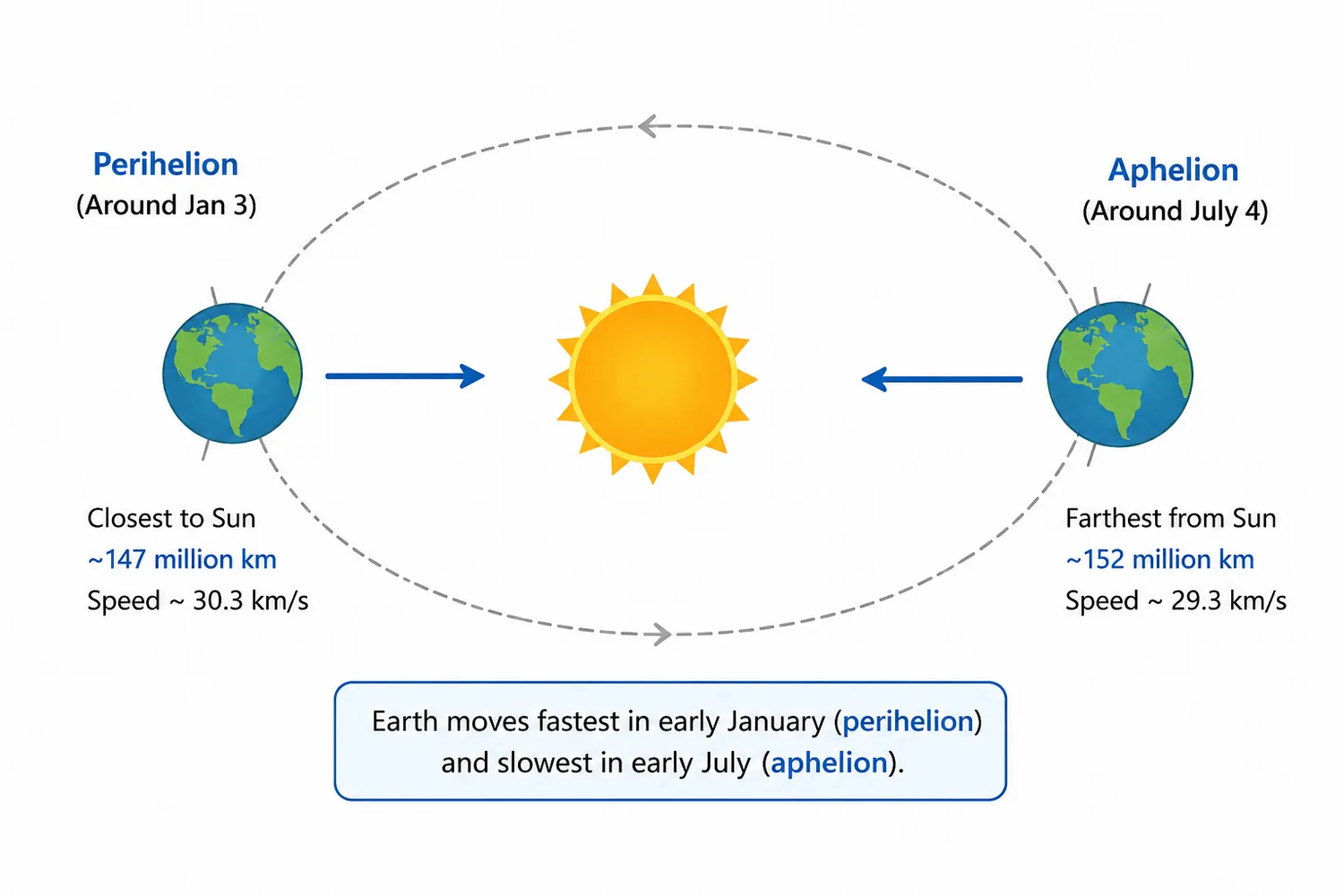
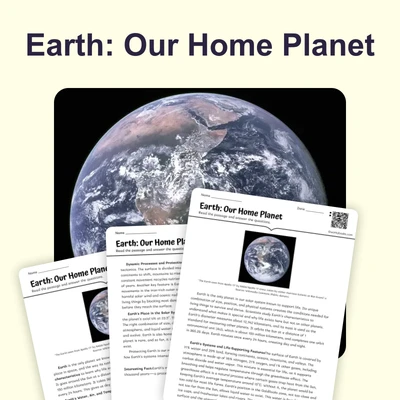
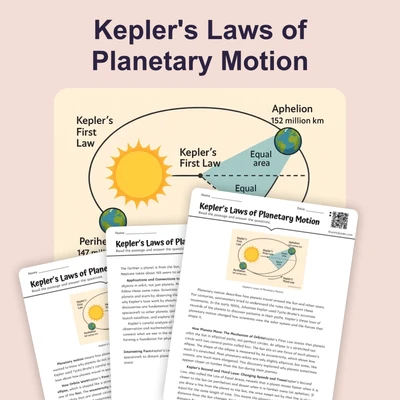
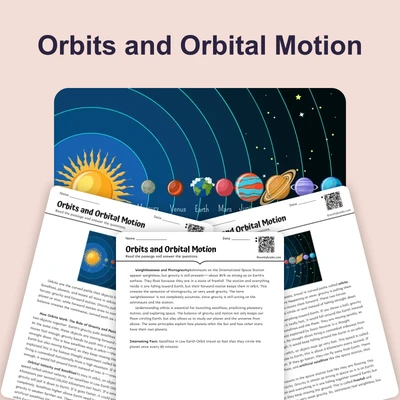
Earth's speed changes throughout the year as it travels around the Sun. The planet moves fastest in early January and slowest in early July. This speed difference happens because Earth follows an elliptical orbit, not a perfect circle. Scientists explain that the changing distance between Earth and the Sun causes these speed variations.
Earth reaches perihelion, its closest point to the Sun, around January 3 each year. At this position, Earth sits about 147 million kilometers from the Sun. The planet travels at approximately 30.3 kilometers per second during this time. Six months later, around July 4, Earth reaches aphelion, its farthest point from the Sun. The distance increases to about 152 million kilometers. Earth's speed drops to roughly 29.3 kilometers per second at this position.
The reason for this speed change involves gravity. When Earth moves closer to the Sun, the Sun's gravitational pull becomes stronger. This stronger pull causes Earth to speed up as it approaches perihelion. Evidence shows that objects closer to a massive body feel a greater gravitational force. When Earth moves farther away at aphelion, the gravitational pull weakens. The weaker force allows Earth to slow down slightly.
German astronomer Johannes Kepler discovered this pattern over 400 years ago. His observations led to Kepler's Second Law, which states that planets sweep out equal areas in equal times. This means a planet must move faster when closer to the Sun and slower when farther away. Kepler's work helped scientists understand that planetary motion follows predictable mathematical patterns.
This speed variation affects Earth in subtle ways. The difference between fastest and slowest speeds is about 1 kilometer per second. While this may seem small, it demonstrates how orbital mechanics work throughout our solar system. All planets with elliptical orbits experience similar speed changes. Understanding these patterns helps scientists predict planetary positions and plan space missions accurately.
Interesting Fact: Even though Earth moves fastest in January when the Northern Hemisphere experiences winter, the speed change does not cause seasons. Seasons result from Earth's tilted axis, not its varying orbital speed.
Comprehension quiz (10 questions)
1. When does Earth move fastest in its orbit around the Sun?
2. What is the name for Earth's closest point to the Sun?
3. What causes Earth's speed to change during its orbit?
4. In the passage, what does 'elliptical orbit' mean?
5. Based on the passage, why does Earth speed up when it approaches perihelion?
6. What is the approximate speed difference between Earth's fastest and slowest orbital speeds?
7. According to Kepler's Second Law, what happens when a planet is closer to the Sun?
8. If scientists wanted to send a spacecraft to meet Earth at its slowest point, when should they plan the mission?
9. True or False: Earth's changing orbital speed causes the seasons.
10. True or False: All planets with elliptical orbits experience speed changes similar to Earth's.
Perfect for the way you teach
- Build comprehension skills
- Auto-graded quiz
- Differentiated reading
- Read together at home
- Improve fluency
- Quiet reading time
- Reading curriculum support
- Independent practice
- Track Lexile growth